The Boy Who Could Not Look Away
A youth in a brocade doublet bends over black water, and the darkness around him swallows everything except the loop he cannot break. Caravaggio painted a myth as a warning about a mirror with no exit.
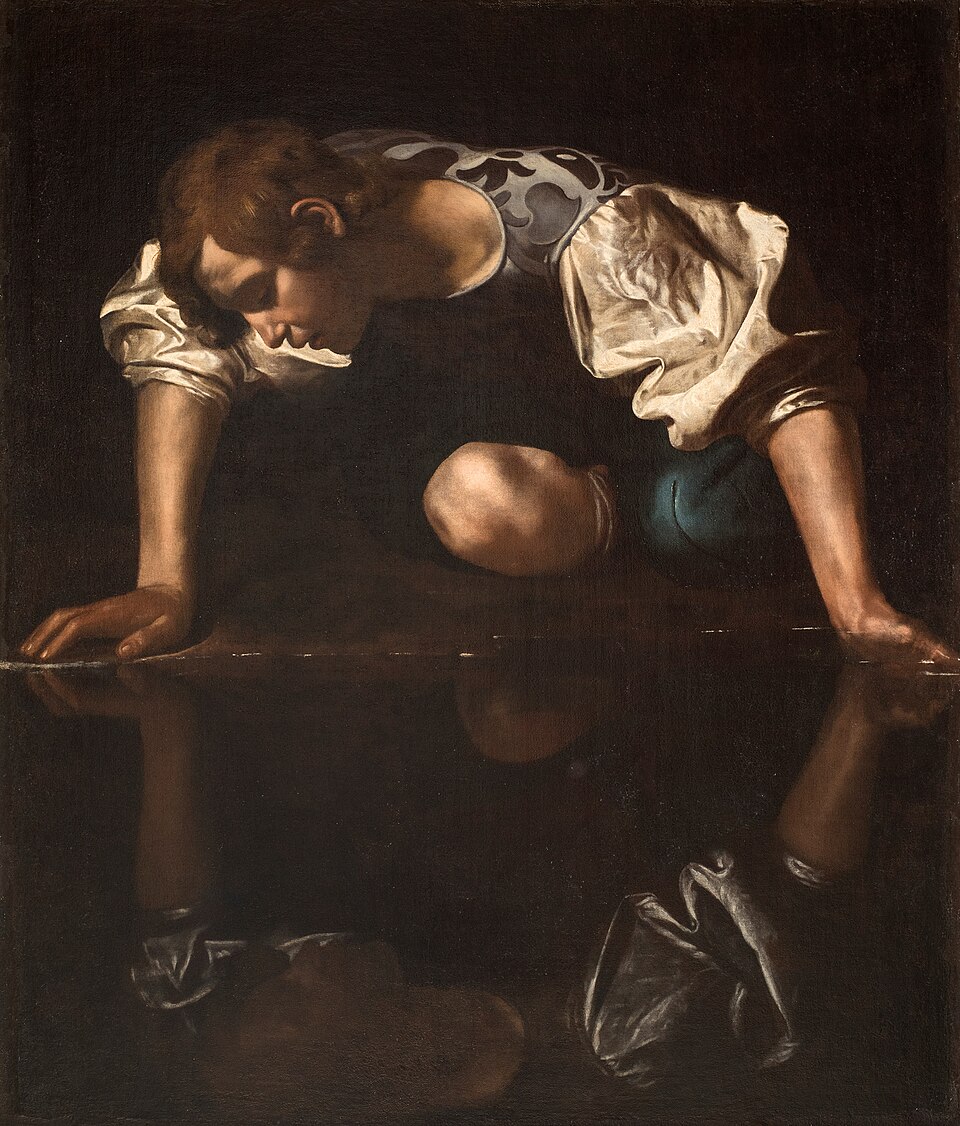
For nearly two centuries no one knew who had painted the strange, dark canvas hanging quietly among Roman collections. It was only in 1916 that the great art historian Roberto Longhi attributed it to Caravaggio, restoring the work to the artist who had made shadow itself a subject worth painting. The picture shows an adolescent page, dressed in an elegant brocade doublet, leaning forward with both hands pressed against the ground as he stares into a pool of water. Painted around 1597 to 1599, it now hangs in the Galleria Nazionale d'Arte Antica in Rome.
The subject comes from Ovid's Metamorphoses, one of the most retold stories of antiquity. Narcissus is a beautiful young man who catches sight of his own reflection in a still pool and falls hopelessly in love with it. He cannot tear himself away from the image, and his obsession consumes him until he dies beside the water — and even then, Ovid tells us, as his shade crosses the river Styx into the underworld, he continues gazing at his own reflection.
By the time Caravaggio took up the subject, the myth had already traveled far through European letters. Dante alluded to it in the Paradiso, and Petrarch wove it into his Canzoniere. It was not an obscure tale plucked from dusty scholarship — it was a story cultivated men of Caravaggio's Rome would have recognized instantly, discussed over wine in the households of collectors like Cardinal Francesco Maria del Monte and the banker Vincenzo Giustiniani, both patrons whose circles Caravaggio moved through during these years.
The artist even had a personal connection to the tale's literary currency: his friend, the poet Giambattista Marino, wrote his own description of Narcissus, suggesting the myth was a live topic of conversation between the two men, perhaps even inspiring or accompanying the painting itself.
For artists in particular, the story carried a deeper resonance. The Renaissance theorist Leon Battista Alberti had gone so far as to claim that Narcissus was, in effect, the first painter — asking rhetorically what painting is, if not the act of embracing the surface of a pool through art. To render Narcissus, then, was to paint a meditation on painting itself: the seduction of surfaces, the impossibility of touching what you see, the risk of loving an image more than reality.
More from Art

The Painting With No Foreground
A single robed figure stares out at an empty grey sea — and the emptiness itself became a scandal. When it was unveiled in Berlin in 1810, no one knew quite what to do with it.

The Painter Who Chased the Light
For a few purple minutes each evening, an American exile knelt in an English garden and raced the dying sun to paint two little girls lighting lanterns. It took him two years to finish.

When a President Became a God
Look straight up inside the U.S. Capitol dome and you will find George Washington enthroned among the clouds, surrounded by goddesses — the founding father transformed into myth.

Marble Brought Back to Life
A corpse asleep, a wing barely brushing her skin — and marble somehow learns to breathe. This is the moment Antonio Canova dared to carve.

The World Turned Upside Down
Look closely at a sixteenth-century Flemish village and you'll find a man biting a pillar, another carrying daylight in a basket, and a wife slipping a blue cloak over her husband's shoulders. Every gesture is a joke — if you know the language.

The Girl in the Glass Case
She stood two-thirds life size, dressed in a real tutu and human hair — and the critics who saw her in 1881 recoiled as if she were something obscene.