The Boy Who Flew Too Close to the Sun
Given wings of feather and wax, a father's warning was simple: not too low, not too high. His son heard only the sky.
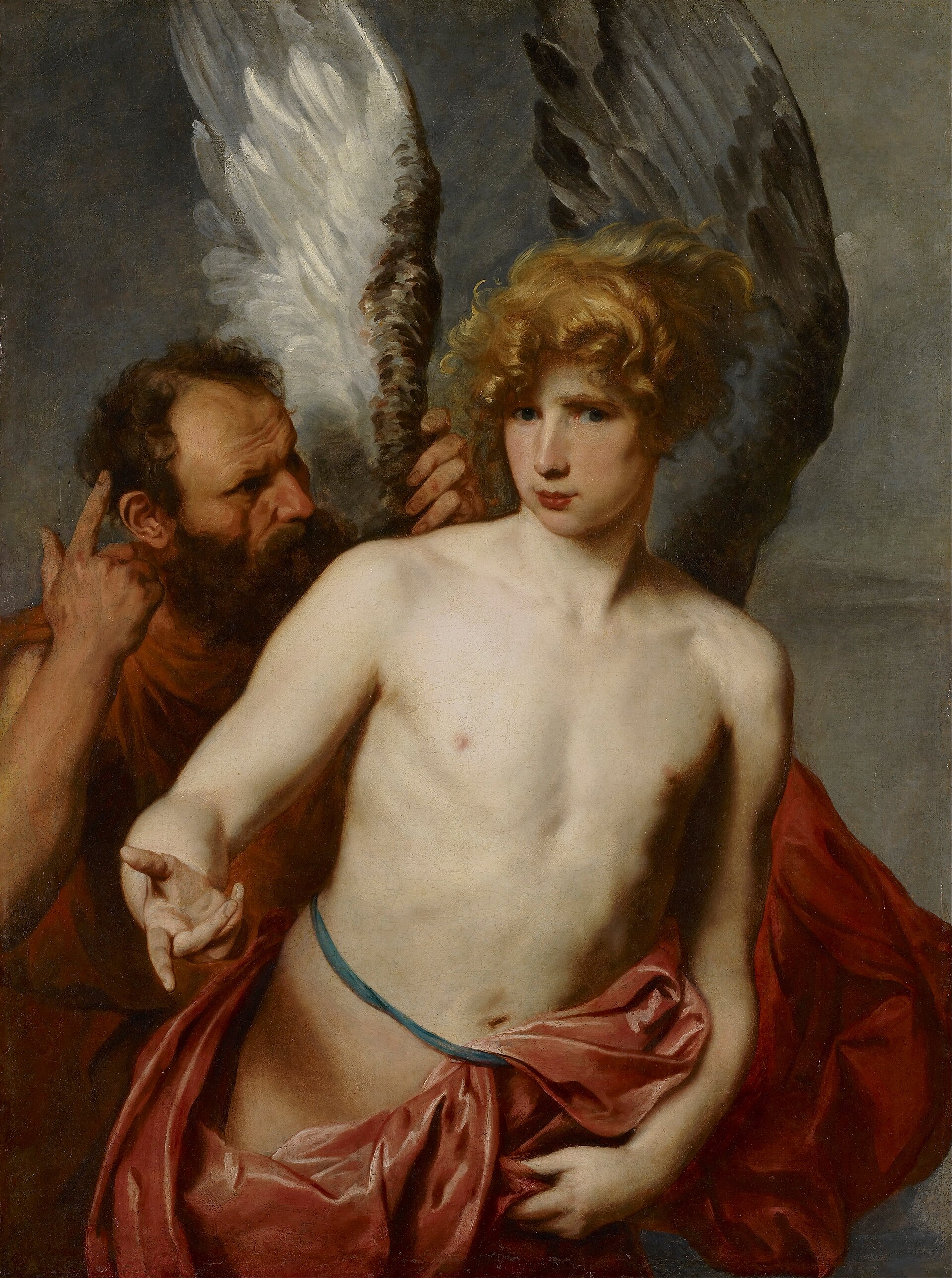
On the island of Crete, in the shadow of King Minos's palace at Knossos, there stood a labyrinth so cunning that even its architect could barely find his way out of it. That architect was Daedalus, a master craftsman of Athens, and the maze was his own creation, built to imprison the Minotaur, a monster born of Minos's wife and the Cretan bull.
When Theseus, prince of Athens and Minos's enemy, escaped the labyrinth and slew the Minotaur, Minos suspected treachery. He believed Daedalus had given his daughter Ariadne the thread that let Theseus find his way through the maze. As punishment, Minos imprisoned Daedalus and his son Icarus, born to Daedalus and his wife Naucrate, either in a tower overlooking the sea or within the labyrinth itself.
Escape by land or sea was watched and guarded, so Daedalus turned to the sky. He gathered feathers molted from birds, threads pulled from blankets, leather straps cut from sandals, and beeswax, and from these he built two pairs of wings, one for himself and one for his son.
Before they leapt from their prison, Daedalus gave Icarus a warning that would outlive them both: fly neither too low, where the sea's dampness would weigh down the feathers, nor too high, where the sun's heat would melt the wax holding them together. A narrow path through the sky was the only safe one.
At first, the plan worked. Father and son rose above Crete and set out over open water, free at last. But flight is its own kind of drink, and Icarus, dizzy with the joy of it, forgot the path his father had drawn. He climbed higher, and higher still, chasing the sky itself.
More from Mythology

The Doctor Who Sang a Nation Into Being
A country doctor rode into the forests of Karelia armed with nothing but a notebook — and rode out with the soul of a nation.

The Boat That Carried the Sun
Every sunset, the ancient Egyptians believed, the sun climbed into a boat and sailed straight into the realm of the dead — only to fight a monstrous serpent before dawn could return.

The Wild Man of the Snows
At 21,000 feet, a colonel found tracks in the snow that he blamed on a wolf — but his guides knew better, and gave the world a name that would echo for a century.

The Knight Who Went Mad for Love: Orlando Furioso
A hero so devoted to duty he was Charlemagne's greatest paladin loses his mind—not to a sword wound, but to heartbreak. To cure him, a friend must ride a flying horse to the Moon.

The Book That Turned the World Into Myth
A poet condemned to exile spent his final years in Rome finishing a poem that would outlive empires—a poem about nothing standing still, not gods, not lovers, not even the shape of a man.

Paradise Lost: Milton's Rebel Angel
A blind poet, dictating verses in the dark, dared to explain the ways of God to men — and in doing so, made Hell's ruler unforgettable.