The Boy Who Never Aged
For centuries, a naked stone youth stood between gods and men, his face frozen in an ancient half-smile — but was he a god, a corpse, or a champion?
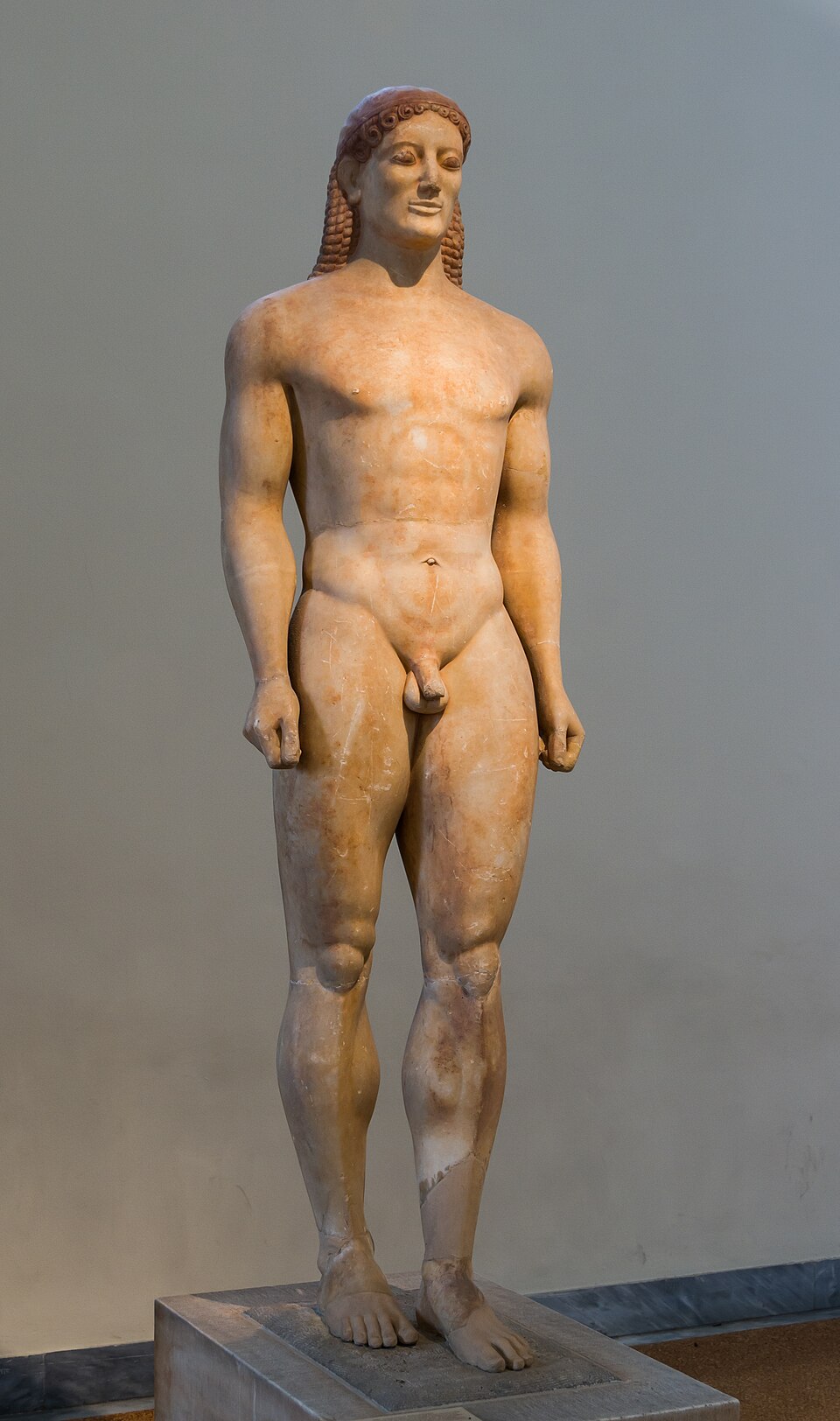
Across the sun-bleached sanctuaries of ancient Greece stand hundreds of stone youths, forever caught mid-stride, arms pinned to their sides, left leg advanced as if about to walk into eternity. Modern scholars call them kouroi — the plural of kouros, an Ancient Greek word meaning 'youth' or 'boy, especially of noble rank.' They first emerged in the Archaic period and became especially common in Attica and Boeotia, though examples turn up as far afield as Sicily. More than a hundred were unearthed at the sanctuary of Apollo Ptoion in Boeotia alone, a staggering concentration that hints at just how central these figures were to Greek religious life.
The term itself is younger than one might expect. The statues were once assumed to be images of Apollo, until V.I. Leonardos proposed the word kouros for the youth from Keratea in 1895. Henri Lechat then adopted it in 1904 as a general label for the standing male figure. Yet the word's roots reach back much further — into Linear B, the syllabic script of Mycenaean Greek, where tablets from Pylos and Knossos record the term ko-wo, possibly referring to the sons of women listed in palace archives.
Most kouroi were carved from marble, though limestone, wood, bronze, ivory and terracotta versions also existed. Typically life-sized, the earliest examples could reach colossal heights of up to 10 feet, or 3 metres. Their female counterpart, the kore, shared the sanctuaries but wore drapery rather than nudity, a telling contrast in how Greek sculptors chose to depict young men and young women.
What exactly a kouros represented has puzzled historians for generations. Vase paintings once suggested they depicted Apollo alone, an idea bolstered by Diodoros's description of the Pythian Apollo statue at Samos as 'Egyptian in style, with his arms hanging by his sides and his legs parted' — a description that fits the kouros form precisely. But archaeology complicates the picture. Many kouroi have been found in cemeteries, apparently serving as tombstones for the dead. Others functioned as victory trophies for athletes; Pausanias described a statue of the Olympic pankratiast Arrhichion rendered in the kouros scheme. Still others were temple offerings unconnected to Apollo altogether — the famous 'Delphi Twins,' Kleobis and Biton, received matching kouroi in honor of their piety, not their divinity.
How this sculptural form came into being remains one of art history's enduring debates. Some scholars trace it to earlier Daedalic forms known mostly from ancient literature — the kolossos, bretas, andrias, and xoanon — evolving naturally into free-standing stone by the sixth century BCE. Others argue for foreign influence, pointing to Egypt, Anatolia and Syria as possible sources, with Egypt's Horus figures cited as the strongest parallel. Long before the Greek trading post of Naukratis was founded in the mid-seventh century BCE, Greek merchants already had contact with Egypt, giving them ample opportunity to observe Egyptian sculpting techniques firsthand.
More from Art

The Painting With No Foreground
A single robed figure stares out at an empty grey sea — and the emptiness itself became a scandal. When it was unveiled in Berlin in 1810, no one knew quite what to do with it.

The Painter Who Chased the Light
For a few purple minutes each evening, an American exile knelt in an English garden and raced the dying sun to paint two little girls lighting lanterns. It took him two years to finish.

When a President Became a God
Look straight up inside the U.S. Capitol dome and you will find George Washington enthroned among the clouds, surrounded by goddesses — the founding father transformed into myth.

Marble Brought Back to Life
A corpse asleep, a wing barely brushing her skin — and marble somehow learns to breathe. This is the moment Antonio Canova dared to carve.

The World Turned Upside Down
Look closely at a sixteenth-century Flemish village and you'll find a man biting a pillar, another carrying daylight in a basket, and a wife slipping a blue cloak over her husband's shoulders. Every gesture is a joke — if you know the language.

The Girl in the Glass Case
She stood two-thirds life size, dressed in a real tutu and human hair — and the critics who saw her in 1881 recoiled as if she were something obscene.