The Boy Who Painted Stillness by the Seine
A twenty-four-year-old painter spent a year quietly building toward a canvas the Paris Salon would flatly reject — and that would one day be called a masterpiece.
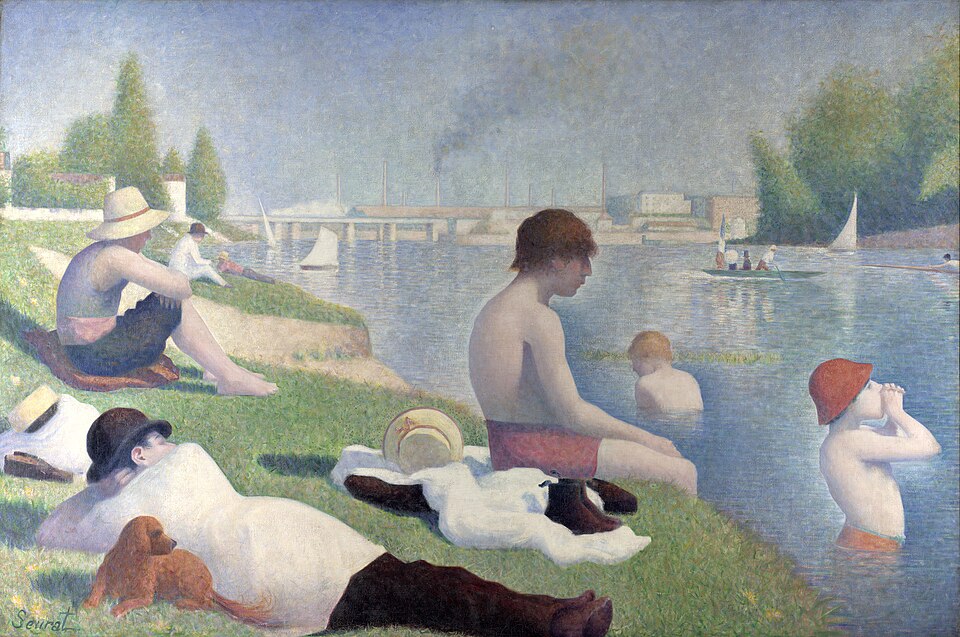
On a hazy summer afternoon along the River Seine, a handful of figures rest on the riverbank near Courbevoie, just west of Asnières. Their clothes lie piled like sculpture on the grass. A boy sits half-submerged in the water, another calls out through cupped hands, and beyond them, faint in the heat, rise the Asnières railway bridge and the industrial rooftops of Clichy. This is the scene Georges Seurat, only twenty-four years old, committed to canvas in 1884 in Bathers at Asnières — the first of the two monumental masterpieces that would define his short career.
Seurat did not invent this stretch of riverbank; it was a real and popular spot, sometimes marked on nineteenth-century French maps simply as 'Baignade' — a bathing place. Technically the scene sits in Courbevoie rather than Asnières itself, with the island of la Grande Jatte visible across the water, its actual length subtly stretched by the artist's brush. Many painters worked this same bend of the Seine in the 1880s, and Seurat himself would return to it again in The Seine at Courbevoie, A Sunday Afternoon on the Island of La Grande Jatte, and The Bridge at Courbevoie.
What set Seurat apart was not just subject but method. He spent roughly a year preparing, producing thirteen surviving oil studies — small outdoor sketches he affectionately called croquetons, pinned to his studio walls — alongside nine drawings in conté crayon that worked out how light and shadow would fall across each figure. Only after this long labor did he translate those monochrome studies into the color of the final canvas.
On that canvas, Seurat developed what he called the balayé technique: a flat brush dragged in crisscrossing strokes of matte color, the strokes shrinking as they near the horizon. He applied it unevenly and deliberately — thick, crosshatched layers over solid underpaint in the grassy foreground to suggest flickering sunlight, thin near-horizontal strokes for the water, and smooth, waxy finish for the skin of the bathers themselves. Art historian Roger Fry later wrote that no one could render this enveloping heat 'with a more exquisitely tremulous sensibility... than Seurat.'
The figures themselves are strange in their stillness. Painted mostly in profile, none facing the viewer, they seem locked in solitary reverie, their postures, tilted heads, and gazes echoing one another to create a quiet rhythmic unity. Clusters of color — the horse-chestnut browns of piled clothing, the oranges of boys in the water — anchor the composition even as light plays across it in ways that don't strictly obey nature.
More from Art

The Painting With No Foreground
A single robed figure stares out at an empty grey sea — and the emptiness itself became a scandal. When it was unveiled in Berlin in 1810, no one knew quite what to do with it.

The Painter Who Chased the Light
For a few purple minutes each evening, an American exile knelt in an English garden and raced the dying sun to paint two little girls lighting lanterns. It took him two years to finish.

When a President Became a God
Look straight up inside the U.S. Capitol dome and you will find George Washington enthroned among the clouds, surrounded by goddesses — the founding father transformed into myth.

Marble Brought Back to Life
A corpse asleep, a wing barely brushing her skin — and marble somehow learns to breathe. This is the moment Antonio Canova dared to carve.

The World Turned Upside Down
Look closely at a sixteenth-century Flemish village and you'll find a man biting a pillar, another carrying daylight in a basket, and a wife slipping a blue cloak over her husband's shoulders. Every gesture is a joke — if you know the language.

The Girl in the Glass Case
She stood two-thirds life size, dressed in a real tutu and human hair — and the critics who saw her in 1881 recoiled as if she were something obscene.