The Boy Who Trampled the World
A grinning, half-naked boy perches on a table, crushing armor and violins beneath one bare foot — and Rome's elite could not stop talking about him.
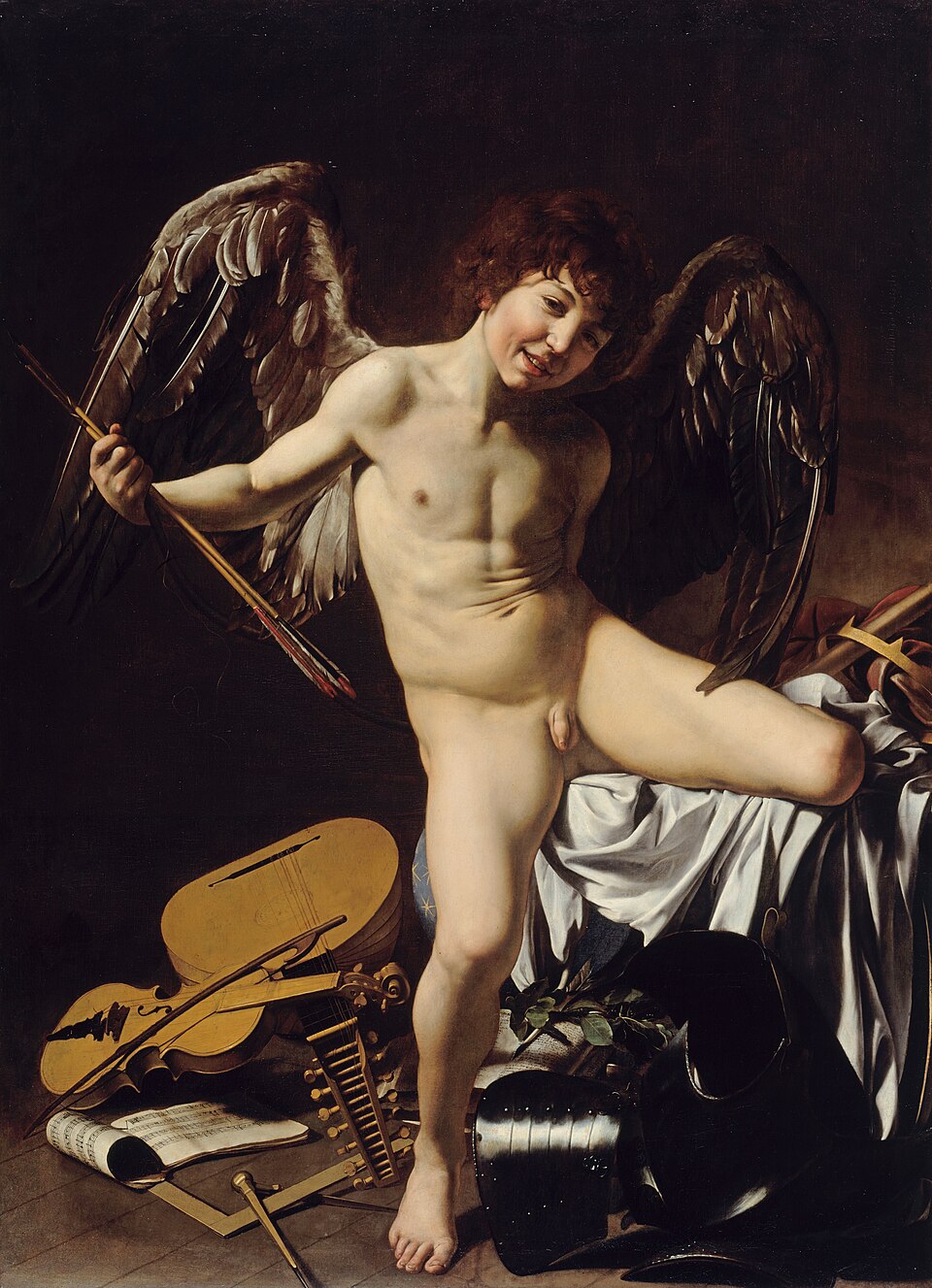
In 1601 or 1602, in a Roman studio thick with the smell of oil and turpentine, Caravaggio painted a boy of about twelve with dark eagle's wings borrowed as a prop from a fellow painter, Orazio Gentileschi. The boy sits, half-climbing down from what looks like a table, laughing directly at the viewer. Scattered beneath and around him are the trophies of human achievement: a violin and lute, a suit of armor, a coronet, a square and compasses, pen and manuscript, bay leaves, a flower — all tangled and trampled under his foot.
The painting takes its eventual title from Virgil's Eclogues: Omnia Vincit Amor et nos cedamus amori — love conquers all, and we must yield to love. A musical manuscript lying on the floor bears a large letter 'V', which some have read as a nod to Marchese Vincenzo Giustiniani, the painting's owner and one of Rome's great art patrons, who is said to have prized this canvas above every other work in his celebrated collection.
What startled contemporaries was not the subject — Cupid was an entirely conventional theme for the age — but the treatment. Where other artists, such as Battistello Caracciolo in his Sleeping Cupid, painted an idealized, generic god of love, Caravaggio painted what looks like an actual boy, lit with his signature harsh chiaroscuro, rendered with almost photographic clarity. And yet beneath that realism lurks an unmistakable echo of Michelangelo's Victory, the sculpture now in Florence's Palazzo Vecchio — allegory and flesh fused into one figure.
The wings themselves tell us something precise: because Gentileschi lent them as studio props, art historians can date the work fairly confidently to 1602–03. And the picture was an instant sensation among Rome's intellectual circles. One poet dashed off three madrigals in its honor; another wrote a Latin epigram that first paired the painting with Virgil's phrase — though the title Omnia Vincit Amor didn't formally attach itself until Giovanni Pietro Bellori's 1672 biography of Caravaggio.
More from Art

The Painting With No Foreground
A single robed figure stares out at an empty grey sea — and the emptiness itself became a scandal. When it was unveiled in Berlin in 1810, no one knew quite what to do with it.

The Painter Who Chased the Light
For a few purple minutes each evening, an American exile knelt in an English garden and raced the dying sun to paint two little girls lighting lanterns. It took him two years to finish.

When a President Became a God
Look straight up inside the U.S. Capitol dome and you will find George Washington enthroned among the clouds, surrounded by goddesses — the founding father transformed into myth.

Marble Brought Back to Life
A corpse asleep, a wing barely brushing her skin — and marble somehow learns to breathe. This is the moment Antonio Canova dared to carve.

The World Turned Upside Down
Look closely at a sixteenth-century Flemish village and you'll find a man biting a pillar, another carrying daylight in a basket, and a wife slipping a blue cloak over her husband's shoulders. Every gesture is a joke — if you know the language.

The Girl in the Glass Case
She stood two-thirds life size, dressed in a real tutu and human hair — and the critics who saw her in 1881 recoiled as if she were something obscene.