The Café That Painted Itself Into the Stars
A yellow lantern, a violet cobblestone street, and not one drop of black paint — Van Gogh found a way to paint night without darkness.
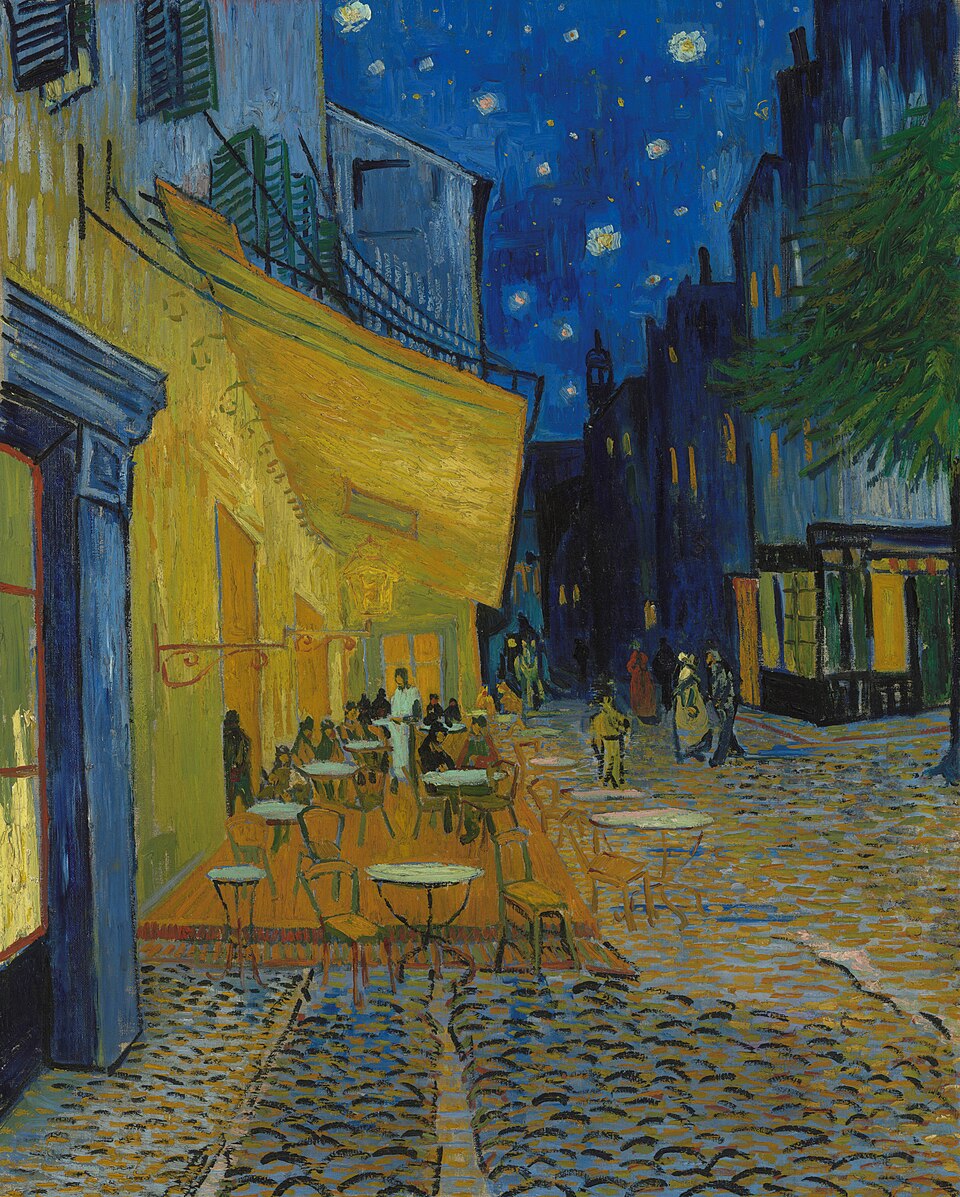
In mid-September 1888, on the northeastern corner of a small square in Arles called the Place du Forum, Vincent van Gogh set up his easel at night and began work on a painting he never signed. He called it, in his letters, simply a view of the café where he and his friends used to go. Today it is known as Café Terrace at Night, and it hangs in the Kröller-Müller Museum in Otterlo, Netherlands — but that plain title barely hints at what he was attempting.
What he was attempting, in his own words to his sister Wil, was a painting of night without black. Van Gogh described a huge yellow lantern lighting the terrace, the façade of the café, and the pavement, which took on a violet-pink tinge under the glow. Above, the gables of the houses on the street leading away were dark blue or violet, with a green tree among them, and over it all stretched a sky studded with stars. He rendered the whole scene in blues, violets, greens, and the pale sulphur-lemon color of the lit square — a deliberate rejection of the conventional, murky black night.
He also described the practical thrill of it: painting directly on the spot at night, rather than sketching by day and filling in a night scene from memory, as was customary. He admitted the risk — that in the dark he might mistake a blue for a green, or a blue lilac for a pink lilac — but he considered this the only way to escape the pallid, whitish light that painters conventionally used to suggest darkness. A single candle, he noted, gives the richest yellows and oranges.
In that same letter to Wil, Van Gogh mentioned Guy de Maupassant's novel Bel-Ami, whose opening describes a starry night in Paris with lighted cafés along the boulevard — a scene he felt resembled the subject he had just painted. Van Gogh Museum curators have connected the painting to this passage, though they note Maupassant's text makes no mention of a starry sky, a detail that appears to be Van Gogh's own addition.
Other scholars have looked for different inspirations. Bogomila Welsh-Ovcharov, in 1981, suggested the painting's funnel-like perspective and dominant blue-yellow tonality owed something to Louis Anquetin's Avenue de Clichy: 5 o'clock in the evening. A more speculative theory, presented at an academic conference in 2013, proposed that Van Gogh secretly intended the composition as a Symbolist reimagining of the Last Supper — pointing to his purchase of a dozen straw-bottomed chairs, his related restaurant interior studies, and a letter to his brother Theo written two weeks later in which he confessed a terrible need for religion and a recurring dream of painting a group of living figures, his 'pals.' Van Gogh never stated this intent outright in any surviving letter.
More from Art

The Painting With No Foreground
A single robed figure stares out at an empty grey sea — and the emptiness itself became a scandal. When it was unveiled in Berlin in 1810, no one knew quite what to do with it.

The Painter Who Chased the Light
For a few purple minutes each evening, an American exile knelt in an English garden and raced the dying sun to paint two little girls lighting lanterns. It took him two years to finish.

When a President Became a God
Look straight up inside the U.S. Capitol dome and you will find George Washington enthroned among the clouds, surrounded by goddesses — the founding father transformed into myth.

Marble Brought Back to Life
A corpse asleep, a wing barely brushing her skin — and marble somehow learns to breathe. This is the moment Antonio Canova dared to carve.

The World Turned Upside Down
Look closely at a sixteenth-century Flemish village and you'll find a man biting a pillar, another carrying daylight in a basket, and a wife slipping a blue cloak over her husband's shoulders. Every gesture is a joke — if you know the language.

The Girl in the Glass Case
She stood two-thirds life size, dressed in a real tutu and human hair — and the critics who saw her in 1881 recoiled as if she were something obscene.