The Color That Shrieked
One evening on a hill above Oslo, the sky turned to blood — and a Norwegian painter heard a sound that no one else could hear.
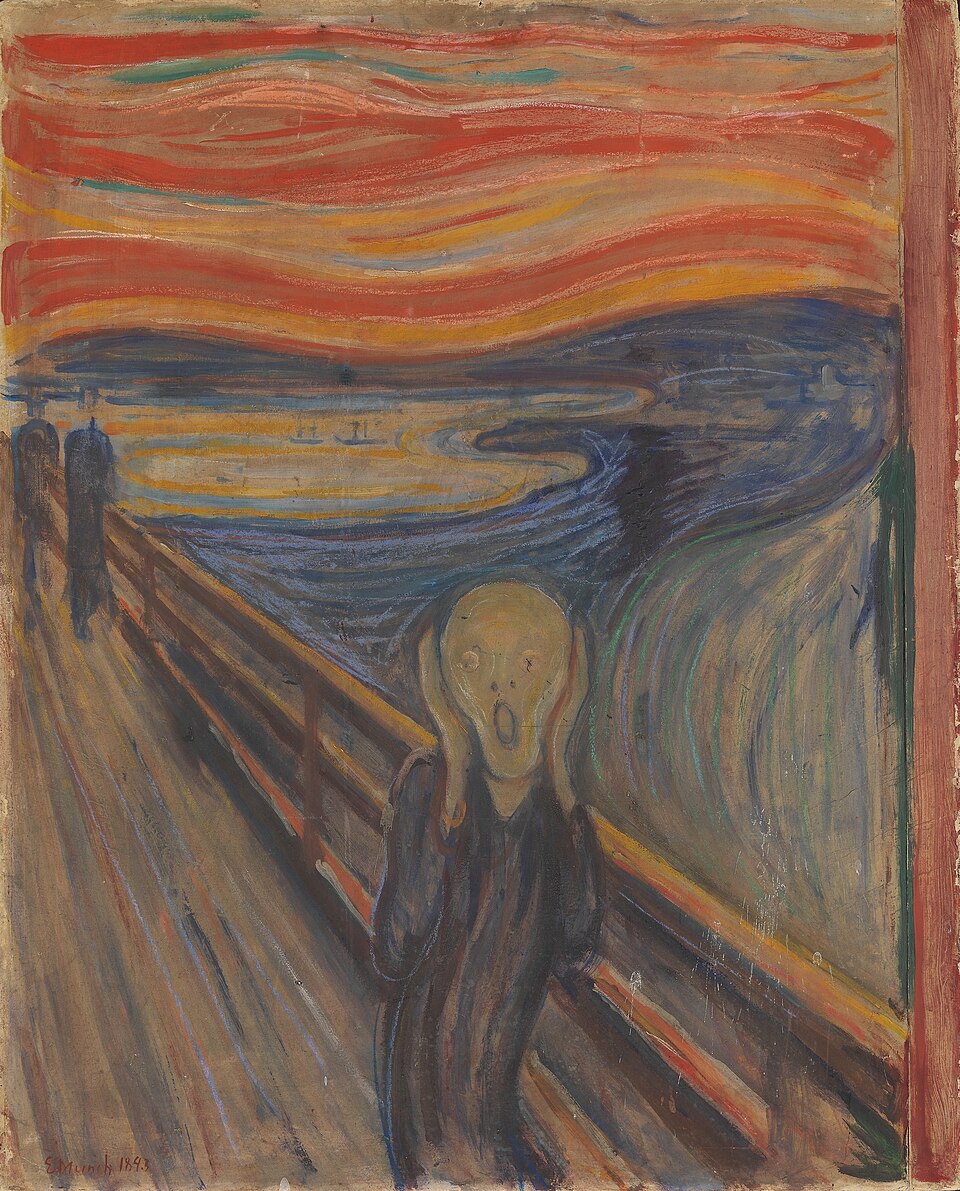
On a walk at sunset along a path above the Oslofjord, Edvard Munch stopped, exhausted and unwell, and looked out over the water. The sun was setting, and the clouds turned, in his own words, 'a blood red.' He sensed an infinite scream passing through nature — and he later wrote that it seemed to him he actually heard it. Munch set down this memory in a diary entry headed 'Nice, 22 January 1892,' though the walk itself took place on some earlier, unspecified evening. That recollection became the seed of one of the most recognized images in the history of art: The Scream.
Munch described the experience more than once. In one account he was walking with two friends when the sky suddenly turned blood red; he paused, leaned on a fence, trembling with anxiety, while his friends walked on ahead, unaware. Above the blue-black fjord and the city he saw blood and tongues of fire. Some scholars, reading these accounts, believe Munch was describing what we would now call a panic attack.
The location has been identified as a road on the hill of Ekeberg, overlooking Oslo, the Oslofjord, and the island of Hovedøya. At the time, Munch's sister Laura Catherine, who suffered from manic depression, was a patient at a mental asylum at the foot of that same hill. A slaughterhouse also stood nearby. Both facts have been offered as possible sources for the painting's unsettling atmosphere, alongside a theory that the fiery sky echoed the real volcanic eruption of Krakatoa a decade earlier, which tinted sunsets red across the world, and another suggesting rare nacreous clouds visible at Norway's latitude.
The strange, skull-like figure in the foreground has its own mystery. In 1978 the Munch scholar Robert Rosenblum proposed that it was inspired by a Peruvian mummy, buried in a fetal position with its hands beside its face, which Munch may have seen at the 1889 Exposition Universelle in Paris — the same mummy that fascinated Paul Gauguin and appeared in more than twenty of his paintings. A later theory pointing to a mummy in Florence was dismissed, since Munch never visited Florence before painting The Scream.
Munch did not make just one Scream. He created two painted versions and two pastel versions, plus a lithograph stone from which several prints survive. The first painting, from 1893, carries a faint pencil inscription reading 'could only have been painted by a madman' and now hangs in the National Museum of Norway in Oslo. A pastel from the same year, likely a preliminary study, sits in the Munch Museum. The second painted version dates to 1910, when Munch revisited earlier compositions; it, too, belongs to the Munch Museum.
More from Art

The Painting With No Foreground
A single robed figure stares out at an empty grey sea — and the emptiness itself became a scandal. When it was unveiled in Berlin in 1810, no one knew quite what to do with it.

The Painter Who Chased the Light
For a few purple minutes each evening, an American exile knelt in an English garden and raced the dying sun to paint two little girls lighting lanterns. It took him two years to finish.

When a President Became a God
Look straight up inside the U.S. Capitol dome and you will find George Washington enthroned among the clouds, surrounded by goddesses — the founding father transformed into myth.

Marble Brought Back to Life
A corpse asleep, a wing barely brushing her skin — and marble somehow learns to breathe. This is the moment Antonio Canova dared to carve.

The World Turned Upside Down
Look closely at a sixteenth-century Flemish village and you'll find a man biting a pillar, another carrying daylight in a basket, and a wife slipping a blue cloak over her husband's shoulders. Every gesture is a joke — if you know the language.

The Girl in the Glass Case
She stood two-thirds life size, dressed in a real tutu and human hair — and the critics who saw her in 1881 recoiled as if she were something obscene.