The Crown That Fell on the Sidewalk
It survived a fallen empire, an exile, and an auction house — only to be crushed through a hole in a display case and left dented on a Paris sidewalk.
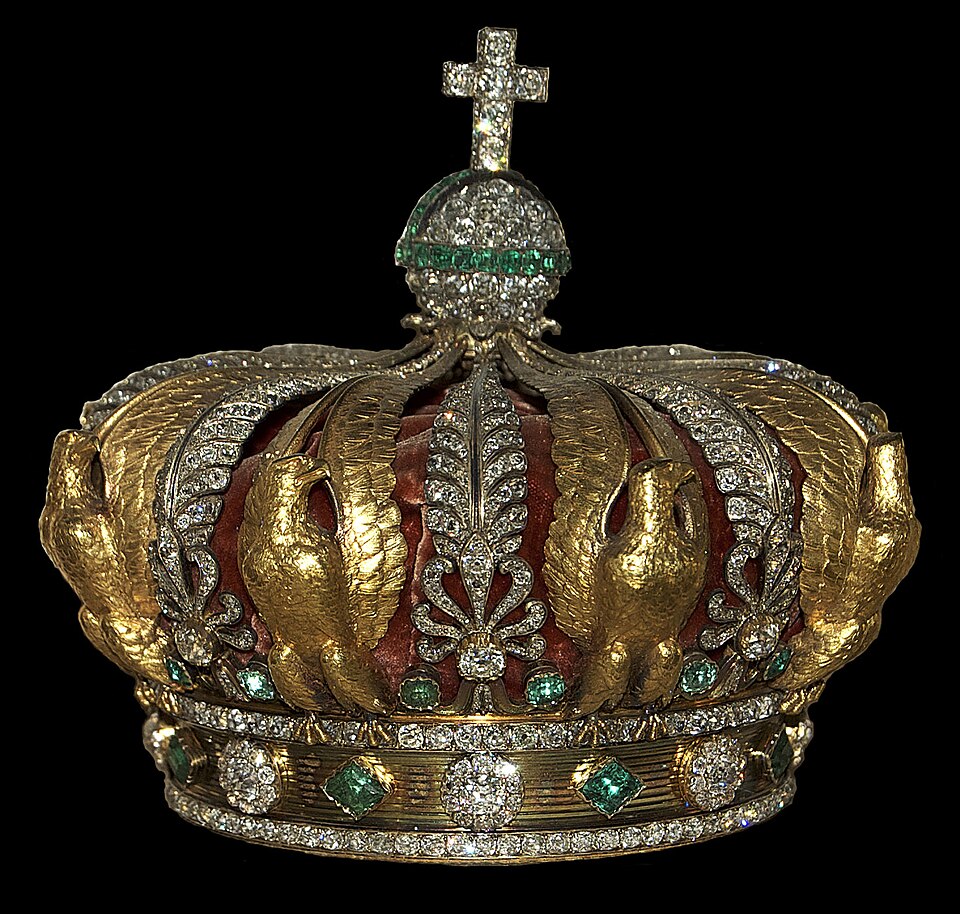
In 1855, Paris was preparing to dazzle the world. The Exposition Universelle would bring visitors from every corner of the globe, and Napoleon III wanted his empire to shine as brightly as any that had come before. For the occasion, a gold crown was made for his wife, Eugénie de Montijo — a piece studded with diamonds and emeralds, worked into eagle and palmette motifs, and crowned at its peak with a monde. Neither Eugénie nor her husband ever underwent a formal coronation. The crown was never placed on her head in ceremony. It existed instead as a statement of imperial splendor, made for display rather than ritual.
A companion piece, the Crown of Napoleon III, was created in the same period, meant to match the empress's crown in grandeur if not in fate.
The glittering era did not last. In 1870, following defeat in the Franco-Prussian War, Napoleon III was overthrown. He and Eugénie fled into exile, settling at Chislehurst in England. There, the emperor died in January 1873. Eugénie outlived him by decades, dying in July 1920 — an empress without an empire for the last fifty years of her life.
Back in France, the Third Republic had little sentiment for the trappings of the fallen monarchy. In 1885, it sold off most of the French Crown Jewels, including the Crown of Napoleon III, which vanished into private hands. But Eugénie's crown followed a different path: it was returned to her. In her will, she left it to Princess Marie-Clotilde Bonaparte, keeping the piece within the family that had once worn it in power.
The crown resurfaced publicly in 1988, when it came up for auction. It was purchased and then donated to the Louvre by Roberto Polo, an act that returned Eugénie's crown to public view after more than a century of private ownership. From then on, it sat in the museum among the treasures of a vanished empire, a relic of a court that no longer existed.
More from Art

The Painting With No Foreground
A single robed figure stares out at an empty grey sea — and the emptiness itself became a scandal. When it was unveiled in Berlin in 1810, no one knew quite what to do with it.

The Painter Who Chased the Light
For a few purple minutes each evening, an American exile knelt in an English garden and raced the dying sun to paint two little girls lighting lanterns. It took him two years to finish.

When a President Became a God
Look straight up inside the U.S. Capitol dome and you will find George Washington enthroned among the clouds, surrounded by goddesses — the founding father transformed into myth.

Marble Brought Back to Life
A corpse asleep, a wing barely brushing her skin — and marble somehow learns to breathe. This is the moment Antonio Canova dared to carve.

The World Turned Upside Down
Look closely at a sixteenth-century Flemish village and you'll find a man biting a pillar, another carrying daylight in a basket, and a wife slipping a blue cloak over her husband's shoulders. Every gesture is a joke — if you know the language.

The Girl in the Glass Case
She stood two-thirds life size, dressed in a real tutu and human hair — and the critics who saw her in 1881 recoiled as if she were something obscene.