The Day the Gods Were Foretold to Die
A seer speaks to Odin of roosters that will crow before the end, of a wolf that will swallow the sky's king whole — and of a world that will drown, only to rise again.
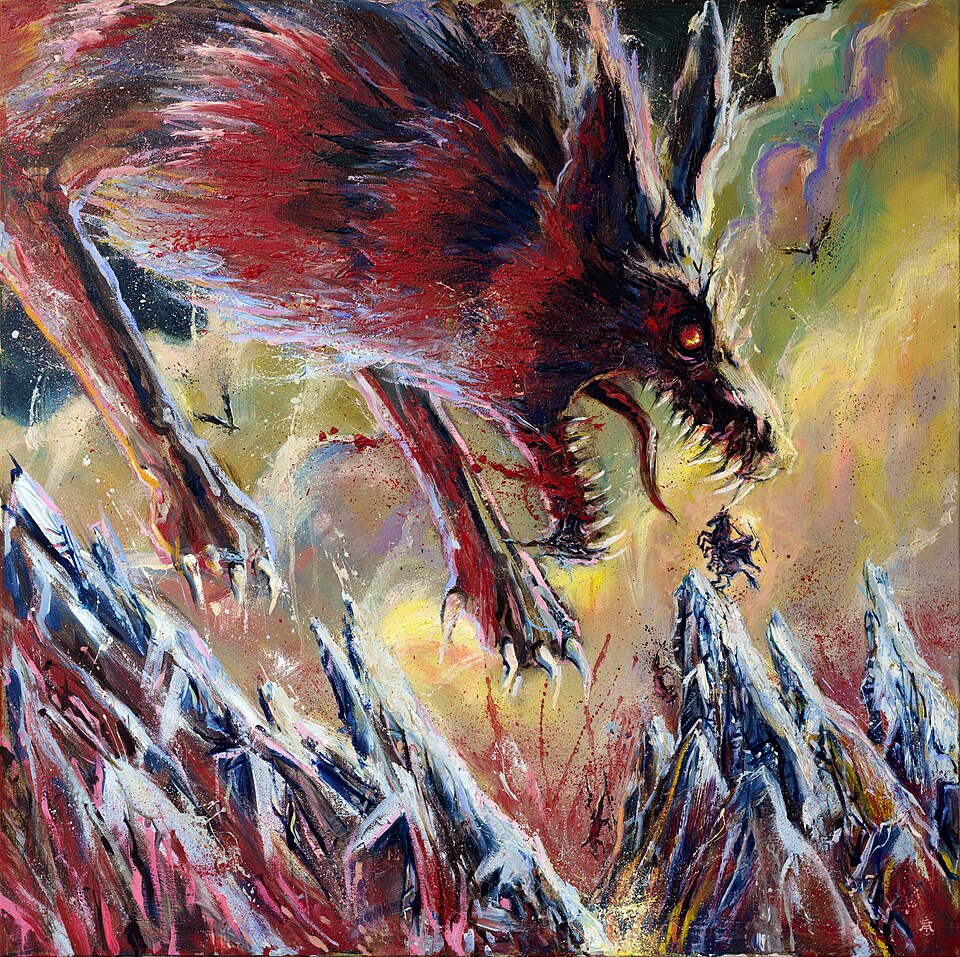
In the beginning of the end, three roosters crow. Fjalar, crimson, calls out in the forest of Gálgviðr. Gullinkambi, golden, wakes the Æsir in Valhalla. A third, unnamed and soot-red, crows in the halls of Hel. This is how the völva — the female seer of the Poetic Edda poem Völuspá — begins her recitation to Odin of Ragnarök, the foretold destruction of the gods. Before the roosters, though, comes Fimbulvetr, an endless winter in which humanity starves, rages, and turns on itself: brothers kill brothers, fathers battle sons.
The earth itself begins to convulse. Great earthquakes shake mountains loose from their roots, and this violence frees the wolf Fenrir from the chain Gleipnir that had bound him. The Midgard serpent Jörmungandr, roused by the same tremors, slithers toward shore and sprays poison into sea and sky, killing everything it touches. In the heavens, a rift tears open above Muspelheim, and the fire giant Surtr leads his burning army across the rainbow bridge Bifrost — which blackens and shatters beneath their advance.
Loki, too, breaks free of his bonds. He captains the ship Naglfar, crewed by the dead of Hel, the realm ruled by his own daughter. As the invaders converge, Heimdall raises the horn Gjallarhorn and blows a warning so deep it wakes every sleeping god. They rise and march to the battlefield of Vígrídr to meet their doom.
Odin faces the wolf Fenrir directly, hurling his spear Gungnir, but no weapon saves him — he is swallowed whole, and Frigg endures her second great sorrow, having already lost her son Baldr. His son Víðarr avenges him, tearing the wolf's jaws apart and driving a blade into its heart. Thor, protector of the earth, meets Jörmungandr in single combat and kills the serpent with his hammer Mjöllnir — but not before its venom finds him, and he collapses dead after only nine steps.
Elsewhere on the field, the one-handed god Týr and the hellhound Garm destroy each other. Freyr falls fighting Surtr and loses. In the poem's telling, the sun blackens, the sky sheds stars, steam rises, and flames lick the heavens as people flee their homes and the earth begins to sink beneath the waves. Loki and Heimdall, the last combatants standing, kill one another. The wolves Sköll and Hati swallow the sun and moon. Finally Surtr lifts his sword, brighter than sunlight, and sets the world ablaze.
More from Mythology

The Doctor Who Sang a Nation Into Being
A country doctor rode into the forests of Karelia armed with nothing but a notebook — and rode out with the soul of a nation.

The Boat That Carried the Sun
Every sunset, the ancient Egyptians believed, the sun climbed into a boat and sailed straight into the realm of the dead — only to fight a monstrous serpent before dawn could return.

The Wild Man of the Snows
At 21,000 feet, a colonel found tracks in the snow that he blamed on a wolf — but his guides knew better, and gave the world a name that would echo for a century.

The Knight Who Went Mad for Love: Orlando Furioso
A hero so devoted to duty he was Charlemagne's greatest paladin loses his mind—not to a sword wound, but to heartbreak. To cure him, a friend must ride a flying horse to the Moon.

The Book That Turned the World Into Myth
A poet condemned to exile spent his final years in Rome finishing a poem that would outlive empires—a poem about nothing standing still, not gods, not lovers, not even the shape of a man.

Paradise Lost: Milton's Rebel Angel
A blind poet, dictating verses in the dark, dared to explain the ways of God to men — and in doing so, made Hell's ruler unforgettable.