The Death of Marat: A Revolution in the Bathtub
A stabbed man slumped in his bath, a quill still in his hand — Jacques-Louis David turned a political murder into a secular pietà, and made propaganda into art history's first modern image.
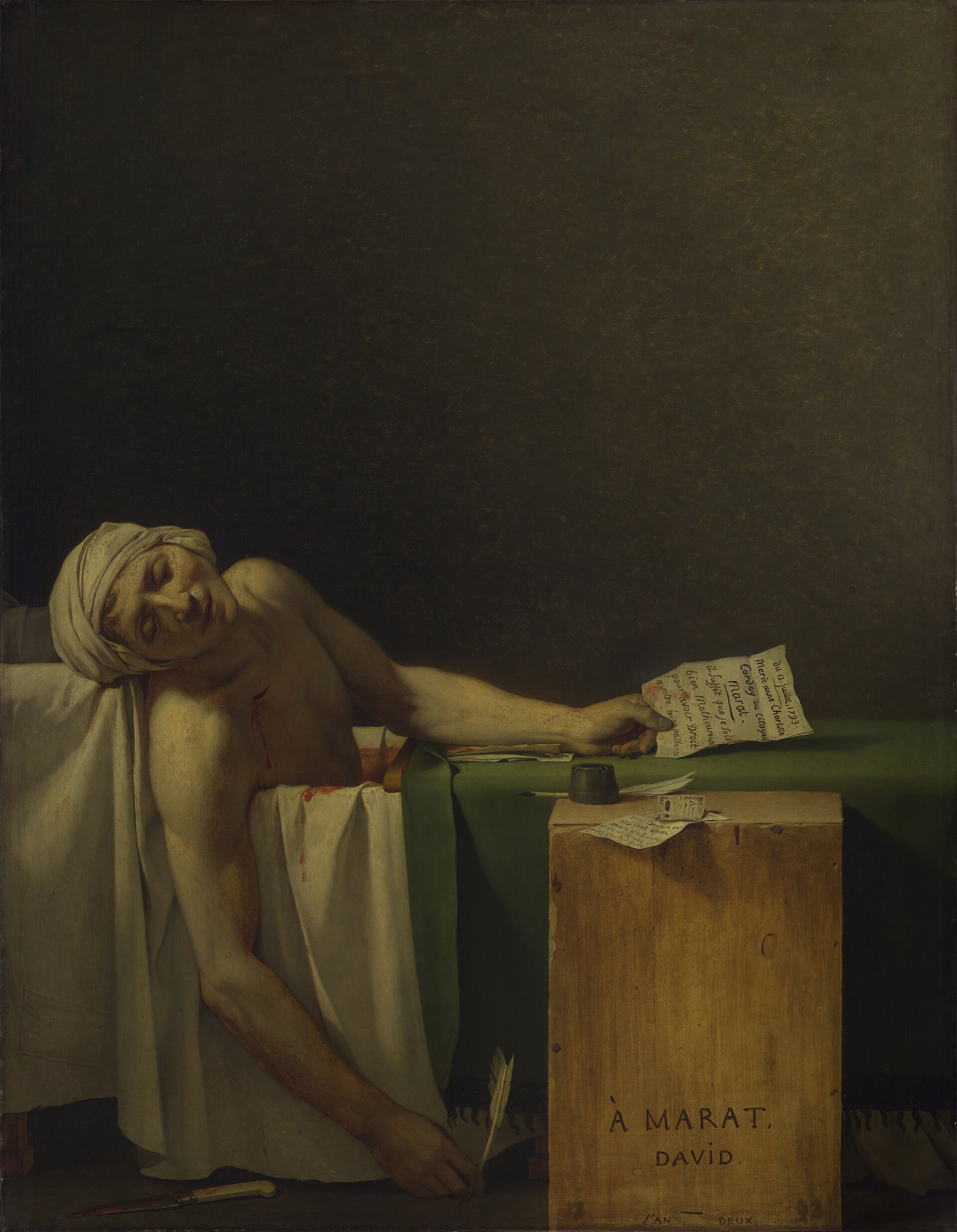
On the evening of 13 July 1793, Jean-Paul Marat was working, as he often did, in his bathtub. A painful skin condition kept him soaking for hours at a time, and he had turned the tub into a makeshift office, correcting proofs of his newspaper L'Ami du peuple while the water eased his suffering. A young woman named Charlotte Corday had gained entry to his lodgings that day, claiming she carried the names of traitors to the Revolution — or, by other accounts, that she meant to plead for the lives of Girondin acquaintances. Once alone with him, she drew a knife and stabbed Marat to death. She made no attempt to flee and was later tried and executed for the killing.
Marat was no ordinary victim. He was a leading voice of the Montagnards, the radical faction driving the Reign of Terror, and Corday, a Girondin, held him responsible for the September Massacres. His murder instantly transformed him from controversial agitator into revolutionary martyr — and his friend Jacques-Louis David, already the era's leading Neoclassical painter and a committed Jacobin ally of Marat and Robespierre, had visited Marat before his assassination, and moved quickly afterward to fix that transformation in paint.
David was no detached observer. As a deputy at the National Convention and a member of the Committee of General Security, he had voted for the execution of Louis XVI and taken an active hand in the machinery of the Terror. He also served on the Committee of Public Instruction. When he painted Marat, he was not simply mourning a friend; he was building an image the Republic needed.
The painting shows Marat dead in his bath, right arm hanging limply over the side, a quill still resting in his fingers. Wrapped in a plain white sheet against a stark, undefined background, his body bears no sign of illness — only the fatal wound. Beside the tub, a small writing table holds the note he was completing, describing a payment for a woman widowed by the Revolution. A bloodied knife lies nearby, and in his other hand he holds the note Corday used to gain entrance — words David wrote himself, a fictional expression based on what Corday might have said, not an actual quotation from her.
The composition draws directly on religious precedent. Art historians have long compared Marat's pose to Michelangelo's Pietà, and David openly admired Caravaggio's Entombment of Christ, whose dramatic lighting and slumped-arm motif reappear almost exactly here. By bathing Marat's face and body in the same soft glow once reserved for Christian martyrs, David transferred the sacred aura of church and monarchy onto the new Republic — Corday, the actual killer, is nowhere in the frame, erased so nothing might dilute Marat's martyrdom.
More from Art

The Painting With No Foreground
A single robed figure stares out at an empty grey sea — and the emptiness itself became a scandal. When it was unveiled in Berlin in 1810, no one knew quite what to do with it.

The Painter Who Chased the Light
For a few purple minutes each evening, an American exile knelt in an English garden and raced the dying sun to paint two little girls lighting lanterns. It took him two years to finish.

When a President Became a God
Look straight up inside the U.S. Capitol dome and you will find George Washington enthroned among the clouds, surrounded by goddesses — the founding father transformed into myth.

Marble Brought Back to Life
A corpse asleep, a wing barely brushing her skin — and marble somehow learns to breathe. This is the moment Antonio Canova dared to carve.

The World Turned Upside Down
Look closely at a sixteenth-century Flemish village and you'll find a man biting a pillar, another carrying daylight in a basket, and a wife slipping a blue cloak over her husband's shoulders. Every gesture is a joke — if you know the language.

The Girl in the Glass Case
She stood two-thirds life size, dressed in a real tutu and human hair — and the critics who saw her in 1881 recoiled as if she were something obscene.