The Door Without a Handle
A knock that has echoed for over a century began with a lantern, a locked door, and one artist's obsession with getting the light exactly right.
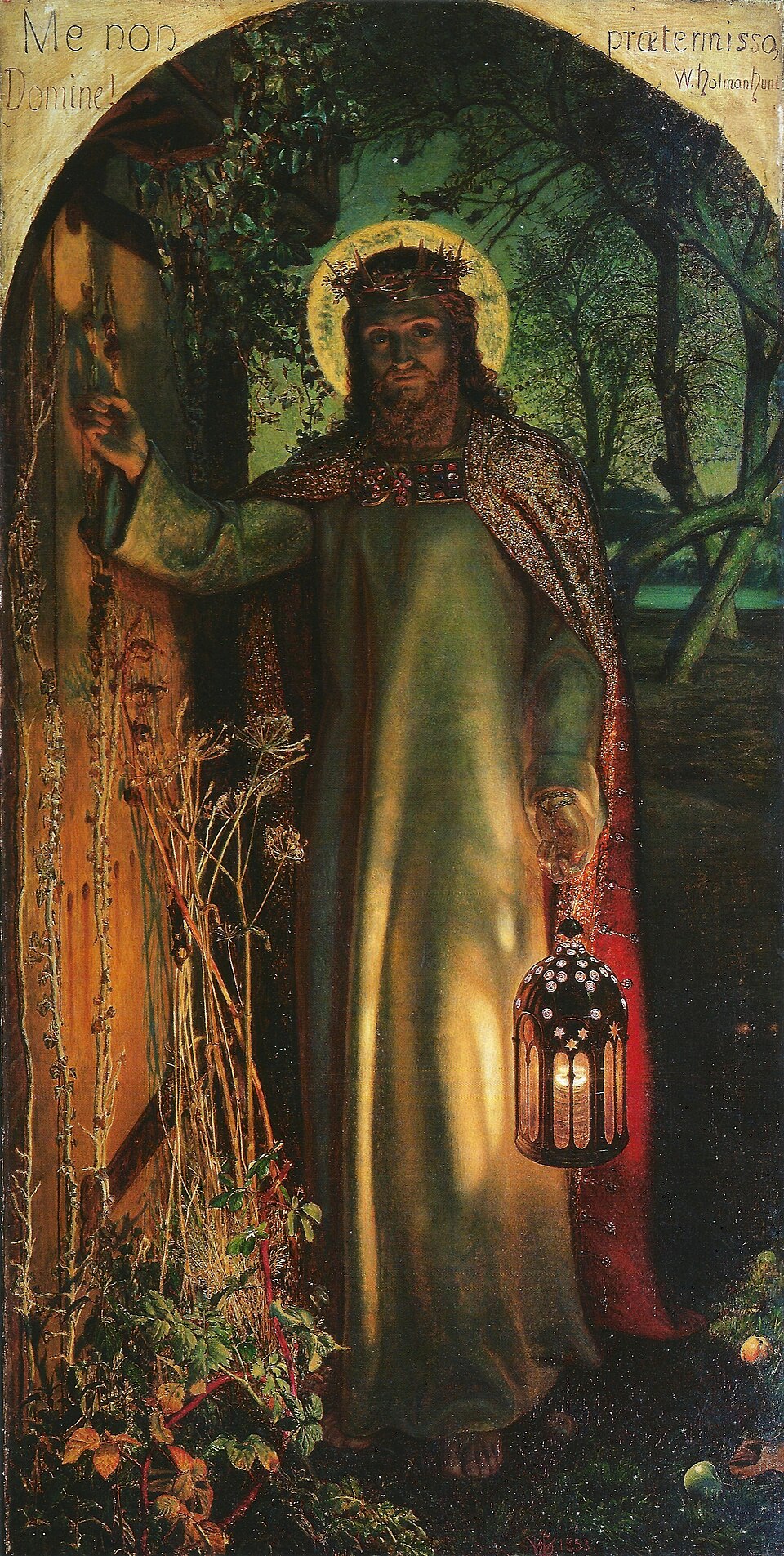
William Holman Hunt began his painting sometime around 1849 or 1850, working through the night in a makeshift hut at Worcester Park Farm in Surrey. He was chasing a very particular kind of light — the eerie, lantern-lit glow that would surround a solitary figure standing at a door in darkness. Some accounts place another stage of the work in the garden of the Oxford University Press, and it has even been suggested that Hunt found the dawn light he needed outside Bethlehem during one of his journeys to the Holy Land. Whatever the truth of these overlapping stories, the effort spanned years: the canvas was not finished until 1854.
The subject was Revelation 3:20 — 'Behold, I stand at the door and knock; if any man hear My voice, and open the door, I will come in to him, and will sup with him, and he with Me.' Hunt did not treat this as a mere illustration. He later said he painted it with what he believed, unworthy as he felt himself to be, was a divine command, not simply a good subject. Every detail was built to carry that weight, most famously the door itself, overgrown with weeds and long unopened — and fitted with no handle at all. It could only be opened from the inside, a quiet but unmistakable symbol of what Hunt called 'the obstinately shut mind.'
The face of Christ became a small mystery of its own. Hunt used a cast taken from a clay model he had shaped himself, then drew on a strange assembly of sitters for different parts of the head: his father, fellow painter John Everett Millais, John Capper, and — captured furtively, without the man's full knowledge — Thomas Carlyle. He also studied effigies of 'departed heroes,' taking whatever fragments of feature served his purpose. Decades later, in January 1898, the writer Edward Clodd sent Hunt a newspaper article speculating about the identity of his models, and Hunt confirmed one detail: the poet Christina Rossetti had indeed sat for the head, after Hunt felt he had already secured the picture's male character.
The finished painting was shown at the Royal Academy in 1854. It eventually found its way to Keble College, Oxford, where it hangs today in a side chapel built specifically to house it. That journey was not simple. The work was given to the college by Martha Combe, widow of Thomas Combe — printer to the University of Oxford, a Tractarian, and a patron of the Pre-Raphaelites — the year after his death in 1872. She gave it on the understanding that it would hang in the college chapel, then under construction between 1873 and 1876. But the chapel's architect, William Butterfield, objected and left no space for it in his design.
So the painting waited. When the college library opened in 1878, it hung there instead, for well over a decade. Only between 1892 and 1895, once a new architect, J. T. Micklethwaite, had designed a side chapel to receive it, did the painting finally reach the position it holds today.
More from Art

The Painting With No Foreground
A single robed figure stares out at an empty grey sea — and the emptiness itself became a scandal. When it was unveiled in Berlin in 1810, no one knew quite what to do with it.

The Painter Who Chased the Light
For a few purple minutes each evening, an American exile knelt in an English garden and raced the dying sun to paint two little girls lighting lanterns. It took him two years to finish.

When a President Became a God
Look straight up inside the U.S. Capitol dome and you will find George Washington enthroned among the clouds, surrounded by goddesses — the founding father transformed into myth.

Marble Brought Back to Life
A corpse asleep, a wing barely brushing her skin — and marble somehow learns to breathe. This is the moment Antonio Canova dared to carve.

The World Turned Upside Down
Look closely at a sixteenth-century Flemish village and you'll find a man biting a pillar, another carrying daylight in a basket, and a wife slipping a blue cloak over her husband's shoulders. Every gesture is a joke — if you know the language.

The Girl in the Glass Case
She stood two-thirds life size, dressed in a real tutu and human hair — and the critics who saw her in 1881 recoiled as if she were something obscene.