The Eggs the Czars Gave Away
A dagger hidden inside an Easter egg, a hen with a diamond crown in its belly, and a revolution that scattered fortunes across the world — this is the strange life of the Fabergé eggs.
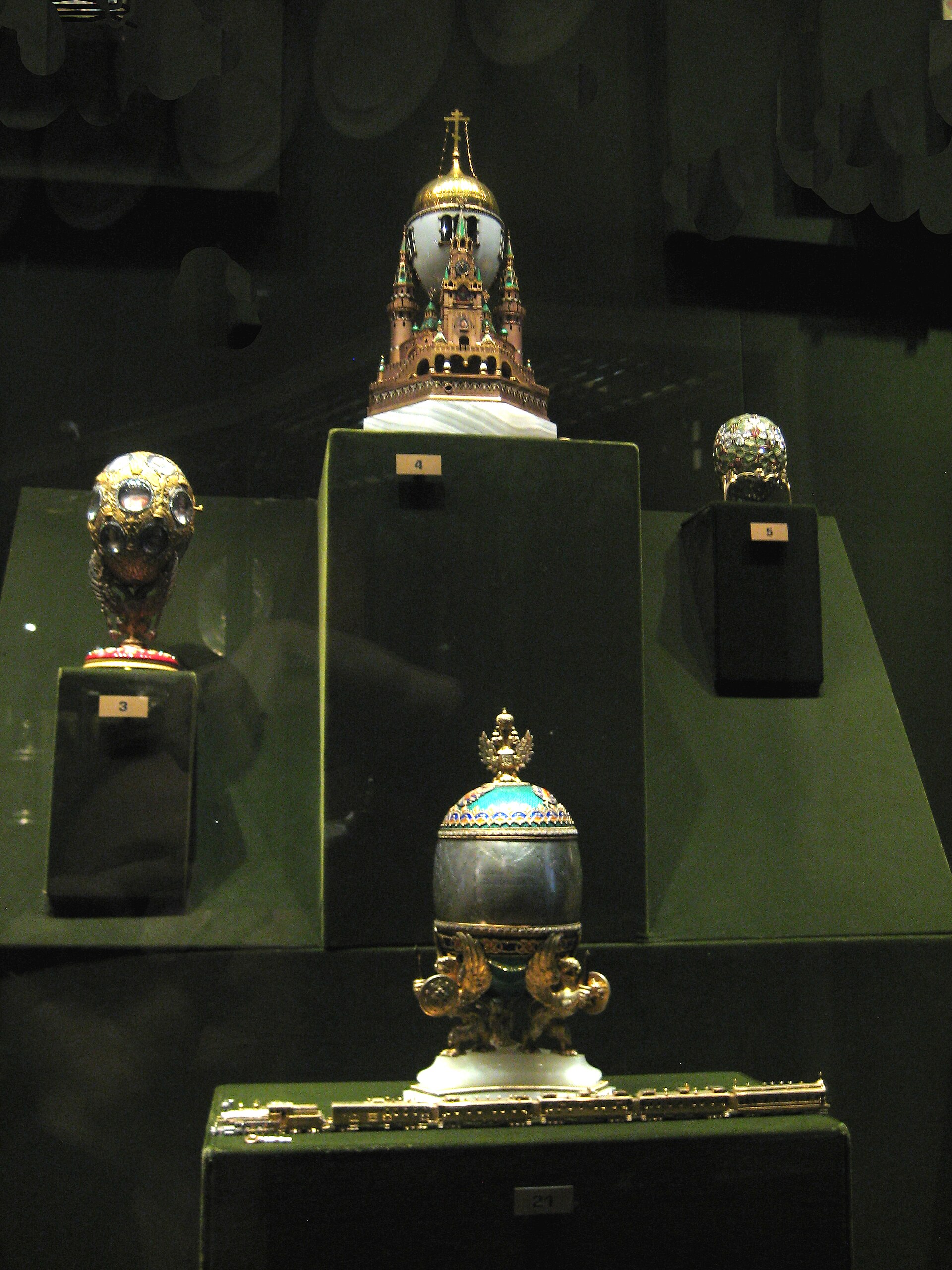
In 1883, before his coronation, Emperor Alexander III of Russia received an Easter egg unlike any other: inside it lay a silver dagger and two tiny skulls, accompanied by notes reading 'Christ is risen' and a chilling nihilist threat. It was a startling gift, but it set the stage for something far more lavish. Two years later, at his brother Grand Duke Vladimir Alexandrovich's suggestion, Alexander III commissioned the jeweller Peter Carl Fabergé to create something entirely new for his wife, Empress Maria Feodorovna.
The result, delivered on 1 May 1885, was the Hen Egg — a 65mm enamel shell with a golden band, opening to reveal a golden yolk, which opened again to reveal a tiny golden hen sitting on golden straw. Inside the hen once sat a miniature diamond replica of the imperial crown and a ruby pendant, both now lost. The egg cost 4,151 rubles. Six weeks later, Alexander III made Fabergé the official supplier to the imperial court, and the designs only grew more elaborate from there.
The House of Fabergé itself had been founded decades earlier, in 1842, by Gustav Fabergé, but it was his son Peter Carl who transformed it into a legend. A team of master craftsmen — including Michael Perkhin, Henrik Wigström, and Erik August Kollin — carried out Fabergé's designs, producing eggs of astonishing intricacy for the imperial family every year, with the sole exception of 1904 and 1905, during the Russo-Japanese War.
After Alexander III's death in 1894, his son Nicholas II continued the tradition, presenting eggs to both his wife, Tsaritsa Alexandra Feodorovna, and his mother, the Dowager Empress. In total, 50 Imperial Easter eggs were delivered — 20 to Alexandra and 30 to Maria Feodorovna — out of 52 designed, with two never completed due to the outbreak of the Russian Revolution in 1917.
The eggs' fame spread beyond the court. Fabergé accepted private commissions from the Duchess of Marlborough, the Rothschild family, and the Yusupovs. He was also asked by Siberian gold magnate Alexander Kelch to produce twelve eggs for his wife Barbara — though only seven were ever finished, simpler in design and often echoing earlier imperial pieces.
More from Art

The Painting With No Foreground
A single robed figure stares out at an empty grey sea — and the emptiness itself became a scandal. When it was unveiled in Berlin in 1810, no one knew quite what to do with it.

The Painter Who Chased the Light
For a few purple minutes each evening, an American exile knelt in an English garden and raced the dying sun to paint two little girls lighting lanterns. It took him two years to finish.

When a President Became a God
Look straight up inside the U.S. Capitol dome and you will find George Washington enthroned among the clouds, surrounded by goddesses — the founding father transformed into myth.

Marble Brought Back to Life
A corpse asleep, a wing barely brushing her skin — and marble somehow learns to breathe. This is the moment Antonio Canova dared to carve.

The World Turned Upside Down
Look closely at a sixteenth-century Flemish village and you'll find a man biting a pillar, another carrying daylight in a basket, and a wife slipping a blue cloak over her husband's shoulders. Every gesture is a joke — if you know the language.

The Girl in the Glass Case
She stood two-thirds life size, dressed in a real tutu and human hair — and the critics who saw her in 1881 recoiled as if she were something obscene.