The Emperor's Grotto: Piecing Together Tiberius's Sea-Cave of Odysseus
In 1957, road workers cutting a coastal highway near Naples struck marble buried for two thousand years — the shattered remains of an emperor's private theater of myth.
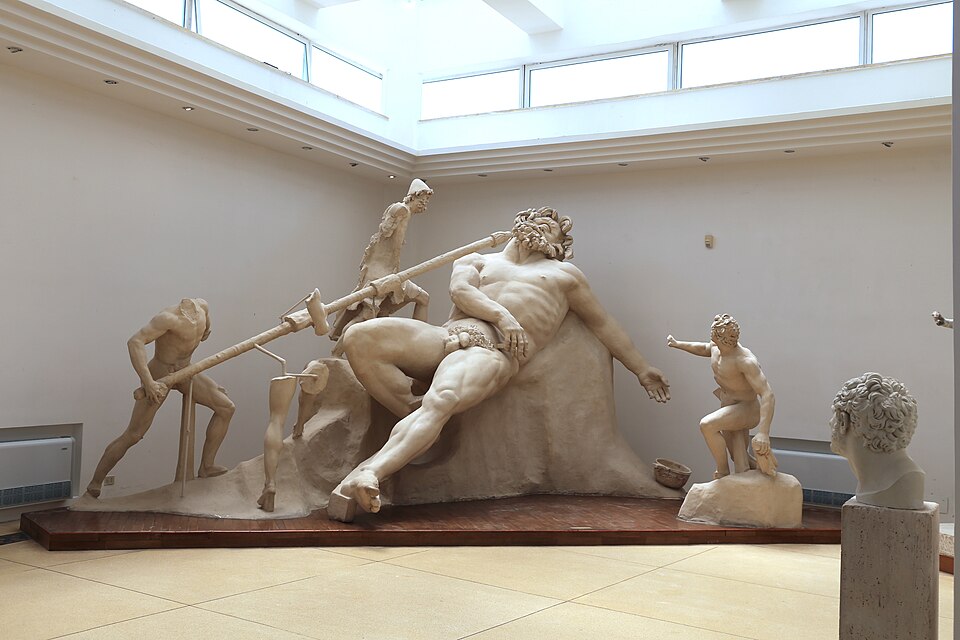
On the coast between Rome and Naples, at a spot called Sperlonga, engineers building a new road in 1957 broke into the grounds of what had once been the seaside villa of the Emperor Tiberius. What they found, and what archaeologist Giulio Iacopi later excavated under proper direction that August, was an enormous cache of shattered ancient sculpture — thousands of fragments scattered through a natural grotto that Tiberius had used as a dining hall facing the sea.
Many scholars believe Tiberius himself commissioned the sculptures that once filled this grotto. Carved in a dramatic, evocative Hellenistic style — described by one classicist as 'a loud, full-blown baroque' — the works are generally dated to the early Imperial period, though they draw on much older Greek storytelling traditions. Their subject was Odysseus, the wandering hero of Homer's epics, portrayed across four major groups arranged around an artificial circular pool that filled most of the cave.
At the rear of the grotto stood the most physically dominant group: the Blinding of Polyphemus, showing the cyclops sprawled drunk while Odysseus and his men prepared their attack. Facing it, on an island in the center of the pool, was a scene of Odysseus's ship under assault by the sea monster Scylla. Two smaller groups flanked the pool's opening toward the sea: one, the so-called 'Pasquino group,' showed a warrior carrying a fallen comrade — most scholars now agree it depicts Odysseus bearing the body of the dead Achilles from the battlefield at Troy, though the same composition elsewhere is linked to Menelaus and Patroclus. The other showed Odysseus poised to betray his companion Diomedes after the two had stolen the sacred Palladium from besieged Troy.
Above the entrance, set into a niche in the cliff face, was a separate figure: Ganymede being carried skyward by an eagle, itself a disguised Zeus. Ancient historians Tacitus and Suetonius both recorded that the grotto collapsed in 26 AD, an accident that nearly killed Tiberius. Whether it was this collapse or a later one that crushed the sculptures into the fragments discovered in 1957 remains uncertain, but the destruction was severe enough that modern reconstructions still have many missing pieces.
The setting itself was designed as an experience. Diners would have watched the sculptural groups from a triclinium, likely under a tent or light pavilion set on a rectangular island within the fish pond that ran into the grotto, and perhaps wandered around the cave itself or even bathed in its pool. The rear of the grotto would have been dim even by day, suggesting the scenes were artificially lit, an effect heightened by decorative touches recorded at the site: fake stalactites and encrustations, a colored opus sectile floor, and a chamber near the Polyphemus group hung with theatrical masks meant to be lit from behind.
More from Art

The Painting With No Foreground
A single robed figure stares out at an empty grey sea — and the emptiness itself became a scandal. When it was unveiled in Berlin in 1810, no one knew quite what to do with it.

The Painter Who Chased the Light
For a few purple minutes each evening, an American exile knelt in an English garden and raced the dying sun to paint two little girls lighting lanterns. It took him two years to finish.

When a President Became a God
Look straight up inside the U.S. Capitol dome and you will find George Washington enthroned among the clouds, surrounded by goddesses — the founding father transformed into myth.

Marble Brought Back to Life
A corpse asleep, a wing barely brushing her skin — and marble somehow learns to breathe. This is the moment Antonio Canova dared to carve.

The World Turned Upside Down
Look closely at a sixteenth-century Flemish village and you'll find a man biting a pillar, another carrying daylight in a basket, and a wife slipping a blue cloak over her husband's shoulders. Every gesture is a joke — if you know the language.

The Girl in the Glass Case
She stood two-thirds life size, dressed in a real tutu and human hair — and the critics who saw her in 1881 recoiled as if she were something obscene.