The Emperor Who Became a Mountain
A seated figure forty feet tall once towered over Rome, its eyes fixed on eternity — and then, for over a thousand years, it lay in pieces, waiting to be reassembled.
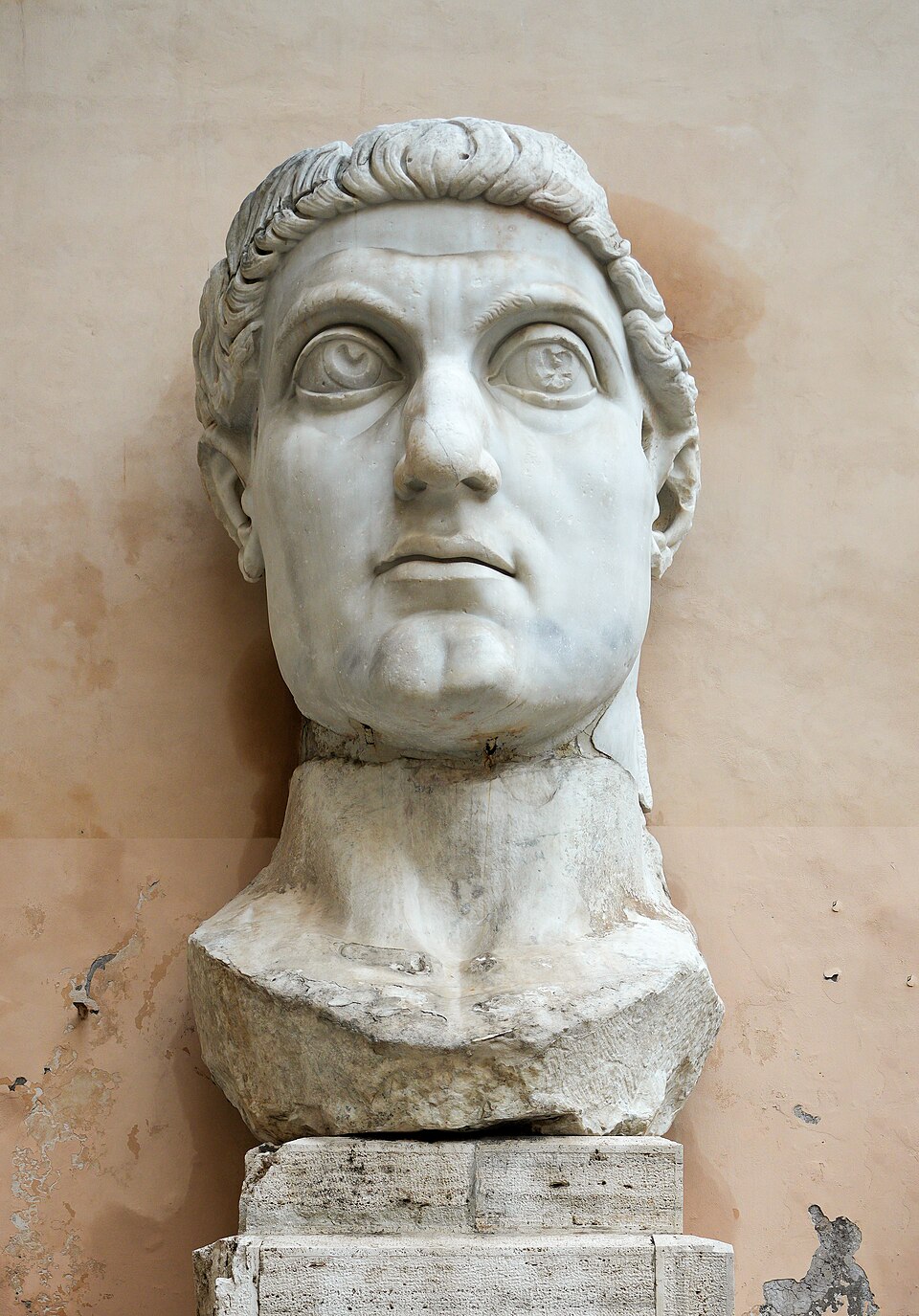
In the early 4th century, anyone standing in the vast Basilica of Maxentius would have felt impossibly small before it: a seated figure roughly 12 meters high, occupying the western apse, its marble head alone about two and a half meters tall and each foot longer than two meters. This was the Colossus of Constantine, and it was not built to be merely admired — it was built to overwhelm.
The statue was acrolithic, a hybrid construction typical of the ancient world's grandest projects. The head, arms, and legs were carved from gleaming white marble, while the torso beneath the drapery was a far humbler affair: a brick core wrapped in a wooden framework, possibly finished with gilded bronze to complete the illusion of a solid golden giant.
According to the historian Eusebius, the emperor's right hand once held a trophy referencing the Passion of Christ, likely a staff bearing the Chi Rho, the same Christian symbol that appeared on coins minted by Constantine around that time. Eusebius also preserved the Latin inscription beneath the statue, in which the emperor declared that through this sign of salvation he had freed Rome from a tyrant's yoke and restored the Senate and People to their former glory.
The sculptors gave the great head a distinctive, otherworldly quality — the hieratic style associated with Constantinian portraiture, all rigid frontality and eyes gazing toward something beyond the human world. Yet the limbs were carved with startling naturalism, down to callused toes and veins bulging in the forearms. It was a deliberate contrast: a god's face on a man's body, an emperor styled as something more than mortal, reflecting, many scholars believe, the Christian deity he had newly embraced.
The basilica itself told a story of conquest. Begun in 307 by Constantine's rival and co-emperor Maxentius, it was seized and completed by Constantine after his victory at the Battle of the Milvian Bridge in 312. Constantine reoriented the building, added a new apse, and placed his colossal likeness at its heart — a monument that was as much political proclamation as religious statement. Scholars believe the statue was first created around 312–315, then substantially reworked sometime after 325, based on stylistic evidence.
More from Art

The Painting With No Foreground
A single robed figure stares out at an empty grey sea — and the emptiness itself became a scandal. When it was unveiled in Berlin in 1810, no one knew quite what to do with it.

The Painter Who Chased the Light
For a few purple minutes each evening, an American exile knelt in an English garden and raced the dying sun to paint two little girls lighting lanterns. It took him two years to finish.

When a President Became a God
Look straight up inside the U.S. Capitol dome and you will find George Washington enthroned among the clouds, surrounded by goddesses — the founding father transformed into myth.

Marble Brought Back to Life
A corpse asleep, a wing barely brushing her skin — and marble somehow learns to breathe. This is the moment Antonio Canova dared to carve.

The World Turned Upside Down
Look closely at a sixteenth-century Flemish village and you'll find a man biting a pillar, another carrying daylight in a basket, and a wife slipping a blue cloak over her husband's shoulders. Every gesture is a joke — if you know the language.

The Girl in the Glass Case
She stood two-thirds life size, dressed in a real tutu and human hair — and the critics who saw her in 1881 recoiled as if she were something obscene.