The Empty Frame at the Gardner
In the small hours of March 18, 1990, two men dressed as policemen walked into a Boston museum and walked out with a Vermeer worth more than any painting on Earth. It has never been seen since.
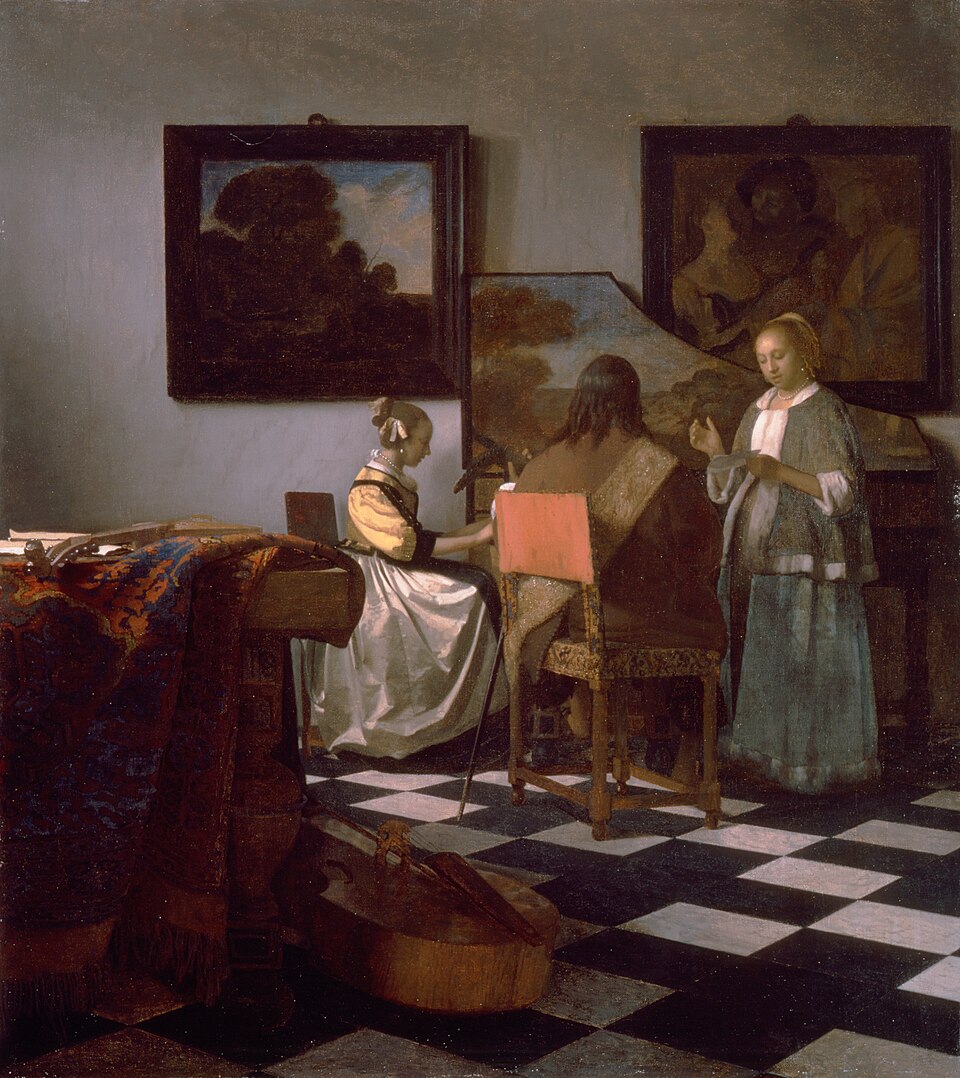
On a quiet night in Boston, two men in police uniforms rang the bell of the Isabella Stewart Gardner Museum. It was March 18, 1990, and by the time they left, thirteen works of art were gone from the walls, including a small, luminous canvas by Johannes Vermeer known as The Concert.
The painting shows three figures caught in a moment of shared music: a young woman at a harpsichord, a man playing the lute, and a woman singing beside them. Their clothing and surroundings mark them as members of the upper bourgeoisie — the lute player, for instance, wears a shoulder belt and a sword. A viola da gamba lies on the floor nearby. Measuring 28.5 by 25.5 inches (72.5 by 64.7 centimetres), it is an intimate scene, but one steeped in the textures of wealth — a black and white marble floor and a harpsichord lid painted with an Arcadian landscape.
Behind the musicians hang two paintings, and neither is there by accident. On the right is Dirck van Baburen's The Procuress, a real work owned by Vermeer's mother-in-law, Maria Thins, and one that also appears in his later painting Lady Seated at a Virginal. On the left is a wild pastoral landscape. Their presence hints at the ambiguous undercurrents Dutch painters often wove into scenes of music — love, seduction, and the quiet tension between domestic order and desire.
The Concert is generally dated to around 1664, though it does not appear in written records until 1780, leaving over a century of its early life undocumented. It resurfaced properly in 1892, when Isabella Stewart Gardner bought it at a Paris auction for $5,000 — a fortune at the time, though a fraction of what the painting would one day be worth. She placed it in the museum she built in Boston to house her collection, where it remained for nearly a century.
Then came the theft. The thieves' method was disarmingly simple: posing as police officers responding to a disturbance, they talked their way past museum security and spent over an hour looting galleries. The Concert was among the most valuable of their haul, and its disappearance instantly became one of the largest unsolved art heists in history.
More from Art

The Painting With No Foreground
A single robed figure stares out at an empty grey sea — and the emptiness itself became a scandal. When it was unveiled in Berlin in 1810, no one knew quite what to do with it.

The Painter Who Chased the Light
For a few purple minutes each evening, an American exile knelt in an English garden and raced the dying sun to paint two little girls lighting lanterns. It took him two years to finish.

When a President Became a God
Look straight up inside the U.S. Capitol dome and you will find George Washington enthroned among the clouds, surrounded by goddesses — the founding father transformed into myth.

Marble Brought Back to Life
A corpse asleep, a wing barely brushing her skin — and marble somehow learns to breathe. This is the moment Antonio Canova dared to carve.

The World Turned Upside Down
Look closely at a sixteenth-century Flemish village and you'll find a man biting a pillar, another carrying daylight in a basket, and a wife slipping a blue cloak over her husband's shoulders. Every gesture is a joke — if you know the language.

The Girl in the Glass Case
She stood two-thirds life size, dressed in a real tutu and human hair — and the critics who saw her in 1881 recoiled as if she were something obscene.