The Finger in the Wound: Caravaggio's Doubting Thomas
An apostle presses his dirty fingernail into a wound and, in that single unflinching gesture, Caravaggio makes disbelief itself visible.
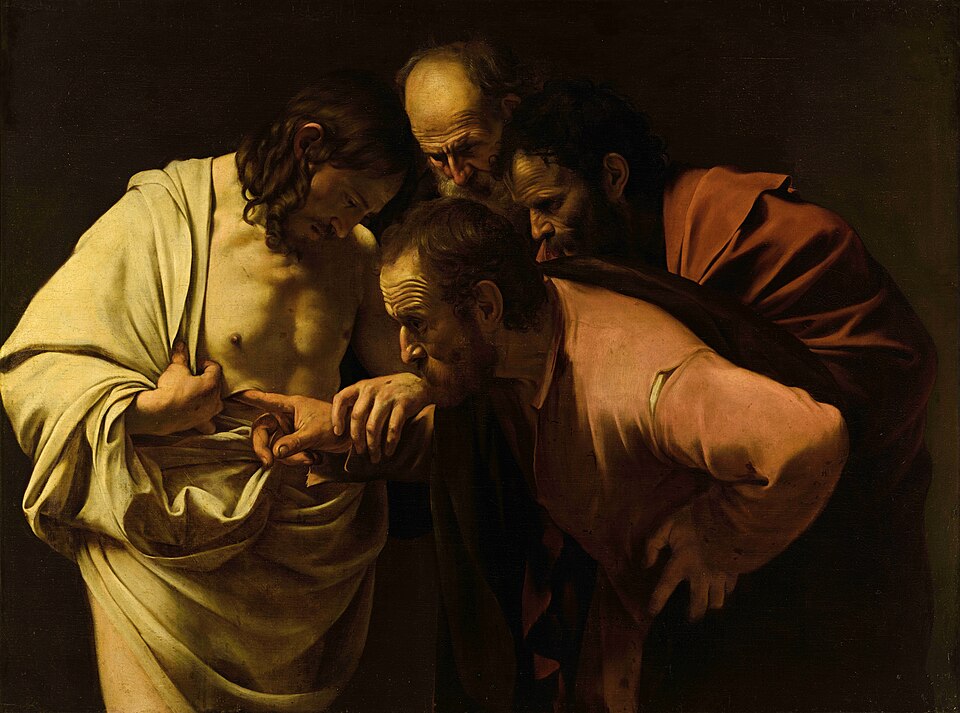
Around 1601 or 1602, in a Rome obsessed with light and shadow, Caravaggio painted a moment the Gospel of John describes in a few blunt lines: Thomas the Apostle, absent when the risen Jesus first appeared to the others, refuses to believe unless he can see the nail marks and put his hand into Christ's side. A week later Jesus returns and tells him to do exactly that — touch, and stop doubting.
Caravaggio does not soften the moment. He shows Thomas's finger actually inside the wound, Christ's own hand guiding it there. Thomas is painted like a peasant, his robe torn at the shoulder, dirt visible under his fingernails — a deliberately unglamorous stand-in for human skepticism confronting the impossible.
Behind him stand two other apostles, likely Peter and John, their faces creased with the same anxious astonishment. The four heads are pressed close together in the frame, forming a triangle of gazes that funnels all attention toward that single point of contact between finger and flesh.
Light does the theological work here. Caravaggio's chiaroscuro falls on Christ's forehead, profile, and open side, marking him as both physically present and quietly divine — notably, without a halo. The shadows sweeping over Thomas represent his doubt, but as his hand touches Christ, he is pulled into that same light.
The composition is built on intersecting axes: a horizontal line running through Thomas's arm and Christ's guiding hands, a vertical one dropping from the apostles' heads to Thomas's neck, and an arch formed by the backs of Thomas and Christ. It is a tightly engineered scene, yet it feels startlingly immediate — Caravaggio essentially photographs the instant of revelation.
More from Art

The Painting With No Foreground
A single robed figure stares out at an empty grey sea — and the emptiness itself became a scandal. When it was unveiled in Berlin in 1810, no one knew quite what to do with it.

The Painter Who Chased the Light
For a few purple minutes each evening, an American exile knelt in an English garden and raced the dying sun to paint two little girls lighting lanterns. It took him two years to finish.

When a President Became a God
Look straight up inside the U.S. Capitol dome and you will find George Washington enthroned among the clouds, surrounded by goddesses — the founding father transformed into myth.

Marble Brought Back to Life
A corpse asleep, a wing barely brushing her skin — and marble somehow learns to breathe. This is the moment Antonio Canova dared to carve.

The World Turned Upside Down
Look closely at a sixteenth-century Flemish village and you'll find a man biting a pillar, another carrying daylight in a basket, and a wife slipping a blue cloak over her husband's shoulders. Every gesture is a joke — if you know the language.

The Girl in the Glass Case
She stood two-thirds life size, dressed in a real tutu and human hair — and the critics who saw her in 1881 recoiled as if she were something obscene.