The Firing Squad and the Faceless Light
A man throws his arms wide before the muzzles, and for the first time in Western art, war has no glory left in it — only blood, lanterns, and a wall.
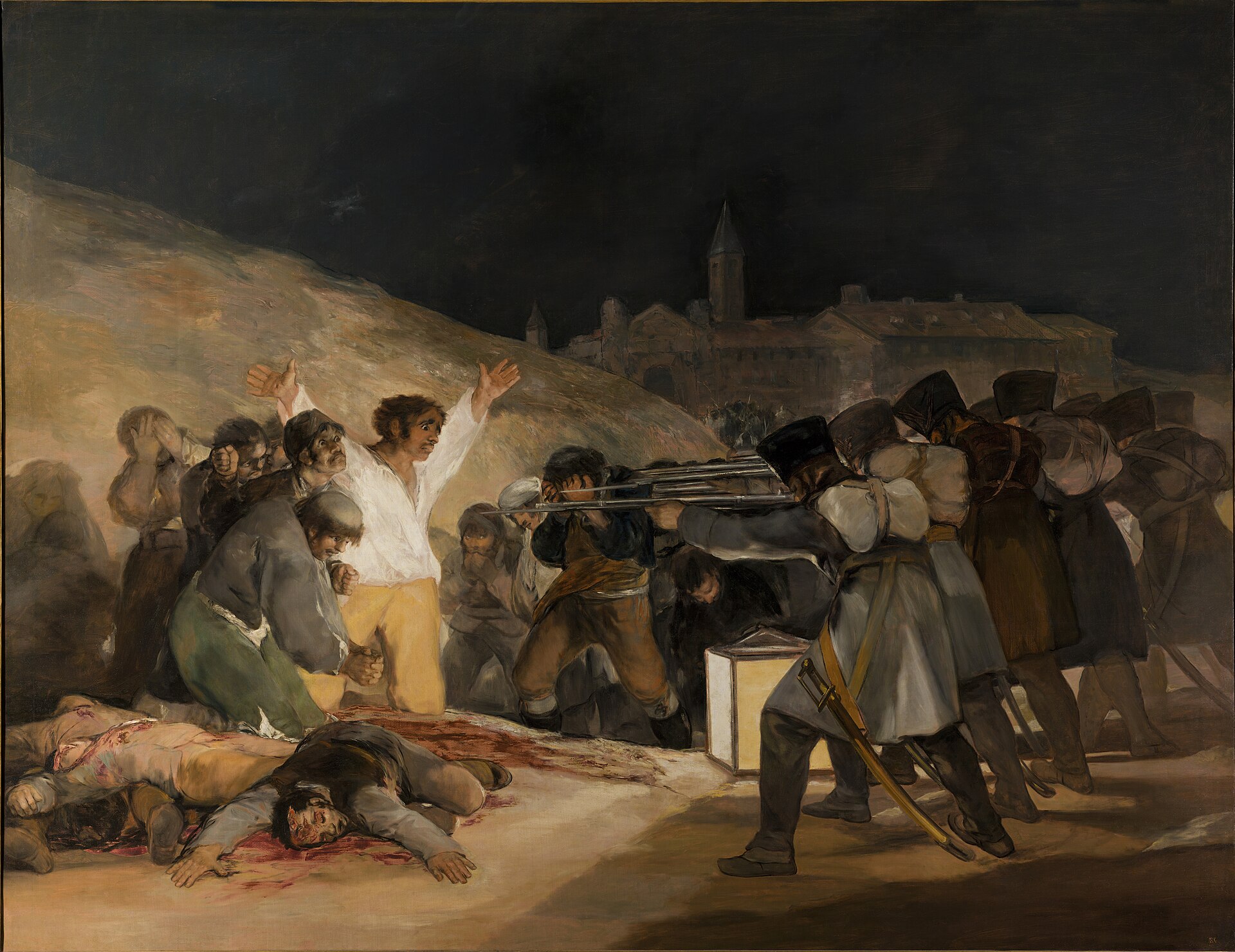
In the predawn dark of May 3, 1808, a line of Spaniards was marched to a hillside outside Madrid and shot. They had been rounded up the night before, arms in hand or simply unlucky, after the people of the city rose against the French occupation in what became known as the Dos de Mayo Uprising. Marshal Joachim Murat, commanding Napoleon's forces, had already promised vengeance: French blood had flowed, and it demanded reprisal. Anyone arrested in the uprising would be shot. Hundreds died that night and the next morning at several sites around the city.
Six years later, in 1814, the Spanish painter Francisco Goya turned that massacre into a painting: The Third of May 1808 in Madrid. It was commissioned, at Goya's own suggestion, by the provisional government restored after Ferdinand VII returned to the throne and the French were driven out. Goya proposed it alongside a companion piece, The Second of May 1808, which shows the earlier cavalry battle in the Puerta del Sol. But it is the Third of May that has endured as one of the most unflinching images ever made of state violence.
The painting shows no battle, no heroism in the traditional sense — only an execution. A faceless line of French soldiers, rifles raised, face a huddle of condemned Spaniards lit by a single square lantern on the ground. One man, arms flung open, white shirt glowing, stands exposed before the guns in a pose art historians have long linked to older images of martyrdom, though Goya strips it of any comforting religious promise. Around him are men already dead or dying, faces buried in their hands, unable to watch.
To understand why this scene happened at all, you have to go back to the tangled politics that dragged Spain into war. Napoleon Bonaparte, having declared himself First Consul in 1799 and crowned emperor in 1804, saw Spain as strategically vital because it controlled access to the Mediterranean. Spain's king, Charles IV, was widely seen as weak and ineffectual, and his prime minister Manuel de Godoy was lured into a scheme to jointly conquer and divide Portugal with France. Godoy failed to see that Napoleon's real ambition was to seize Spain itself, and that Ferdinand VII, the king's own son, was scheming to use the French alliance to force his father from the throne.
In November 1807, 23,000 French troops entered Spain under the pretext of reinforcing the march to Lisbon. Resistance was scattered until February 1808, when Napoleon's intentions became clear. Ferdinand forced his father's abdication on March 19, 1808, only to find himself outmaneuvered — Napoleon compelled him to hand the crown to Joseph Bonaparte. The Spanish public, who had tolerated foreign monarchs before, would not tolerate this. When rumors spread on May 2 that the last members of the royal family would be deported to France, Madrid rose up in fury.
More from Art

The Painting With No Foreground
A single robed figure stares out at an empty grey sea — and the emptiness itself became a scandal. When it was unveiled in Berlin in 1810, no one knew quite what to do with it.

The Painter Who Chased the Light
For a few purple minutes each evening, an American exile knelt in an English garden and raced the dying sun to paint two little girls lighting lanterns. It took him two years to finish.

When a President Became a God
Look straight up inside the U.S. Capitol dome and you will find George Washington enthroned among the clouds, surrounded by goddesses — the founding father transformed into myth.

Marble Brought Back to Life
A corpse asleep, a wing barely brushing her skin — and marble somehow learns to breathe. This is the moment Antonio Canova dared to carve.

The World Turned Upside Down
Look closely at a sixteenth-century Flemish village and you'll find a man biting a pillar, another carrying daylight in a basket, and a wife slipping a blue cloak over her husband's shoulders. Every gesture is a joke — if you know the language.

The Girl in the Glass Case
She stood two-thirds life size, dressed in a real tutu and human hair — and the critics who saw her in 1881 recoiled as if she were something obscene.