The Floor That Remembered a Battle
In a wealthy Roman's dining room, four million tiny stones froze the moment a king lost his nerve — and an empire.
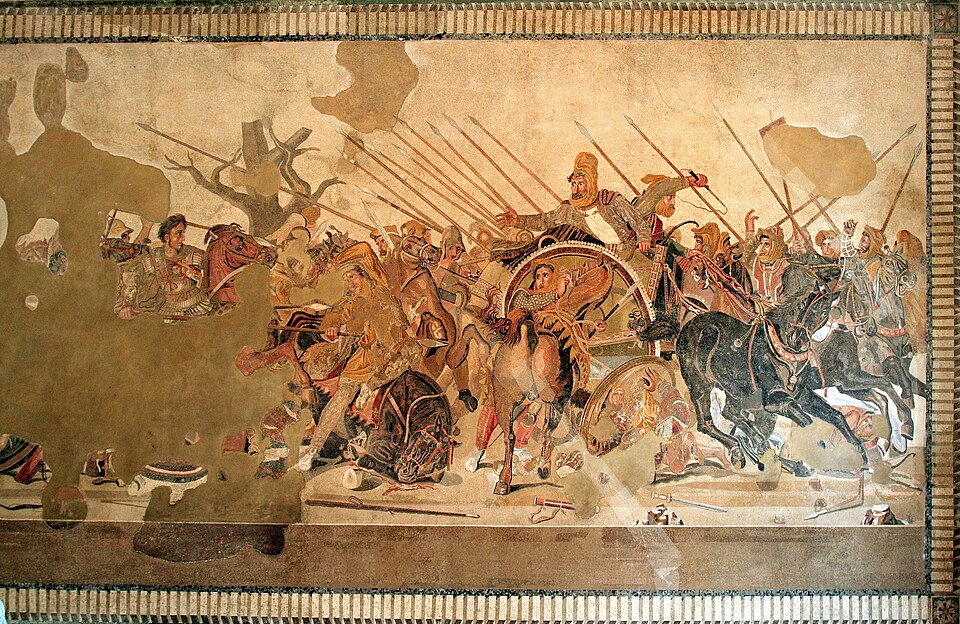
Sometime around 120 to 100 BC, in the House of the Faun in Pompeii, a craftsman set the final tessera into a floor that would outlast the empire it celebrated. The scene beneath the diners' feet was not Roman at all in subject: it showed a battle between Alexander of Macedonia and Darius III of Persia, most likely the Battle of Issus, fought centuries earlier in a mountain pass far from Italy.
The mosaic crowds more than fifty men into a single dramatic instant. On the left, Alexander rides Bucephalus bareheaded, his curly hair loose, his lance driven through an enemy cavalryman whose horse is collapsing beneath him. He wears a linen breastplate marked with the Gorgon's head, Athena's old emblem, and his eyes are fixed on one man only: Darius.
On the right, the Persian king is caught mid-collapse of will. He reaches toward a dying soldier even as his own chariot is being wheeled away from the fighting. His charioteer whips the horses toward escape. Darius holds a bow in one hand, his other arm stretched helplessly toward Alexander, his brow furrowed with visible fear. In front of the chariot, his brother Oxyathres grips the reins, sacrificing himself to buy the king's escape.
The most startling figure may be the horse turned away from the viewer, its hindquarters filling the foreground, tail raised, rendered in a radical foreshortening rare for ancient art. Nearby, a fallen Persian soldier watches his own death reflected in the surface of a shield, a small frozen tragedy amid the chaos of spears and clashing metal.
The technical achievement matches the drama. The mosaic is built from roughly one and a half million — by some estimates more than four million — tiny colored tesserae, each about two millimeters wide, set in the flowing technique called opus vermiculatum, or 'worm work,' for the way the curving rows seem to crawl like a worm across the floor. The palette stays deliberately restrained: reds, yellows, black, and white, drawn entirely from marble found in nature, since no other pigments were used.
More from Art

The Painting With No Foreground
A single robed figure stares out at an empty grey sea — and the emptiness itself became a scandal. When it was unveiled in Berlin in 1810, no one knew quite what to do with it.

The Painter Who Chased the Light
For a few purple minutes each evening, an American exile knelt in an English garden and raced the dying sun to paint two little girls lighting lanterns. It took him two years to finish.

When a President Became a God
Look straight up inside the U.S. Capitol dome and you will find George Washington enthroned among the clouds, surrounded by goddesses — the founding father transformed into myth.

Marble Brought Back to Life
A corpse asleep, a wing barely brushing her skin — and marble somehow learns to breathe. This is the moment Antonio Canova dared to carve.

The World Turned Upside Down
Look closely at a sixteenth-century Flemish village and you'll find a man biting a pillar, another carrying daylight in a basket, and a wife slipping a blue cloak over her husband's shoulders. Every gesture is a joke — if you know the language.

The Girl in the Glass Case
She stood two-thirds life size, dressed in a real tutu and human hair — and the critics who saw her in 1881 recoiled as if she were something obscene.