The Frescoes That Ate a Man's Weight in Detroit
For eight punishing months, a Mexican painter lived inside a Ford factory's rhythms, losing a hundred pounds to give the walls of a museum the pulse of an assembly line.
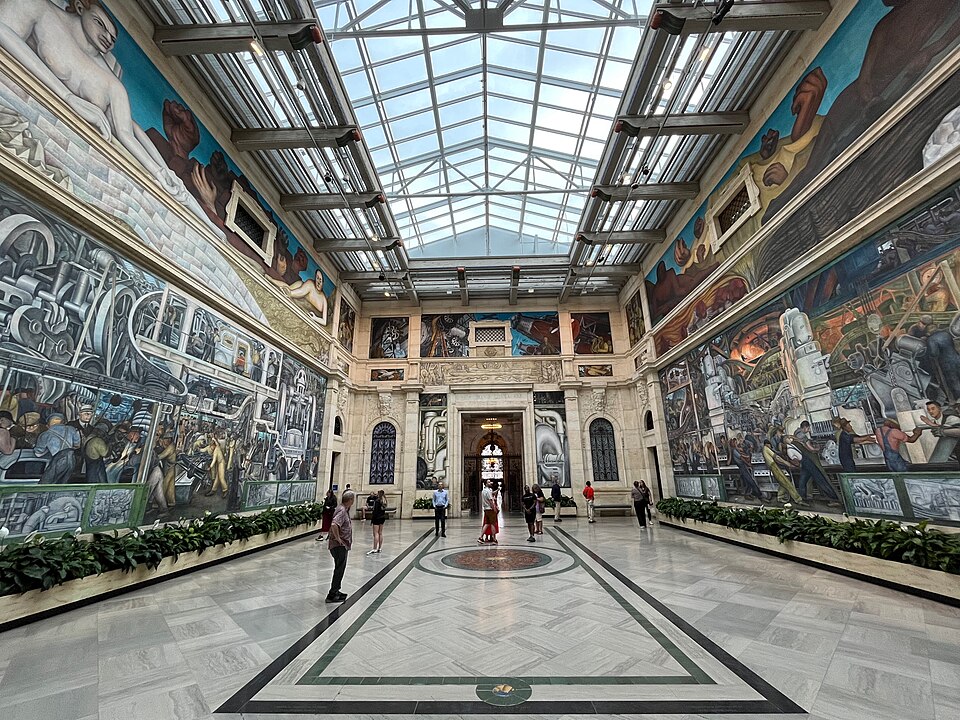
In 1932, Wilhelm Valentiner, director of the Detroit Institute of Arts, invited Diego Rivera to fill the museum's interior courtyard with murals celebrating the industries of Detroit. Rivera had recently finished a mural at the California School of Fine Arts that revealed both his technical mastery and his fascination with American industrial modernity, and Valentiner believed he was the right artist to capture the city's factories. The museum agreed to cover materials, while Rivera would pay his assistants out of his own fee, and Edsel Ford contributed $20,000 to make the commission possible.
Valentiner's proposal left the subject largely open, suggesting only that Rivera might find inspiration in the industry of the town, but leaving the final decision to the artist. Rivera embraced the challenge fully. He spent three months touring the Ford River Rouge Complex, producing hundreds of sketches, aided by the plant's official photographer, W. J. Stettler, who helped him gather visual reference material.
Rivera was captivated by the scale and modernity of Detroit's factories, but his curiosity extended beyond automobiles. He also spent time at the Parke-Davis pharmaceutical plant, researching the chemical and medical industries that would eventually find their way into the murals as well.
Completing all 27 panels took Rivera and his team just eight months, an extraordinary pace for such a vast undertaking. The work demanded fifteen-hour days without breaks, and Rivera lost 100 pounds over the course of the project. He was known for paying his assistants poorly, and at one point they staged a protest demanding higher wages.
The murals were painted against the backdrop of the Great Depression, when one in four Detroit laborers was unemployed and Ford workers were pushing for better pay and conditions. Six thousand workers went on strike, an effort that was ultimately sabotaged; five men died in the resulting violence and others were wounded. This charged atmosphere of protest against one of the world's most powerful industries likely shaped Rivera's vision.
More from Art

The Painting With No Foreground
A single robed figure stares out at an empty grey sea — and the emptiness itself became a scandal. When it was unveiled in Berlin in 1810, no one knew quite what to do with it.

The Painter Who Chased the Light
For a few purple minutes each evening, an American exile knelt in an English garden and raced the dying sun to paint two little girls lighting lanterns. It took him two years to finish.

When a President Became a God
Look straight up inside the U.S. Capitol dome and you will find George Washington enthroned among the clouds, surrounded by goddesses — the founding father transformed into myth.

Marble Brought Back to Life
A corpse asleep, a wing barely brushing her skin — and marble somehow learns to breathe. This is the moment Antonio Canova dared to carve.

The World Turned Upside Down
Look closely at a sixteenth-century Flemish village and you'll find a man biting a pillar, another carrying daylight in a basket, and a wife slipping a blue cloak over her husband's shoulders. Every gesture is a joke — if you know the language.

The Girl in the Glass Case
She stood two-thirds life size, dressed in a real tutu and human hair — and the critics who saw her in 1881 recoiled as if she were something obscene.