The Giant Who Watched Over Rhodes
For twelve years, molten bronze and buried earth mounds slowly built a god taller than any statue the world had seen. Then, in one night of shaking ground, he fell — and lay broken for eight centuries.
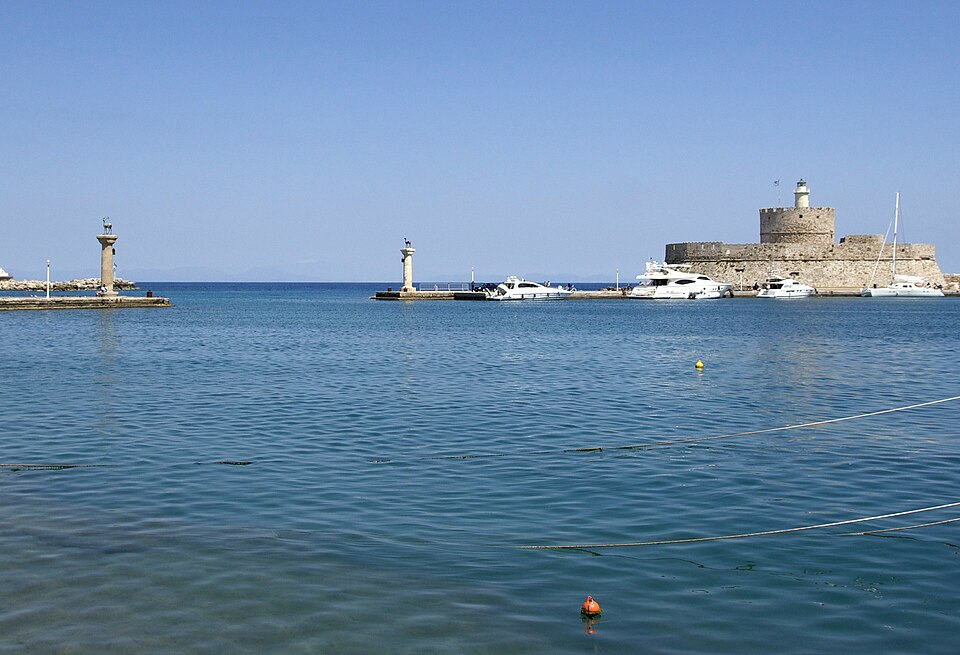
In 305 BC, the island of Rhodes faced annihilation. Demetrius I of Macedon, son of Antigonus I Monophthalmus, laid siege to the city with a massive army and navy, determined to punish Rhodes for its alliance with Ptolemy I of Egypt. For a year the Rhodians held out, and when a relief fleet sent by Ptolemy finally arrived, Demetrius abandoned the siege, leaving behind most of his enormous siege equipment.
Rather than let the machinery rust, the Rhodians sold it for 300 talents. With that fortune, they resolved to honor Helios, their patron sun god, with a monument worthy of their deliverance. The task fell to Chares of Lindos, a local sculptor who had trained under Lysippos, the man who had once cast a 22-metre bronze Zeus at Tarentum. Chares would need to surpass even that.
Construction began in 292 BC. According to Philo of Byzantium, Chares built the statue in situ, casting it in horizontal sections and burying each completed layer under mounds of earth before casting the next section atop it — working his way skyward level by level. The statue rose from a marble pedestal at least 18 metres wide, standing 15 metres tall, near the entrance to the harbor of Rhodes.
The body was ingeniously engineered for its era: iron tie bars radiating from the ankles gave the legs their frame, while curved bronze plates, each about 1.5 metres square, were riveted together into rings that thickened toward the base — 25 millimetres at the lower legs, thinning to under a centimetre near the shoulders and neck, where extra reinforcement was added at the joints. Much of the iron and bronze had a poetic origin: it came from the very weapons and siege towers Demetrius's army had abandoned.
After twelve years of labor, the Colossus was completed in 280 BC — a bronze giant approximately 32 metres tall, about two-thirds the height of the modern Statue of Liberty from feet to crown. It was the tallest statue in the ancient world, and its dedication was later preserved in Greek poetic anthologies.
More from Art

The Painting With No Foreground
A single robed figure stares out at an empty grey sea — and the emptiness itself became a scandal. When it was unveiled in Berlin in 1810, no one knew quite what to do with it.

The Painter Who Chased the Light
For a few purple minutes each evening, an American exile knelt in an English garden and raced the dying sun to paint two little girls lighting lanterns. It took him two years to finish.

When a President Became a God
Look straight up inside the U.S. Capitol dome and you will find George Washington enthroned among the clouds, surrounded by goddesses — the founding father transformed into myth.

Marble Brought Back to Life
A corpse asleep, a wing barely brushing her skin — and marble somehow learns to breathe. This is the moment Antonio Canova dared to carve.

The World Turned Upside Down
Look closely at a sixteenth-century Flemish village and you'll find a man biting a pillar, another carrying daylight in a basket, and a wife slipping a blue cloak over her husband's shoulders. Every gesture is a joke — if you know the language.

The Girl in the Glass Case
She stood two-thirds life size, dressed in a real tutu and human hair — and the critics who saw her in 1881 recoiled as if she were something obscene.