The Gift Chicago Didn't Ask For
A 50-foot steel head appeared in a plaza of gangster city, and nobody — not even the artist — could agree on what it was.
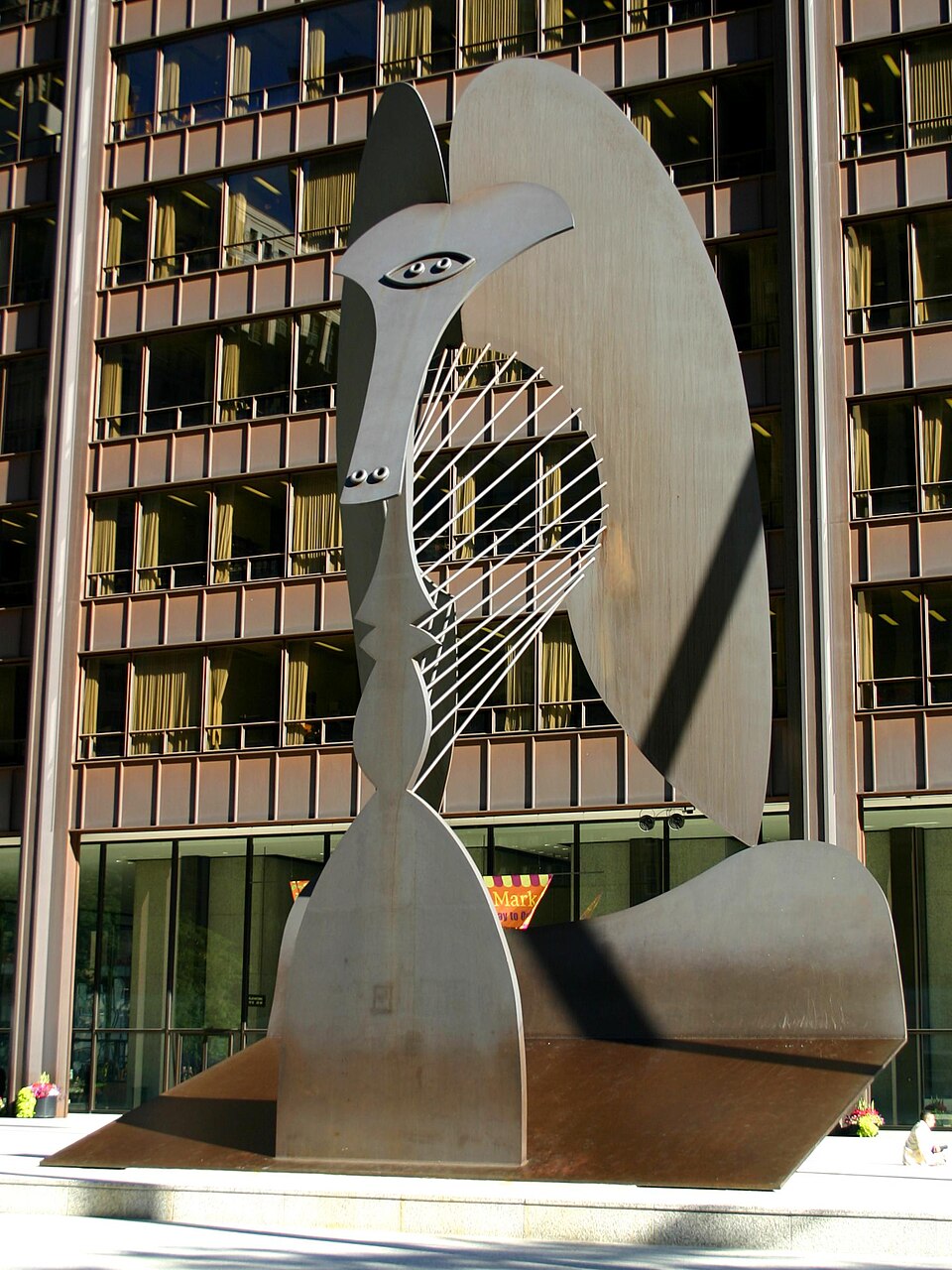
On August 15, 1967, in the granite plaza of the newly built Chicago Civic Center, a crowd gathered beneath 162 short tons (147 metric tons) of COR-TEN steel that had no name and, officially, no clear subject. It stood 50 feet tall, its rusted brown surface already weathering into the color of the city around it. This was the Chicago Picasso, and it would change what public art in America was allowed to look like.
The sculpture began not with a commission letter but with a poem. Richard Bennett, one of the architects working on the Daley Center project, wrote Pablo Picasso verse asking him to design something for the plaza. Picasso, who famously refused commissioned work, said yes, joking that he was now involved with 'the two great gangster cities' — Chicago and Marseille. The deal was brokered by architect William Hartmann of Skidmore, Owings & Merrill, and by 1965 Picasso had completed a maquette; a final model was approved in 1966.
Building it was an industrial undertaking as much as an artistic one. The steel was rolled at the U.S. Steel Gary Works, in the largest plate mill of its kind in the world at the time, then fabricated by the American Bridge Company in Gary, Indiana, disassembled, and shipped to Chicago. A 12-foot wooden model was built first for Picasso's approval before construction began; ground broke in Daley Plaza on May 25, 1967. The full cost came to $351,959.17, paid mostly by three charitable foundations — the Woods Charitable Fund, the Chauncey and Marion Deering McCormick Foundation, and the Field Foundation of Illinois. Picasso himself was offered $100,000 for his work. He refused it, insisting the sculpture be a gift to the city.
That generosity didn't buy goodwill immediately. Chicago's public sculpture, before this, had mostly honored historical figures on horseback or in bronze busts. This alien, faceless form baffled and irritated many. Alderman John Hoellen proposed replacing it outright with a statue of Cubs legend Ernie Banks. Publicist Algis Budrys, working for a pickle company client, erected a giant pickle on the site as a jab. Columnist Mike Royko was blunter still, describing it in print as having 'a long stupid face' and looking 'like some giant insect about to eat a smaller, weaker insect' — though he conceded Picasso had somehow captured the soul of the city, comparing its eyes to those of slumlords and bribed building inspectors.
What exactly was it? Guesses multiplied: a bird, an aardvark, a baboon, the Egyptian god Anubis. Picasso himself later told researcher Stanley Coren that the head was an abstract rendering of his Afghan Hound, Kabul, describing the dog's elegance and the way he moved, and admitting he thought of Kabul sometimes while working on the piece.
More from Art

The Painting With No Foreground
A single robed figure stares out at an empty grey sea — and the emptiness itself became a scandal. When it was unveiled in Berlin in 1810, no one knew quite what to do with it.

The Painter Who Chased the Light
For a few purple minutes each evening, an American exile knelt in an English garden and raced the dying sun to paint two little girls lighting lanterns. It took him two years to finish.

When a President Became a God
Look straight up inside the U.S. Capitol dome and you will find George Washington enthroned among the clouds, surrounded by goddesses — the founding father transformed into myth.

Marble Brought Back to Life
A corpse asleep, a wing barely brushing her skin — and marble somehow learns to breathe. This is the moment Antonio Canova dared to carve.

The World Turned Upside Down
Look closely at a sixteenth-century Flemish village and you'll find a man biting a pillar, another carrying daylight in a basket, and a wife slipping a blue cloak over her husband's shoulders. Every gesture is a joke — if you know the language.

The Girl in the Glass Case
She stood two-thirds life size, dressed in a real tutu and human hair — and the critics who saw her in 1881 recoiled as if she were something obscene.