The Girl Who Painted Discomfort
A seventeen-year-old girl signed her name into a stone step and, in doing so, quietly rewrote a familiar biblical scene that generations of men had painted as spectacle.
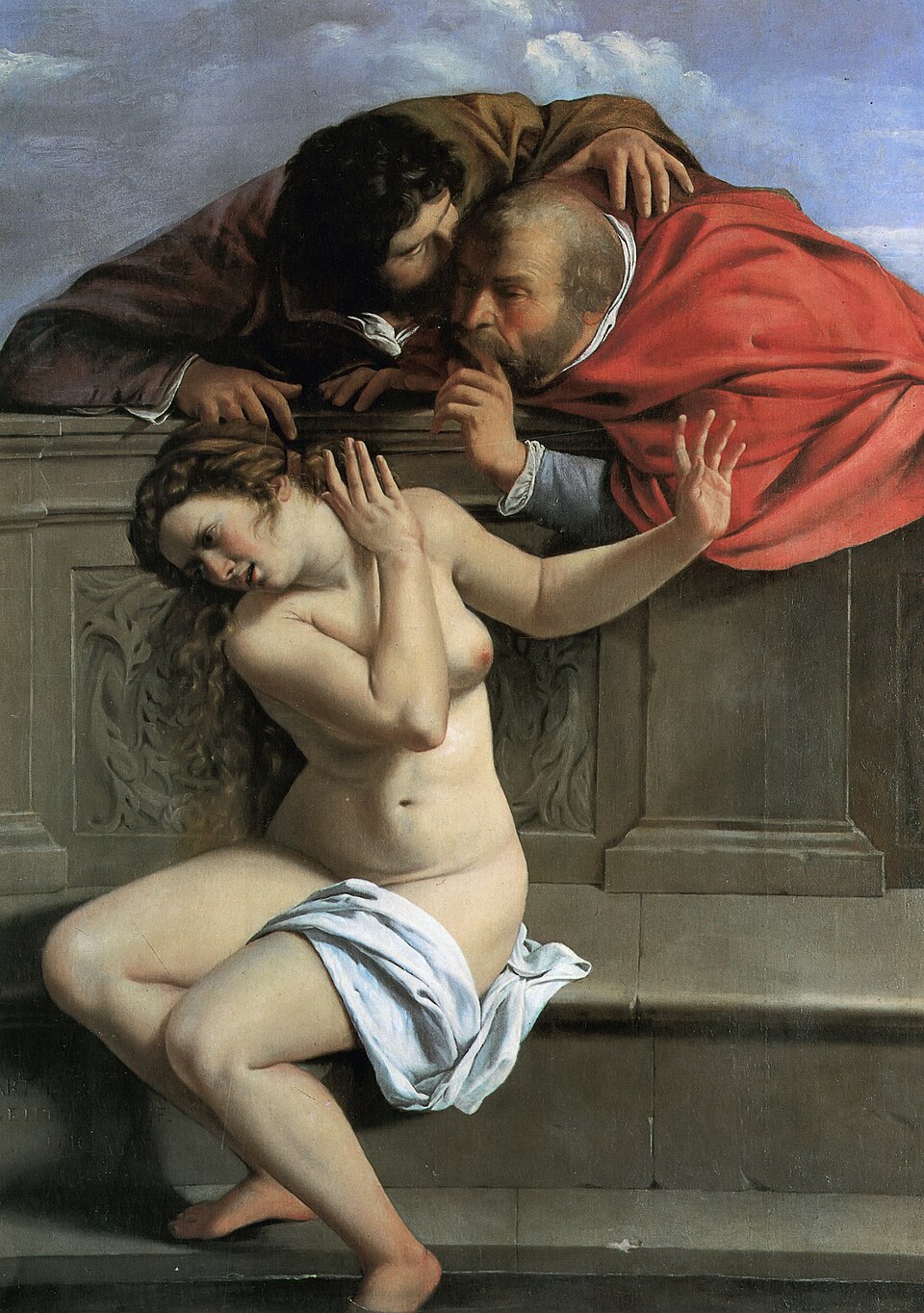
In 1610, in a Roman studio, a teenage painter named Artemisia Gentileschi completed a canvas that would become her earliest known signed and dated work. The subject was one of the most popular in Baroque art: Susanna and the Elders, drawn from chapter 13 of the Book of Daniel as preserved in Catholic and Eastern Orthodox scripture. Susanna, a young married woman, is bathing in her garden when two elders hidden nearby demand sexual favors. She refuses. They threaten her reputation, then falsely accuse her of adultery, a crime punishable by death, until the young Daniel exposes their contradictory testimony and clears her name.
The scene had long been a favorite of European painters since the sixteenth century, prized for letting Susanna embody virtues of modesty and fidelity while simultaneously giving artists an excuse to render the female nude for the pleasure of male patrons. Most versions showed a Susanna who seemed untroubled by her ordeal, her body arranged for the viewer's gaze rather than her own distress.
Gentileschi's Susanna is different. She sits uncomfortably, her body twisted in a way that visibly conveys distress. Compared to Annibale Carracci's treatment of the same subject, whose Susanna appears almost receptive to the elders' attention despite a more masculine physique, Gentileschi's figure is both more feminine and unmistakably in anguish. Rather than following the conventional body type used by earlier painters, she gave Susanna a classical form that elevates the nudity into something heroic rather than merely decorative.
The setting itself breaks from tradition. Instead of the customary garden, Gentileschi places Susanna in a stone enclosure, and her vertical composition pushes the two elders to the top of the frame, looming over the scene like a dark, malevolent pressure bearing down on her.
More from Art

The Painting With No Foreground
A single robed figure stares out at an empty grey sea — and the emptiness itself became a scandal. When it was unveiled in Berlin in 1810, no one knew quite what to do with it.

The Painter Who Chased the Light
For a few purple minutes each evening, an American exile knelt in an English garden and raced the dying sun to paint two little girls lighting lanterns. It took him two years to finish.

When a President Became a God
Look straight up inside the U.S. Capitol dome and you will find George Washington enthroned among the clouds, surrounded by goddesses — the founding father transformed into myth.

Marble Brought Back to Life
A corpse asleep, a wing barely brushing her skin — and marble somehow learns to breathe. This is the moment Antonio Canova dared to carve.

The World Turned Upside Down
Look closely at a sixteenth-century Flemish village and you'll find a man biting a pillar, another carrying daylight in a basket, and a wife slipping a blue cloak over her husband's shoulders. Every gesture is a joke — if you know the language.

The Girl in the Glass Case
She stood two-thirds life size, dressed in a real tutu and human hair — and the critics who saw her in 1881 recoiled as if she were something obscene.