The Girl Who Shredded Herself
A hooded bidder pays over a million pounds for a Banksy. Seconds later, the painting starts eating itself.
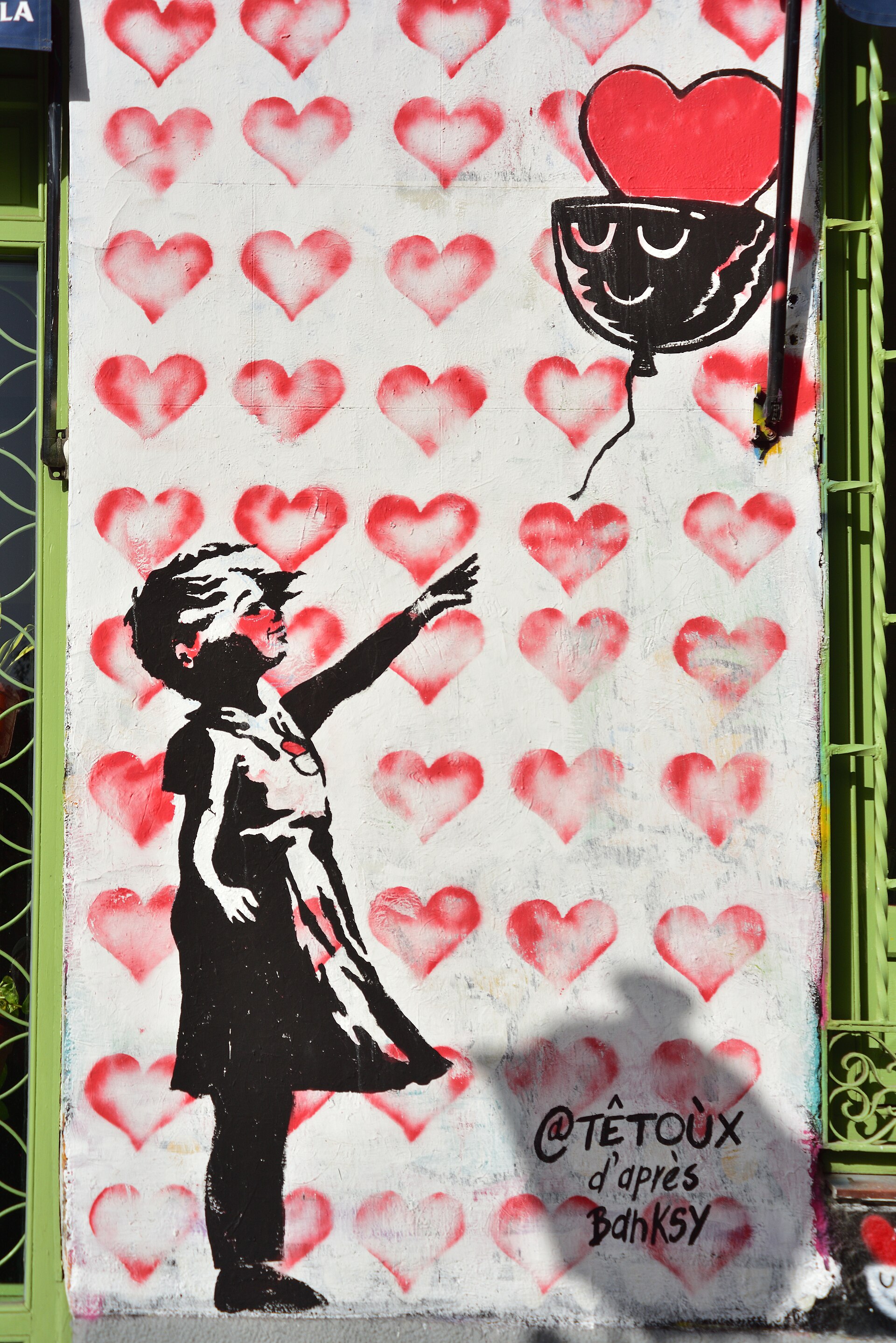
In 2002, on a wall somewhere in London, a stencil appeared: a small girl, arm outstretched, fingers open toward a red heart-shaped balloon slipping away on the wind. Beside it ran a simple line — 'There is always hope.' It was signed, in spirit if not in name, by the elusive street artist Banksy, and it would go on to become one of the most reproduced images of the 21st century.
The image migrated across the city over the following years. Versions turned up on Waterloo Bridge, in Shoreditch, on a shop wall on Old Street. None of these original London murals survive today — they were painted over, removed, or lost to time. But their disappearance only fed the myth. An initial set of 25 signed prints was produced in 2003, followed in 2004/2005 by a set of 150 signed prints and a set of 600 unsigned prints, plus 88 colored artist proofs in blue, pink, gold, and purple. What had been disposable street art was becoming a market commodity.
Banksy kept returning to the girl and her balloon whenever the world gave him a reason. In August 2005 he painted her floating above the West Bank barrier clutching a bunch of balloons, a piece called Balloon Debate. In March 2014, marking three years of the Syrian conflict, he reworked her into a veiled refugee girl and released the image with the hashtag #WithSyria, projected onto the Eiffel Tower and Nelson's Column, paired with an animated film narrated by Idris Elba with music by Elbow. Justin Bieber briefly got a tattoo based on it. Banksy's only comment, posted to Facebook alongside the tattoo photo, was one word: 'Controversial.'
The image found its way into politics too. Before the 2017 UK general election, Banksy released a version with the balloon rendered in Union Jack colors, offering free prints to voters who could prove they'd voted against the Conservatives. The Electoral Commission warned this could amount to bribery and invalidate results in affected constituencies; Banksy withdrew the offer within days. Later that year, a Samsung poll of 2,000 people crowned Girl with Balloon Britain's favourite artwork.
Then came October 2018. A framed 2006 copy went up for auction at Sotheby's in London and sold for £1,042,000 — a record for the artist. Moments after the gavel fell, the canvas began to slide downward through its own frame, shredded by a mechanical device Banksy had secretly built into it years earlier, apparently in case it was ever auctioned. Only the lower half was destroyed before the mechanism jammed. Sotheby's, stunned, admitted: 'We have not experienced this situation in the past where a painting spontaneously shredded.'
More from Art

The Painting With No Foreground
A single robed figure stares out at an empty grey sea — and the emptiness itself became a scandal. When it was unveiled in Berlin in 1810, no one knew quite what to do with it.

The Painter Who Chased the Light
For a few purple minutes each evening, an American exile knelt in an English garden and raced the dying sun to paint two little girls lighting lanterns. It took him two years to finish.

When a President Became a God
Look straight up inside the U.S. Capitol dome and you will find George Washington enthroned among the clouds, surrounded by goddesses — the founding father transformed into myth.

Marble Brought Back to Life
A corpse asleep, a wing barely brushing her skin — and marble somehow learns to breathe. This is the moment Antonio Canova dared to carve.

The World Turned Upside Down
Look closely at a sixteenth-century Flemish village and you'll find a man biting a pillar, another carrying daylight in a basket, and a wife slipping a blue cloak over her husband's shoulders. Every gesture is a joke — if you know the language.

The Girl in the Glass Case
She stood two-thirds life size, dressed in a real tutu and human hair — and the critics who saw her in 1881 recoiled as if she were something obscene.