The Goddess Who Lost Her Arms
A farmer's spade struck marble on a windswept Greek island, and within moments a sailor with an eye for antiquity was urging him to keep digging. What emerged would become one of the most famous women in the world — armless, timeless, and endlessly argued over.
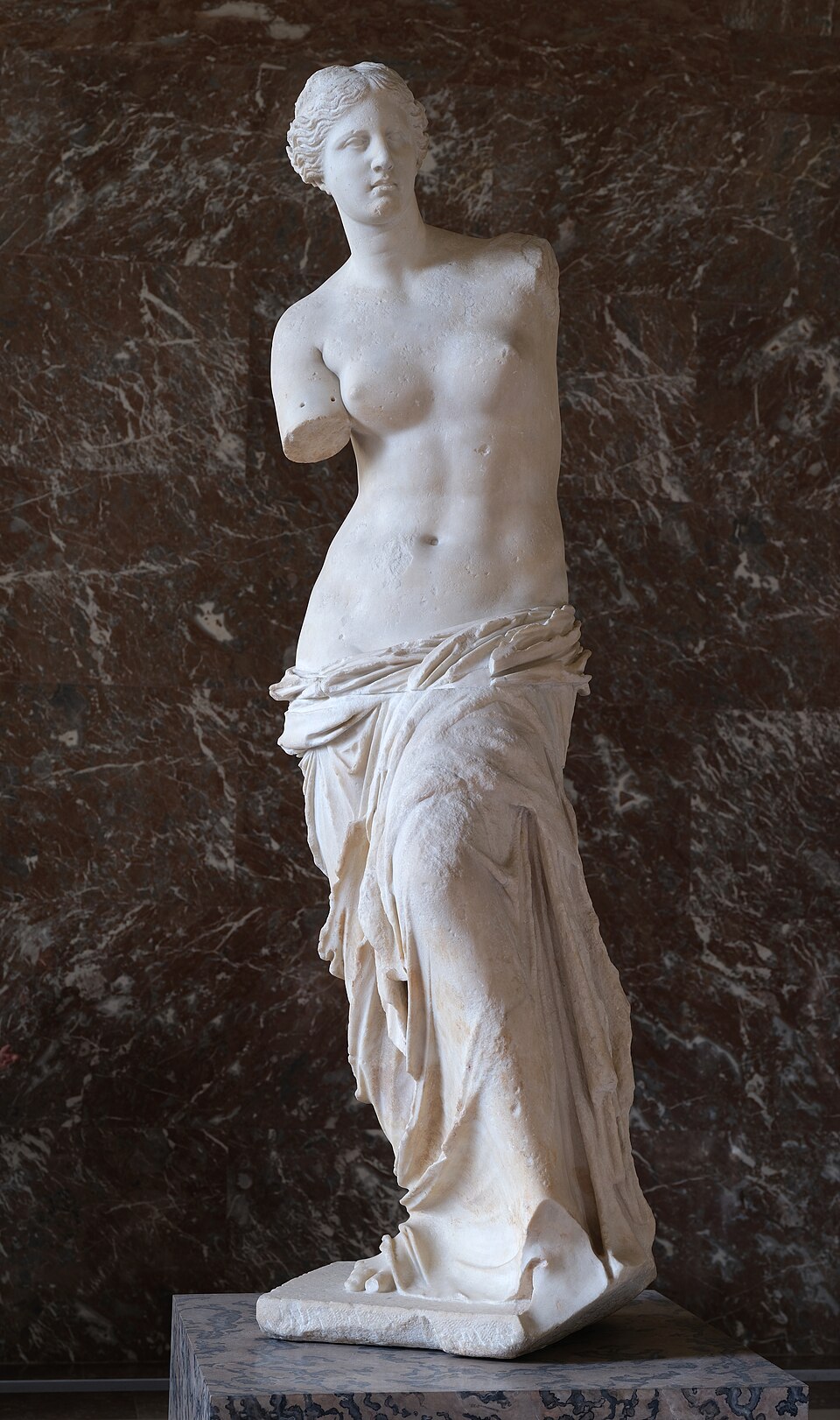
On 8 April 1820, on the small island of Milos, then part of the Ottoman Empire, a Greek farmer was digging in the earth when his tool struck stone that was not stone at all. A French sailor named Olivier Voutier, who had a passion for archaeology, happened to be nearby and witnessed the discovery. Rather than let the moment pass, he urged the farmer to keep digging. Together they unearthed two large marble pieces and a smaller fragment — the beginnings of what the world would come to know as the Venus de Milo.
The find did not stop there. Alongside the statue's body, excavators uncovered a fragment of an arm, a marble hand holding an apple, and two carved herms. Two inscriptions were also reportedly found nearby, though both have since been lost. One, copied down by French naval officer Dumont D'Urville, honored a dedication by a man named Bakchios, son of Satios, an assistant gymnasiarch. The other, preserved only in a drawing made by Auguste Debay, held part of a sculptor's signature — a tantalizing clue to the statue's authorship that vanished before it could be fully studied.
D'Urville, who arrived on Milos shortly after the discovery, later wrote an account describing the statue as having been found in a quadrangular niche. If that account is accurate, and if the gymnasiarch's inscription belonged with it, the Venus may originally have stood in the gymnasium of ancient Melos. A rival theory, put forward later by Salomon Reinach, suggested the find spot was actually the remains of a lime kiln and that the other fragments had nothing to do with the statue at all — a claim scholar Christofilis Maggidis has dismissed as having no factual basis.
Word of the discovery traveled fast. After leaving Milos, D'Urville's ship sailed to Constantinople, where he reported the find to the Comte de Marcellus, assistant to the French ambassador, the Marquis de Rivière. Rivière agreed that Marcellus should travel to Milos and negotiate the statue's purchase. By the time Marcellus reached the island, however, the farmer had already received a competing offer for his find — setting off a scramble that would ultimately deliver the statue to France, reportedly at the urging of King Louis XVIII, and into the collection of the Louvre, where it has remained on display since 1821.
What makes the Venus de Milo so striking is not only her survival but her incompleteness. Carved from Parian marble and standing over two meters tall — 203 centimeters by measurement — she depicts a goddess, almost certainly Aphrodite, her torso bare and drapery wrapped around her hips. Her weight rests on her right leg, her left leg raised, her head turned gently to one side. Both her arms are missing, along with her left foot and earlobes, and a filled hole below her right breast shows where a metal tenon once anchored an arm that has never been found.
More from Art

The Painting With No Foreground
A single robed figure stares out at an empty grey sea — and the emptiness itself became a scandal. When it was unveiled in Berlin in 1810, no one knew quite what to do with it.

The Painter Who Chased the Light
For a few purple minutes each evening, an American exile knelt in an English garden and raced the dying sun to paint two little girls lighting lanterns. It took him two years to finish.

When a President Became a God
Look straight up inside the U.S. Capitol dome and you will find George Washington enthroned among the clouds, surrounded by goddesses — the founding father transformed into myth.

Marble Brought Back to Life
A corpse asleep, a wing barely brushing her skin — and marble somehow learns to breathe. This is the moment Antonio Canova dared to carve.

The World Turned Upside Down
Look closely at a sixteenth-century Flemish village and you'll find a man biting a pillar, another carrying daylight in a basket, and a wife slipping a blue cloak over her husband's shoulders. Every gesture is a joke — if you know the language.

The Girl in the Glass Case
She stood two-thirds life size, dressed in a real tutu and human hair — and the critics who saw her in 1881 recoiled as if she were something obscene.