The Golden Salt Cellar That Slipped Through a Museum Window
A gold sculpture small enough to fit under one arm survived four centuries, a near-melting, and finally a burglar with a ladder — and it still came back.
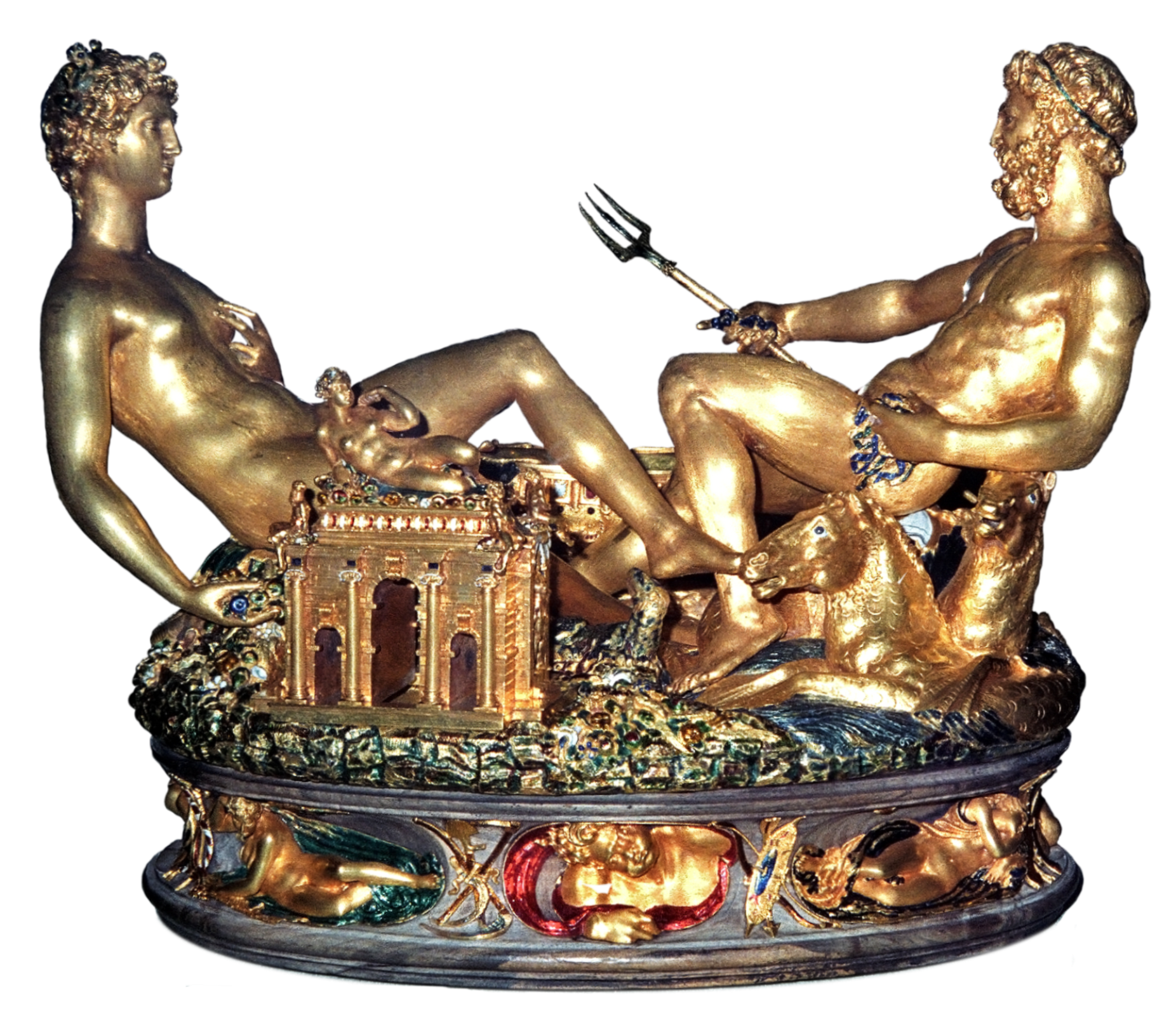
Sometime in the 1540s, at the court of Francis I of France, a goldsmith named Benvenuto Cellini set to work on an object meant to spark conversation as much as season food. Cellini, once known merely as a coin maker, had risen through the patronage of Cardinal Ippolito d'Este and now served one of Europe's most powerful kings. The piece he produced, later called the Saliera in Vienna, was completed in 1543 using a design originally modeled decades earlier for d'Este. Five other artists — two Italians, two Frenchmen, one German — assisted him. Cellini himself recorded the price: 1,000 scudi.
The salt cellar was never just a container for a condiment. Its very existence was meant to provoke discussion among intellectuals about the meanings layered into its form. Fashioned from hammered gold — not cast, but painstakingly shaped by hand — and finished with vitreous enamel, ebony, and ivory, it stood about 10.5 inches (267 mm) tall on a base about 13.1 inches (333 mm) wide, and was even fitted with bearings so it could roll across a banquet table. In an age when access to salt and pepper signified real wealth and power, the object was as political as it was artistic, a symbol of Francis I's domestic and international standing.
The design followed a technique Cellini had learned from the goldsmith Caradosso, who first built small wax models before creating a final work. Cellini adopted this method but pushed it further, aiming for something grander than anything his teacher had made. The result was Mannerist through and through: enigmatic expressions, exaggerated proportions, twisting contrapposto poses, all wrapped in sumptuous gold and enamel.
At the center of the sculpture stand two nude figures locked in a kind of confrontation — Terra e Mare, Land and Sea. Neptune, the male figure, reclines beside a ship that serves as the actual salt holder, trident in hand, surrounded by sea horses, fish, and shells drawn from ancient iconography. Facing him is Tellus, the female embodiment of earth, cradling her breast as a symbol of fertility and holding a horn signifying nature's abundance. Beneath her arm sits a small temple designed to hold pepper.
The oval base carries its own hidden universe. Four gold figures represent the times of day, inspired by Michelangelo's allegorical Day, Night, Dawn, and Dusk in the Medici Chapel in the church of San Lorenzo in Florence. Around them, male youths with puffed cheeks blow the cardinal winds. A salamander crouches beneath Tellus's heel — the personal emblem of Francis I — representing fire, while the king's coat of arms, an elephant, and lilies round out the courtly symbolism. Earth, water, air, and fire: the whole cosmos compressed into a tabletop object.
More from Art

The Painting With No Foreground
A single robed figure stares out at an empty grey sea — and the emptiness itself became a scandal. When it was unveiled in Berlin in 1810, no one knew quite what to do with it.

The Painter Who Chased the Light
For a few purple minutes each evening, an American exile knelt in an English garden and raced the dying sun to paint two little girls lighting lanterns. It took him two years to finish.

When a President Became a God
Look straight up inside the U.S. Capitol dome and you will find George Washington enthroned among the clouds, surrounded by goddesses — the founding father transformed into myth.

Marble Brought Back to Life
A corpse asleep, a wing barely brushing her skin — and marble somehow learns to breathe. This is the moment Antonio Canova dared to carve.

The World Turned Upside Down
Look closely at a sixteenth-century Flemish village and you'll find a man biting a pillar, another carrying daylight in a basket, and a wife slipping a blue cloak over her husband's shoulders. Every gesture is a joke — if you know the language.

The Girl in the Glass Case
She stood two-thirds life size, dressed in a real tutu and human hair — and the critics who saw her in 1881 recoiled as if she were something obscene.