The Golden Virgin of the Acropolis
Thirteen meters tall, wrapped in more than a ton of gold, she stood in a room built for her alone — and then, one day in the first millennium, she simply vanished.
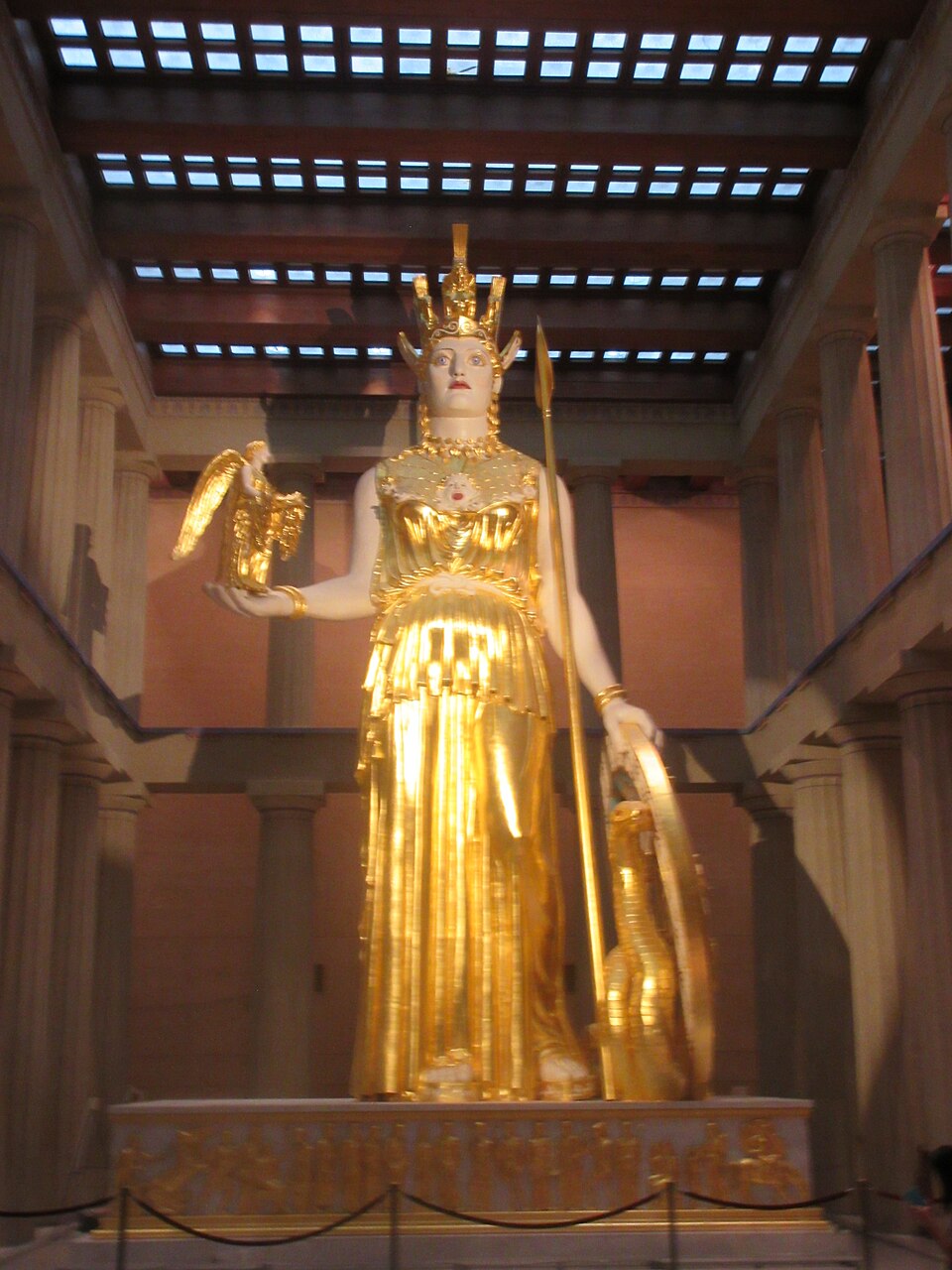
In 480 BCE, Persian soldiers tore through the Acropolis of Athens, ransacking the temple then under construction. After victories at Salamis and Plataea, the Athenians swore an oath not to rebuild the ruined shrines, leaving them as scars to remember Persian barbarism. But within a generation, Athens had transformed the Delian League — once a defensive alliance against Persia — into an empire of its own. By 454 BCE, the league's treasury had been moved to Athens, and its funds bankrolled an audacious building campaign that would give the city its most enduring monument.
The new Parthenon rose between 447 and 438 BCE under Pericles' patronage, with Phidias overseeing the sculptural program alongside architects Ictinos and Kallikrates. The building itself was really a treasury and a stage for something even more extraordinary: a colossal statue of Athena that may well have been conceived before the temple that would house her. The eastern chamber, the hecatompedos neos, measured 29.90 meters long, 19 meters wide, and rose to a ceiling height of 12.50 meters — a space built to precise specifications so it could hold her.
What ancient writers called simply 'the statue' or 'the golden Athena' eventually acquired a name: Athena Parthenos, the Virgin Athena, a title traced to the geographer Pausanias. There was no priestess devoted to her, no cult of worship in the conventional sense — she was, first and foremost, a gift. The city of Athens gave her to its patron goddess, a public offering on a scale the ancient world had rarely seen.
The construction itself was a feat of collaborative craftsmanship. Pausanias and Plutarch both record that Phidias did not work alone but directed a team of specialists across many trades. No one today knows exactly where the workshop stood — perhaps on the Acropolis itself, perhaps tucked away at the base of the sacred rock, safely apart from the dust and bustle of the main building site, given the staggering value of the materials involved.
The statue was likely assembled in pieces, tested together in the workshop, then dismantled and carried up to the finished Parthenon for final installation. Its cost has been estimated at 704 talents — equivalent to 200 triremes, the very backbone of Athens' naval power. Ancient sources suggest between 40 and 50 talents of gold went into her decoration, roughly one to 1.3 tons. To put that in perspective: the annual tribute from all the allies of the Delian League totaled just 28 talents. The gold sheathing Athena represented more than a year's wages for 10,000 skilled workers, or 10,000 hoplites, or 10,000 rowers in the war fleet — and crucially, it was designed to be removable, a literal financial reserve that could be melted down in an emergency.
More from Art

The Painting With No Foreground
A single robed figure stares out at an empty grey sea — and the emptiness itself became a scandal. When it was unveiled in Berlin in 1810, no one knew quite what to do with it.

The Painter Who Chased the Light
For a few purple minutes each evening, an American exile knelt in an English garden and raced the dying sun to paint two little girls lighting lanterns. It took him two years to finish.

When a President Became a God
Look straight up inside the U.S. Capitol dome and you will find George Washington enthroned among the clouds, surrounded by goddesses — the founding father transformed into myth.

Marble Brought Back to Life
A corpse asleep, a wing barely brushing her skin — and marble somehow learns to breathe. This is the moment Antonio Canova dared to carve.

The World Turned Upside Down
Look closely at a sixteenth-century Flemish village and you'll find a man biting a pillar, another carrying daylight in a basket, and a wife slipping a blue cloak over her husband's shoulders. Every gesture is a joke — if you know the language.

The Girl in the Glass Case
She stood two-thirds life size, dressed in a real tutu and human hair — and the critics who saw her in 1881 recoiled as if she were something obscene.