The Hammer That Held Up the Sky
A giant stole it once, and thunder itself fell silent. To get it back, the strongest of the gods put on a wedding dress.
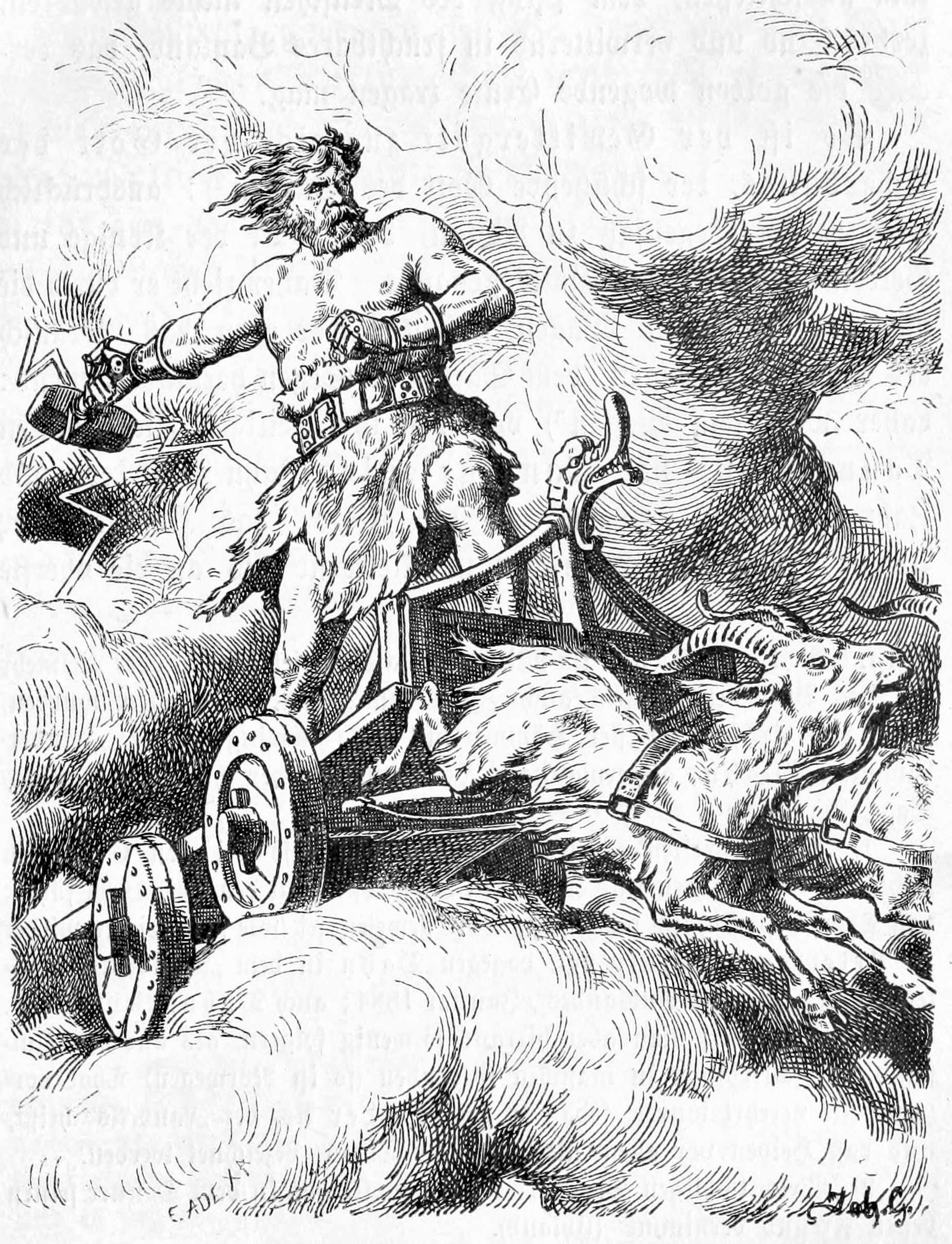
Among the gods of the old Germanic world, none was invoked more often, or loved more fiercely, than the red-bearded thunderer known across languages as Thor, Donar, Thunor, and Þunraz. His name itself means thunder, tracing back through Old Norse, Old English, Old Frisian, Old Saxon, and Old High German to a shared Proto-Germanic root meaning exactly that. Wherever Germanic peoples lived, from the Roman frontier to the Viking longships, his name was spoken, carved into runestones, and given to children.
At the center of his power was Mjölnir, a hammer whose name meant 'the crusher' or 'the grinder.' It was forged not by gods but by two dwarf brothers, Brokkr and Eitri, master smiths of the underground world. As they worked, the trickster god Loki, disguised as a fly, bit at Eitri to sabotage the work, causing the hammer's handle to come out shorter than intended — a flaw that never diminished its power.
The dwarves gave Mjölnir extraordinary properties. It could shrink small enough to hide inside Thor's shirt. Thrown at an enemy, it struck with unerring force and always flew back into his hand, like a boomerang that never missed. Thor spun it to change his shape, summoned storms and rain with it, and used it to bless marriages and consecrate objects. Alongside it he wore Megingjörð, a golden belt that doubled his strength, and Járngreipr, iron gloves needed to grip the hammer's handle.
Thor was no lone figure. He was the son of Odin and Jörð, husband to the golden-haired goddess Sif, and father to several children, including Þrúðr, Magni, and Móði. He traveled in a chariot pulled by two goats, Tanngrisnir and Tanngnjóstr — 'Teeth-Barer' and 'Teeth-Grinder' — animals he could slaughter for a feast and resurrect afterward, so long as their bones remained unbroken. He lived in a hall called Bilskirnir, said to have five hundred and forty rooms, within a realm called Þrúðheimr.
One of the most memorable tales tells of the giant Thrym, builder of the gods' dwellings, who fell for the love goddess Freyja and demanded her hand. When Freyja refused, Thrym stole Mjölnir and offered its return only in exchange for her. Thor's solution was audacious: he dressed as a bride, wore Freyja's jewelry, and traveled to the land of giants. The moment Thrym set the hammer aside to embrace his supposed bride, Thor seized it and struck him down.
More from Mythology

The Doctor Who Sang a Nation Into Being
A country doctor rode into the forests of Karelia armed with nothing but a notebook — and rode out with the soul of a nation.

The Boat That Carried the Sun
Every sunset, the ancient Egyptians believed, the sun climbed into a boat and sailed straight into the realm of the dead — only to fight a monstrous serpent before dawn could return.

The Wild Man of the Snows
At 21,000 feet, a colonel found tracks in the snow that he blamed on a wolf — but his guides knew better, and gave the world a name that would echo for a century.

The Knight Who Went Mad for Love: Orlando Furioso
A hero so devoted to duty he was Charlemagne's greatest paladin loses his mind—not to a sword wound, but to heartbreak. To cure him, a friend must ride a flying horse to the Moon.

The Book That Turned the World Into Myth
A poet condemned to exile spent his final years in Rome finishing a poem that would outlive empires—a poem about nothing standing still, not gods, not lovers, not even the shape of a man.

Paradise Lost: Milton's Rebel Angel
A blind poet, dictating verses in the dark, dared to explain the ways of God to men — and in doing so, made Hell's ruler unforgettable.