The Instant Before the Blade Falls
A widow's hand closes around a general's hair, a sword bites into his neck — and Caravaggio freezes the exact second between life and death.
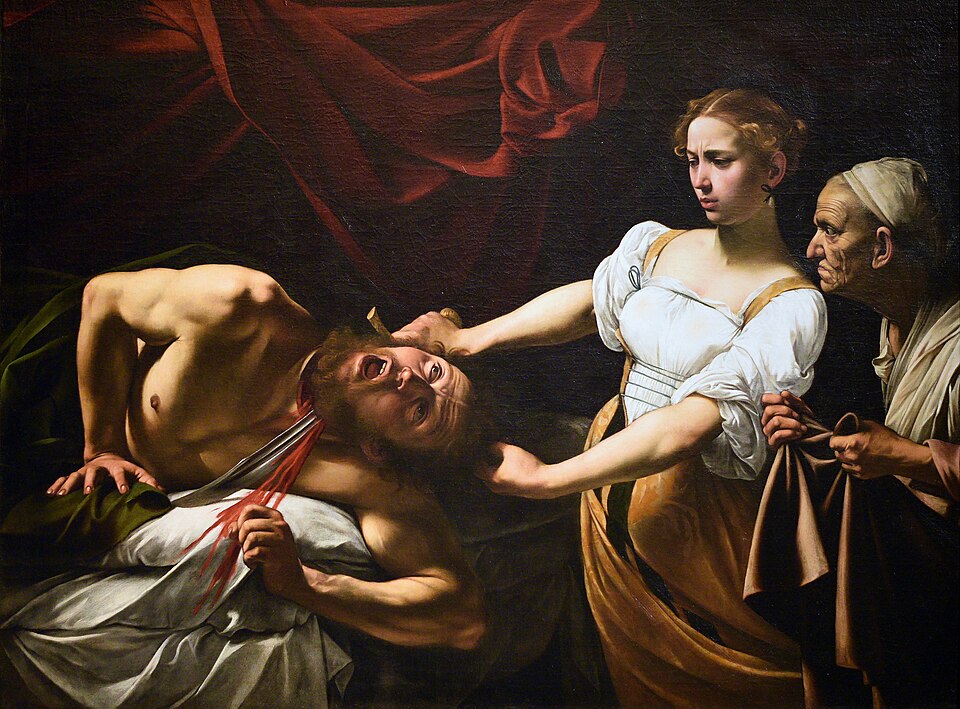
The tent is dark, almost airless, as if the whole world has narrowed to a single lamp-lit stage. On it, three figures: a general sprawled on his stomach, his neck twisted in agony as he turns toward his killer; a young woman gripping his hair with one hand and driving a blade through his throat with the other; and beside her, to the right, an old maidservant, unmoved, as if she has seen this before. This is Judith Beheading Holofernes, painted by Caravaggio around 1599–1600, or perhaps as late as 1602 — a date the 2017–18 Dentro Caravaggio exhibition in Milan favored, pointing to underlying light sketches typical of his later technique.
The story comes from the deuterocanonical Book of Judith. Holofernes, an Assyrian general, threatens Judith's people. She infiltrates his camp, lets him drink himself into a stupor after a banquet, and then, alone with him in his tent, kills him with his own sword: 'Approaching to his bed, she took hold of the hair of his head.' Painters before Caravaggio had shown the aftermath, or the buildup. Caravaggio chose the one moment nobody wanted to look at directly — the cut itself, blood spraying in thin arcs, the general's eyes still open.
He staged it like a play caught in a flash of side-lighting, the background swallowed in black so nothing distracts from the bodies. X-rays of the canvas later showed that Caravaggio revised his composition as he worked, nudging Holofernes' severed head slightly to the right, pulling it a little further from the torso — small adjustments that sharpen the horror rather than soften it.
What lingers longest is not the violence but the faces. Judith's expression carries both resolve and visible disgust, a woman doing something necessary and terrible at once. It's a psychological complexity rare for the period, and it left a deep mark on later artists — Artemisia Gentileschi, most famously, returned to this same subject with an intensity clearly shaped by Caravaggio's version.
The artist likely used Fillide Melandroni, a Roman courtesan who modeled for him in several works around this time, as Judith. For the grim physical details — the blood, the mechanics of decapitation — he may have drawn on something he'd actually witnessed: the public execution of Beatrice Cenci in 1599, a scene Rome had not stopped talking about.
More from Art

The Painting With No Foreground
A single robed figure stares out at an empty grey sea — and the emptiness itself became a scandal. When it was unveiled in Berlin in 1810, no one knew quite what to do with it.

The Painter Who Chased the Light
For a few purple minutes each evening, an American exile knelt in an English garden and raced the dying sun to paint two little girls lighting lanterns. It took him two years to finish.

When a President Became a God
Look straight up inside the U.S. Capitol dome and you will find George Washington enthroned among the clouds, surrounded by goddesses — the founding father transformed into myth.

Marble Brought Back to Life
A corpse asleep, a wing barely brushing her skin — and marble somehow learns to breathe. This is the moment Antonio Canova dared to carve.

The World Turned Upside Down
Look closely at a sixteenth-century Flemish village and you'll find a man biting a pillar, another carrying daylight in a basket, and a wife slipping a blue cloak over her husband's shoulders. Every gesture is a joke — if you know the language.

The Girl in the Glass Case
She stood two-thirds life size, dressed in a real tutu and human hair — and the critics who saw her in 1881 recoiled as if she were something obscene.