The Jester Who Would Not Dance
While the court twirls in candlelight behind him, one man sits utterly still, his bells silent — because he alone has read the letter.
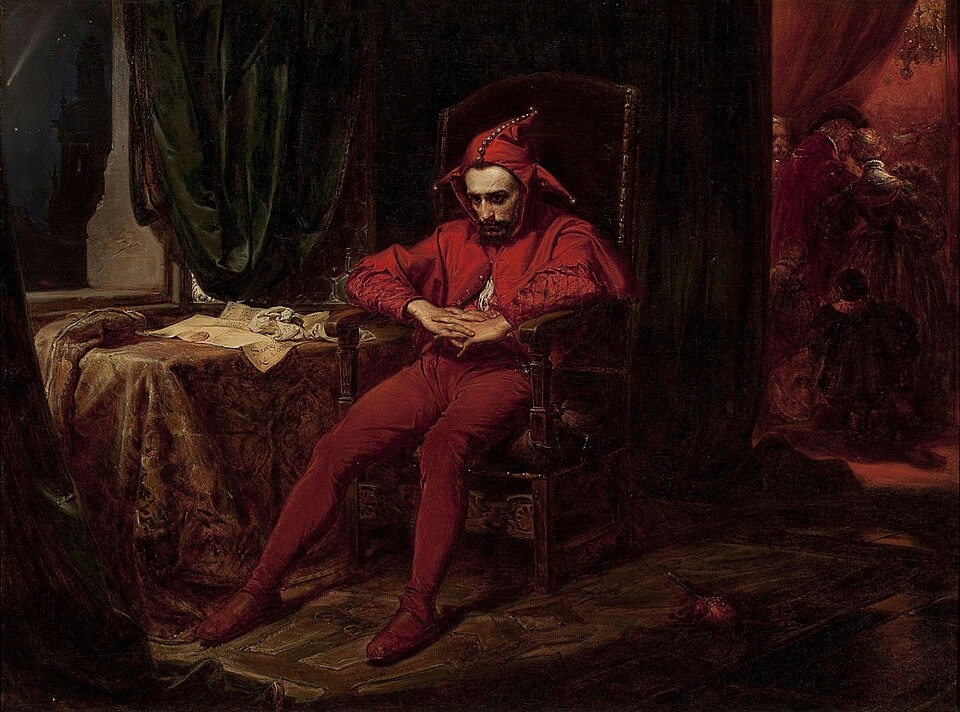
In 1862, the Polish painter Jan Matejko finished a canvas that would become one of the most recognizable images in his country's art: a solitary jester, slumped in a chair, staring into nothing while a royal ball glitters in the next room. He called it, in full, Stańczyk during a ball at the court of Queen Bona in the face of the loss of Smolensk.
The title points to a real historical figure. Stańczyk was court jester during the reign of King Sigismund I the Old, who ruled Poland from 1506 to 1548, an era often remembered as the golden age of Polish culture and power. He was no mere clown; sources and later legend describe him as eloquent, witty, and sharply intelligent, a man who used satire to comment on his nation's past, present, and future. Because so little was actually recorded about him, 19th-century scholars debated whether he was invented outright by writers like Jan Kochanowski, or a real 'grey eminence' among court jesters. Most modern historians accept that he existed, and his legend only grew stronger through works by writers such as Julian Ursyn Niemcewicz and Józef Ignacy Kraszewski in the 1820s and 1830s.
Matejko's title contains a curious historical wrinkle. It names Queen Bona Sforza as the ruler at the time of the ball, but Smolensk actually fell to Russia on 30 July 1514, when Sigismund's queen was actually Barbara Zápolya, who reigned from 1512 to 1515. Bona Sforza did not marry Sigismund until 1518. Smolensk was lost during the second Muscovite–Lithuanian War, a defeat suffered even as Poland celebrated its victory at the Battle of Orsha.
The painting's power lies in this exact contrast: a joyous court, oblivious, celebrating one triumph while ignoring a devastating loss elsewhere. Stańczyk sits apart, in a darkened room, while the ball rages next door. He looks nothing like a jester should — his marotte, the traditional fool's staff, lies discarded on the floor, while a medallion of the Black Madonna of Częstochowa hangs on his chest. The carpet at his feet is rumpled, as though he collapsed heavily into the chair upon reading a letter now resting on the table before him — a letter that seems to announce the loss of Smolensk to the Grand Duchy of Moscow.
Every detail in the room is loaded with meaning. The letter bears the date 1533 and references Samogitia, a province of the old Commonwealth — oddly inconsistent with the actual 1514 date of Smolensk's fall, a discrepancy historians still debate, though Matejko was famously meticulous with symbolism and unlikely to have erred by accident. A court dwarf carries a lute, a symbol of glory, hinting at the declining fortunes of the Jagiellonian dynasty. The window has blown open, ruffling the tablecloth, as if the established order itself were being disturbed.
More from Art

The Painting With No Foreground
A single robed figure stares out at an empty grey sea — and the emptiness itself became a scandal. When it was unveiled in Berlin in 1810, no one knew quite what to do with it.

The Painter Who Chased the Light
For a few purple minutes each evening, an American exile knelt in an English garden and raced the dying sun to paint two little girls lighting lanterns. It took him two years to finish.

When a President Became a God
Look straight up inside the U.S. Capitol dome and you will find George Washington enthroned among the clouds, surrounded by goddesses — the founding father transformed into myth.

Marble Brought Back to Life
A corpse asleep, a wing barely brushing her skin — and marble somehow learns to breathe. This is the moment Antonio Canova dared to carve.

The World Turned Upside Down
Look closely at a sixteenth-century Flemish village and you'll find a man biting a pillar, another carrying daylight in a basket, and a wife slipping a blue cloak over her husband's shoulders. Every gesture is a joke — if you know the language.

The Girl in the Glass Case
She stood two-thirds life size, dressed in a real tutu and human hair — and the critics who saw her in 1881 recoiled as if she were something obscene.