The Kiss: Lovers Rescued from Hell
Two marble bodies lean into an embrace that never quite completes — a kiss frozen forever a heartbeat away from happening, and from murder.
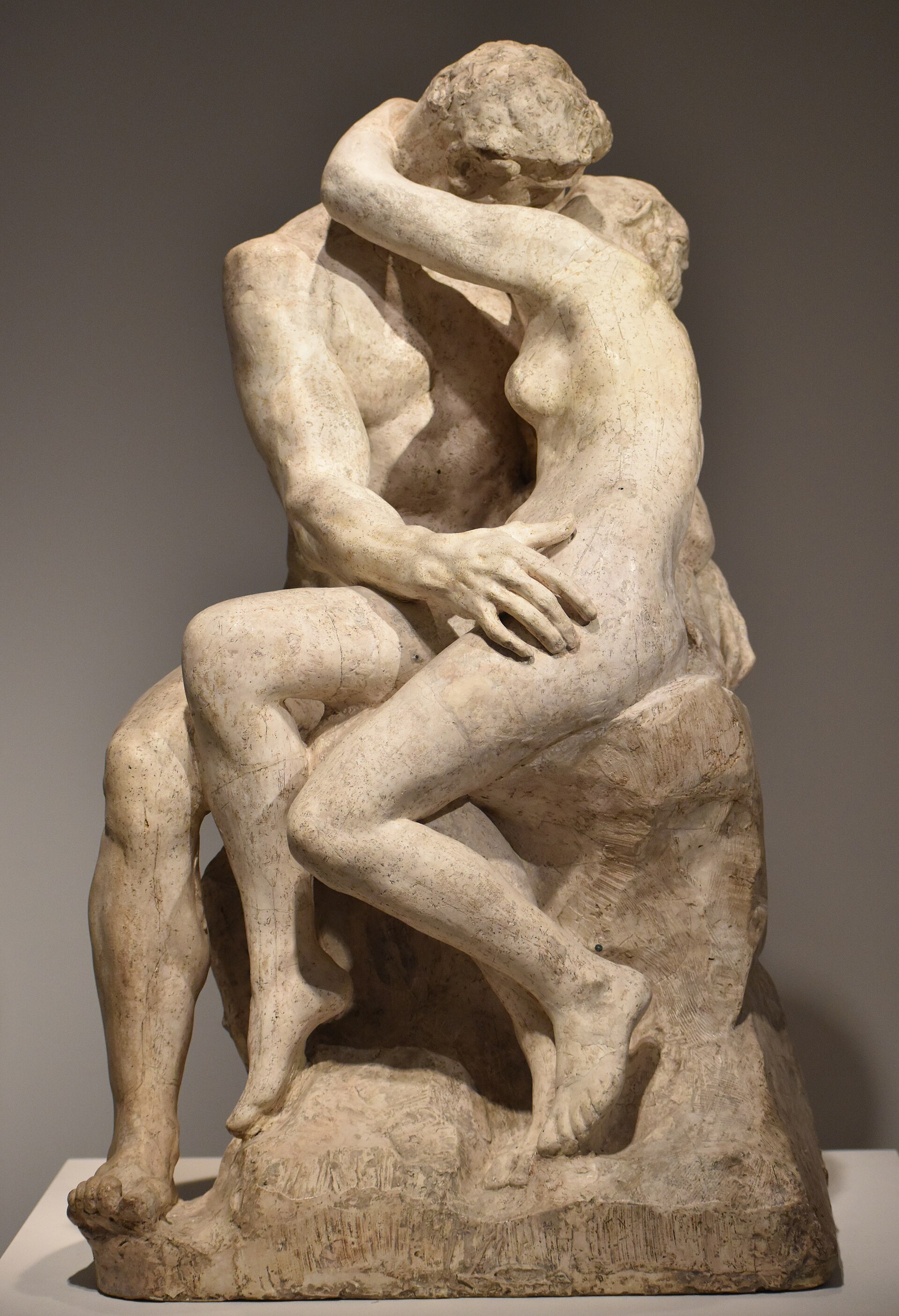
In 1880, the sculptor Auguste Rodin received a commission that would consume much of his career: a monumental bronze portal called The Gates of Hell, meant for a planned museum of decorative arts in Paris. Drawing on Dante's Inferno, Rodin populated the doors with tormented figures pulled from the poem's Circle of Hell. Among the two hundred figures he modeled was a small embracing couple, tucked beneath the left panel of the gate.
That couple was Paolo and Francesca, the star-crossed lovers from Canto 5 of the Inferno. Francesca da Rimini, a 13th-century Italian noblewoman, fell in love with Paolo, her husband Giovanni Malatesta's younger brother, after the two read together the story of Lancelot and Guinevere. In Dante's telling, Francesca's husband discovered the affair and killed them both. Rodin placed the book they had shared directly into Paolo's sculpted hand.
By 1886, Rodin decided the couple's tenderness clashed with the anguish that defined the rest of the Gates, and he removed them, replacing the pair with another set of lovers on the smaller right-hand column. He reworked the embracing figures into an independent sculpture, dated 1882, first titling it Francesca da Rimini. When critics saw it in 1887, they suggested a simpler, more universal name: Le Baiser — The Kiss.
Look closely at the marble and a strange tension appears: the lovers' lips never actually touch. That gap holds the entire drama of the story — the instant just before Francesca's husband bursts in, or perhaps the instant of desire itself, suspended before consequence catches up with it.
Rodin's sensuous treatment of the female form, presented as an equal partner in passion rather than a passive object, made the work controversial. When a bronze version was sent to the 1893 World's Columbian Exposition in Chicago, organizers judged it unfit for general display and confined it to an inner chamber, viewable only by special request.
More from Art

The Painting With No Foreground
A single robed figure stares out at an empty grey sea — and the emptiness itself became a scandal. When it was unveiled in Berlin in 1810, no one knew quite what to do with it.

The Painter Who Chased the Light
For a few purple minutes each evening, an American exile knelt in an English garden and raced the dying sun to paint two little girls lighting lanterns. It took him two years to finish.

When a President Became a God
Look straight up inside the U.S. Capitol dome and you will find George Washington enthroned among the clouds, surrounded by goddesses — the founding father transformed into myth.

Marble Brought Back to Life
A corpse asleep, a wing barely brushing her skin — and marble somehow learns to breathe. This is the moment Antonio Canova dared to carve.

The World Turned Upside Down
Look closely at a sixteenth-century Flemish village and you'll find a man biting a pillar, another carrying daylight in a basket, and a wife slipping a blue cloak over her husband's shoulders. Every gesture is a joke — if you know the language.

The Girl in the Glass Case
She stood two-thirds life size, dressed in a real tutu and human hair — and the critics who saw her in 1881 recoiled as if she were something obscene.