The Lamb of Ghent: A Masterpiece Born of Two Brothers
In a small Belgian cathedral hangs a polyptych so revolutionary that some call it the first great oil painting in Western history — and its true authorship remains an unsolved riddle.
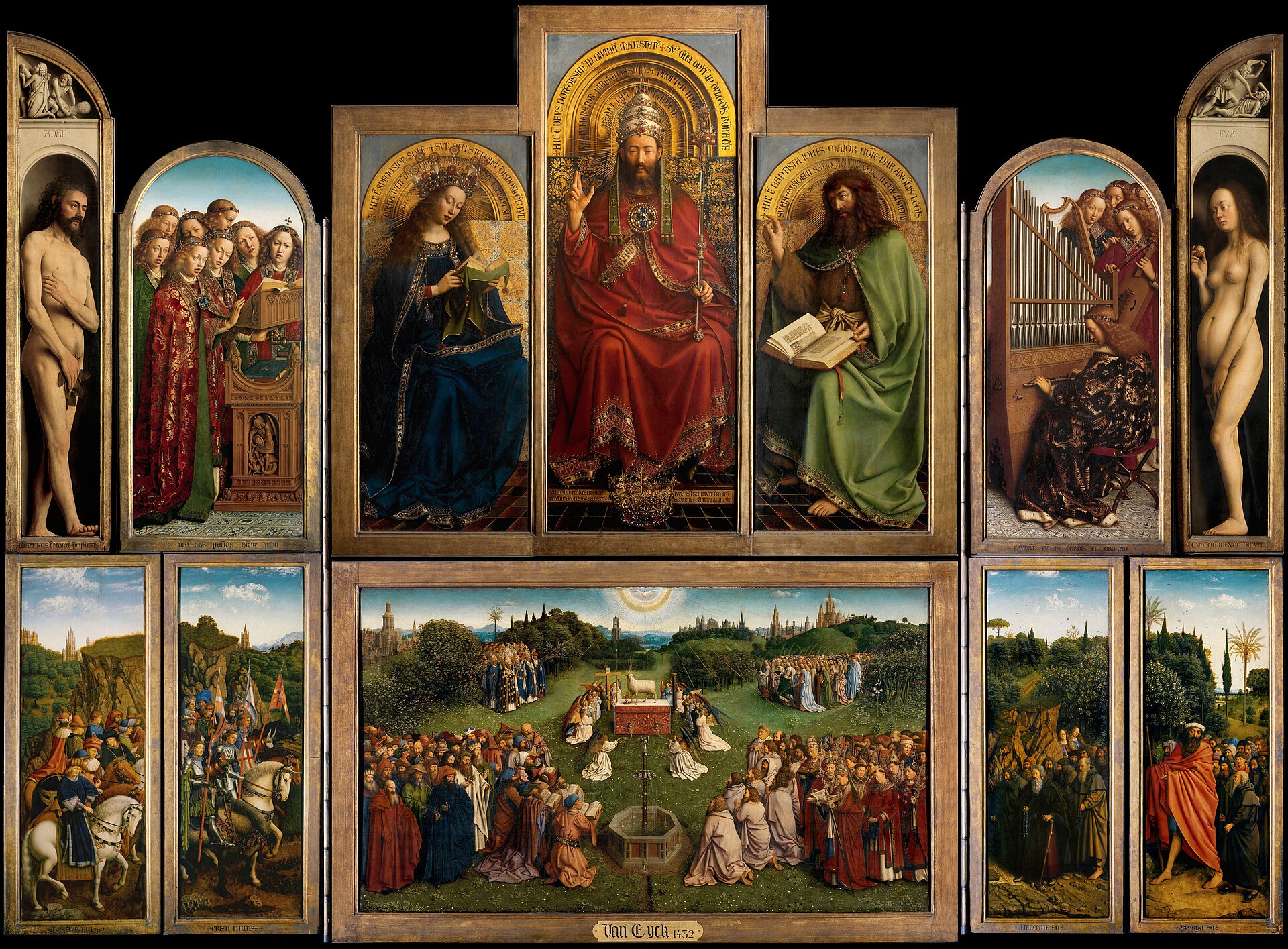
In St Bavo's Cathedral in Ghent, Belgium, there stands a folding altarpiece unlike anything that had come before it. Begun around the mid-1420s and completed by 1432, the Ghent Altarpiece — also known as the Adoration of the Mystic Lamb — is attributed to the Early Netherlandish painters Hubert and Jan van Eyck, brothers whose combined vision helped usher European art out of the Middle Ages and into the Renaissance.
The work is staggering in its complexity. Its panels are arranged in two vertical registers, each fitted with foldable wings bearing paintings on both their inner and outer faces. The upper inner register depicts heavenly redemption: a central Deësis of God — identified variously as Christ the King or God the Father — flanked by the Virgin Mary and John the Baptist, with music-making angels beside them and, at the far edges, the figures of Adam and Eve.
Below, the lower register's central panel gathers saints, sinners, clergy, and soldiers in adoration of the Lamb of God, overseen by the dove of the Holy Spirit. When closed, the altarpiece reveals grisaille depictions of St John the Baptist and St John the Evangelist, flanked by donor portraits of Jodocus Vijd and his wife Lysbette Borluut. Above them appear the archangel Gabriel and the Annunciation, and at the very top, prophets and sibyls look on.
The altarpiece owes its existence to Jodocus Vijd, a merchant and mayor of Ghent, and his wife Lysbette, who commissioned it as part of a larger chapel project for Saint Bavo Cathedral. Its installation was celebrated officially on 6 May 1432, and — apart from being moved to the cathedral's principal chapel for security — it has remained in its original home ever since.
Who actually painted it has puzzled scholars for generations. Art historians broadly agree that Hubert designed the overall structure during or before the mid-1420s, probably before 1422, and that his younger brother Jan executed most of the panel paintings between 1430 and 1432. Yet despite decades of scrutiny, no one has managed to convincingly separate which brushstrokes belong to which brother — it is entirely possible that Jan simply finished panels his brother had begun.
More from Art

The Painting With No Foreground
A single robed figure stares out at an empty grey sea — and the emptiness itself became a scandal. When it was unveiled in Berlin in 1810, no one knew quite what to do with it.

The Painter Who Chased the Light
For a few purple minutes each evening, an American exile knelt in an English garden and raced the dying sun to paint two little girls lighting lanterns. It took him two years to finish.

When a President Became a God
Look straight up inside the U.S. Capitol dome and you will find George Washington enthroned among the clouds, surrounded by goddesses — the founding father transformed into myth.

Marble Brought Back to Life
A corpse asleep, a wing barely brushing her skin — and marble somehow learns to breathe. This is the moment Antonio Canova dared to carve.

The World Turned Upside Down
Look closely at a sixteenth-century Flemish village and you'll find a man biting a pillar, another carrying daylight in a basket, and a wife slipping a blue cloak over her husband's shoulders. Every gesture is a joke — if you know the language.

The Girl in the Glass Case
She stood two-thirds life size, dressed in a real tutu and human hair — and the critics who saw her in 1881 recoiled as if she were something obscene.