The Little God Who Wore the Sky
A gilded bronze youth barely taller than a housecat once stood in for the largest sanctuary in the Roman world — and somehow carried the sun, moon, and five planets on his chest.
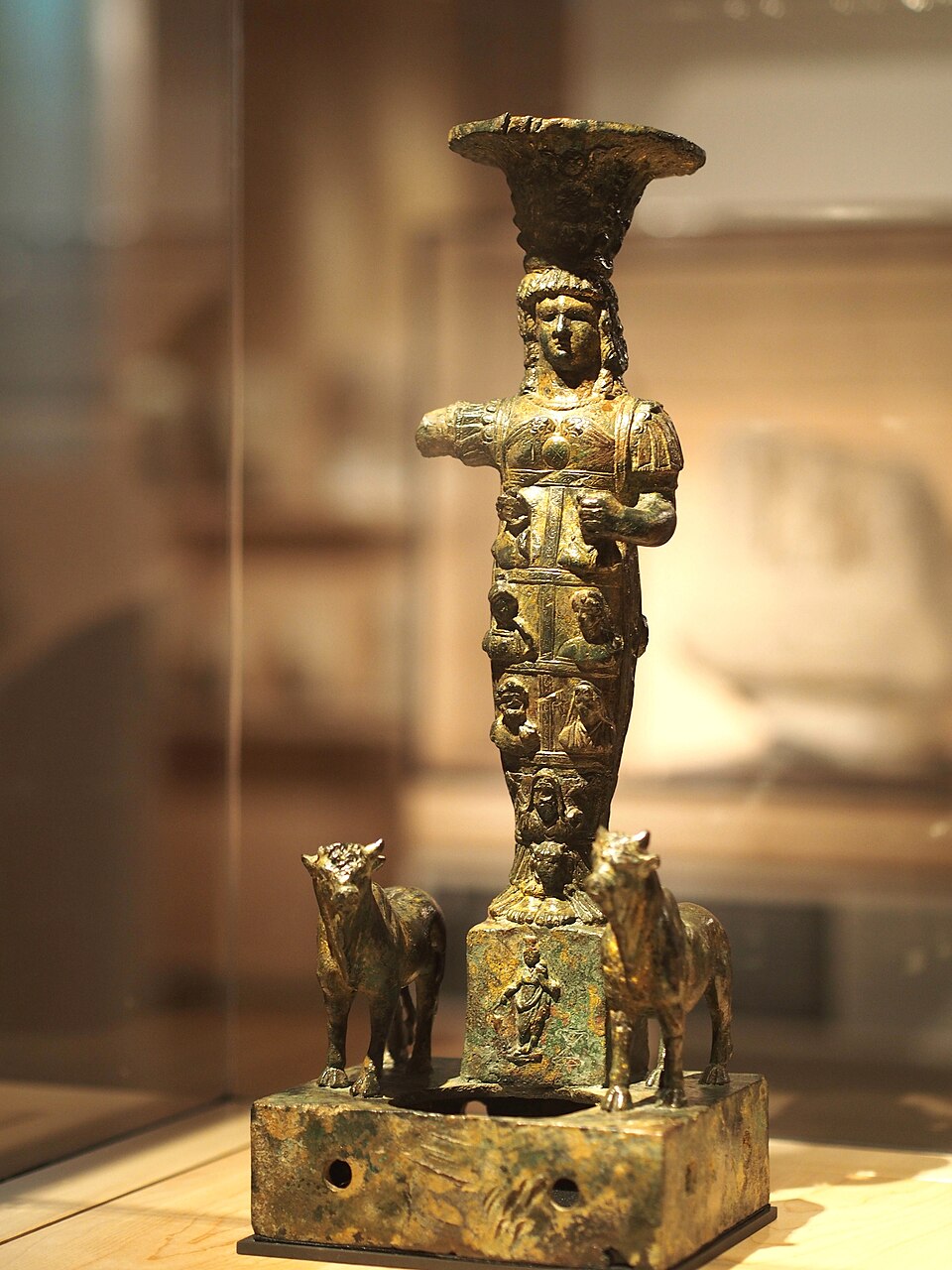
In a glass case in the Louvre's Roman Levant collection stands a small bronze figure, only 38.4 centimeters tall, that once represented one of the most revered gods of the ancient Near East. Known as the Sursock bronze, or the Sursock statuette, it is a gilt-bronze sculptural group depicting Jupiter Heliopolitanus, the Heliopolitan Jupiter, dating to the second century AD. It is a miniature echo of the colossal cult statue that stood inside the Great Temple of Baalbek in modern-day Lebanon, a sanctuary famed across the Roman world both for its scale and for its oracular power.
The statuette shows the god as a beardless youth, crowned with a kalathos, a basket-shaped hat, and wrapped in an ependytes, a close-fitting dress worn beneath ornate armor. That armor is the piece's most extraordinary feature: it is covered in busts of seven deities tied to the celestial bodies, arranged in neat rectangular registers. Sol and Luna, sun and moon, sit at the top; below them Mars and Mercury; then Jupiter himself alongside Juno, who stands in for Venus in accordance with ancient traditions linking Venus' light to Juno; and finally Saturn. Four-pointed stars mark Mars, Mercury, and Saturn as planetary powers, while Venus receives two stars, honoring her double identity as morning and evening star.
Above this cosmic armor spreads a winged solar disc, and near the god's bare feet rests a lion's head. On the small pedestal at the front stands Tyche, goddess of fortune, holding a cornucopia, while stylized thunderbolt motifs decorate the sides of the armor. The whole figure stands on a cubic base flanked by two young bulls, the entire group resting on a larger rectangular plinth. Together these details tell a story of fusion: Canaanite, Greek, and Roman religious traditions layered into a single small object.
That fusion had deep roots. Jupiter Heliopolitanus evolved from Baal-Hadad, the Canaanite storm and fertility god venerated across the Levant, whose name is attested as far back as third-millennium BC texts from Abu Salabikh in Iraq. Hadad, god of rain, thunder, and storms, was often shown holding a whip and thunderbolt, and many scholars believe 'Baal' — meaning lord or master — became a reverent substitute name for him as his cult grew too sacred to name aloud, much as 'Bel' stood in for Marduk among the Babylonians or 'Adonai' for Yahweh among the Israelites. Others argue Baal was originally a distinct Canaanite deity whose worship later merged with Hadad's. By the first millennium BC the two were treated as separate gods, Hadad favored by the Aramaeans and Baal by the Phoenicians.
During the Hellenistic period, roughly 332 to 64 BC, the cult in Baalbek took on a solar dimension, as Greek overlords likely identified Baal-Hadad with their own sun god Helios — both deities were linked to the whip, one cracking it as a symbol of lightning, the other to drive the sun's chariot. The town itself was renamed Heliopolis, a name it shared with the famous Egyptian city. That coincidence let Egyptian priests claim the Baalbek cult had originated in Egypt, a myth repeated by the Roman historian Macrobius in his fifth-century AD Saturnalia. Scholars Henri Seyrig and Joseph Hajjar later dismantled this claim, showing it stemmed from Macrobius's own syncretic confusion between the Baalbek storm-god and the solar deity Helios. In Roman times Hadad was also frequently equated with Zeus, especially Zeus Keraunios, Zeus of the Thunderbolt.
More from Art

The Painting With No Foreground
A single robed figure stares out at an empty grey sea — and the emptiness itself became a scandal. When it was unveiled in Berlin in 1810, no one knew quite what to do with it.

The Painter Who Chased the Light
For a few purple minutes each evening, an American exile knelt in an English garden and raced the dying sun to paint two little girls lighting lanterns. It took him two years to finish.

When a President Became a God
Look straight up inside the U.S. Capitol dome and you will find George Washington enthroned among the clouds, surrounded by goddesses — the founding father transformed into myth.

Marble Brought Back to Life
A corpse asleep, a wing barely brushing her skin — and marble somehow learns to breathe. This is the moment Antonio Canova dared to carve.

The World Turned Upside Down
Look closely at a sixteenth-century Flemish village and you'll find a man biting a pillar, another carrying daylight in a basket, and a wife slipping a blue cloak over her husband's shoulders. Every gesture is a joke — if you know the language.

The Girl in the Glass Case
She stood two-thirds life size, dressed in a real tutu and human hair — and the critics who saw her in 1881 recoiled as if she were something obscene.