The Man Inside the Circle and the Square
A nude figure, arms flung two ways at once, hands and feet grazing the edges of a circle and a square — a single drawing that tried to fit the whole human body inside the logic of the universe.
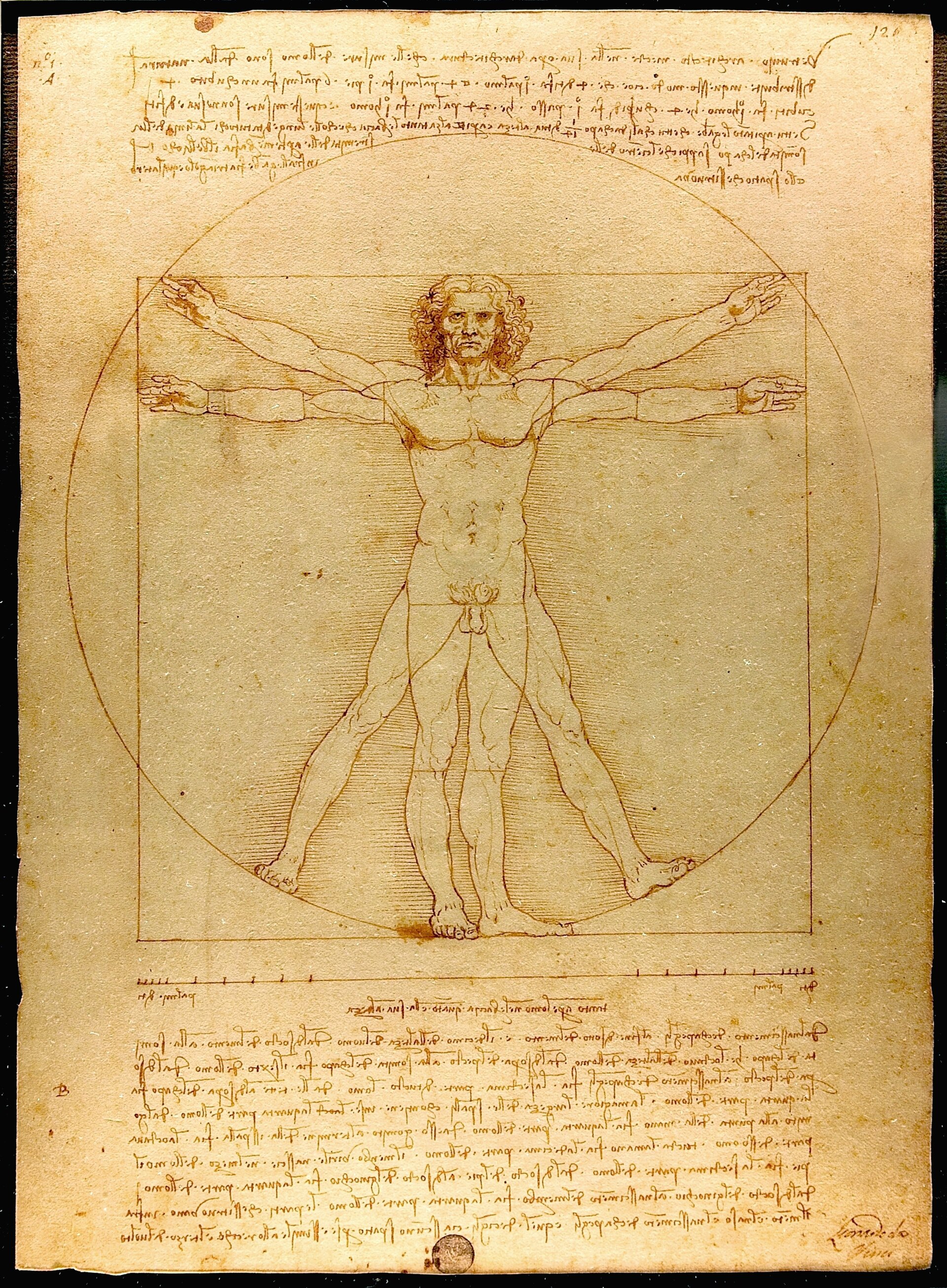
Around 1490, in Milan, Leonardo da Vinci picked up pen and light-brown ink and began measuring a man. He worked with the precision of an engineer rather than the looseness of a sketch artist, using metalpoint, calipers, and a compass, leaving small tick marks across the paper to record exact intervals. The result, on an irregular sheet of paper measuring 34.4 by 25.5 centimeters, larger than most of his other manuscript pages, was a drawing devoid of hesitation: every line placed with intent.
The figure he drew is a nude man shown in two overlapping stances at once. In one, his arms stretch diagonally above his shoulders and his legs spread wide, so that his hands and feet touch the edge of a circle centered on his navel. In the other, his arms reach out horizontally and his legs close together, so that his hands, head, and feet touch the corners and sides of a surrounding square. Scholar Carlo Vecce has compared the effect to a photograph capturing multiple phases of movement simultaneously. Leonardo was careful with every finger and toe, never letting them breach the geometric boundaries, and biographer Walter Isaacson has written that the delicate linework, intimate gaze, and intricate curls of hair 'weave together the human and the divine.'
Leonardo did not invent this idea from nothing. He was drawing on the Roman architect Vitruvius, who lived from around 80 to 20 BCE and wrote De architectura, the only substantial architectural treatise to survive from antiquity. In its third volume, Vitruvius described a man lying flat with limbs extended, his navel as the center of a circle traced by compass, his fingers and toes touching its edge — and noted that the same body, measured from soles to crown and then compared to outstretched arms, would also form a perfect square. Vitruvius called these figures homo ad circulum and homo ad quadratum.
Vitruvius's treatise had been obscured for centuries in monastic manuscript copies until it was rediscovered in the 15th century by Poggio Bracciolini. Once revived, it inspired a wave of artists trying to visualize its description, including Francesco di Giorgio Martini in the 1470s. Leonardo himself may have been influenced by the architect Giacomo Andrea, with whom records show he dined in 1490, and who made his own version of the Vitruvian Man that same year — a drawing unknown to scholars until the 1980s. Leonardo refined his own study further by drawing on Leon Battista Alberti's treatise De pictura and his own careful observation.
Above the figure, Leonardo wrote in his characteristic mirror script, notes explaining the proportions he had charted. The drawing has often been titled, in his own words, Le proporzioni del corpo umano secondo Vitruvio — The Proportions of the Human Figure after Vitruvius. Art historian Carlo Pedretti has also noted a striking resemblance between the man's face and posture and the angel in Leonardo's earlier Annunciation painting, suggesting the same artistic hand and sensibility at work years apart.
More from Art

The Painting With No Foreground
A single robed figure stares out at an empty grey sea — and the emptiness itself became a scandal. When it was unveiled in Berlin in 1810, no one knew quite what to do with it.

The Painter Who Chased the Light
For a few purple minutes each evening, an American exile knelt in an English garden and raced the dying sun to paint two little girls lighting lanterns. It took him two years to finish.

When a President Became a God
Look straight up inside the U.S. Capitol dome and you will find George Washington enthroned among the clouds, surrounded by goddesses — the founding father transformed into myth.

Marble Brought Back to Life
A corpse asleep, a wing barely brushing her skin — and marble somehow learns to breathe. This is the moment Antonio Canova dared to carve.

The World Turned Upside Down
Look closely at a sixteenth-century Flemish village and you'll find a man biting a pillar, another carrying daylight in a basket, and a wife slipping a blue cloak over her husband's shoulders. Every gesture is a joke — if you know the language.

The Girl in the Glass Case
She stood two-thirds life size, dressed in a real tutu and human hair — and the critics who saw her in 1881 recoiled as if she were something obscene.