The Man Who Stood Up
At a small-town meeting about rebuilding a burned school, one dissenting farmer rose to speak — and Norman Rockwell turned that ordinary moment into an icon of American democracy.
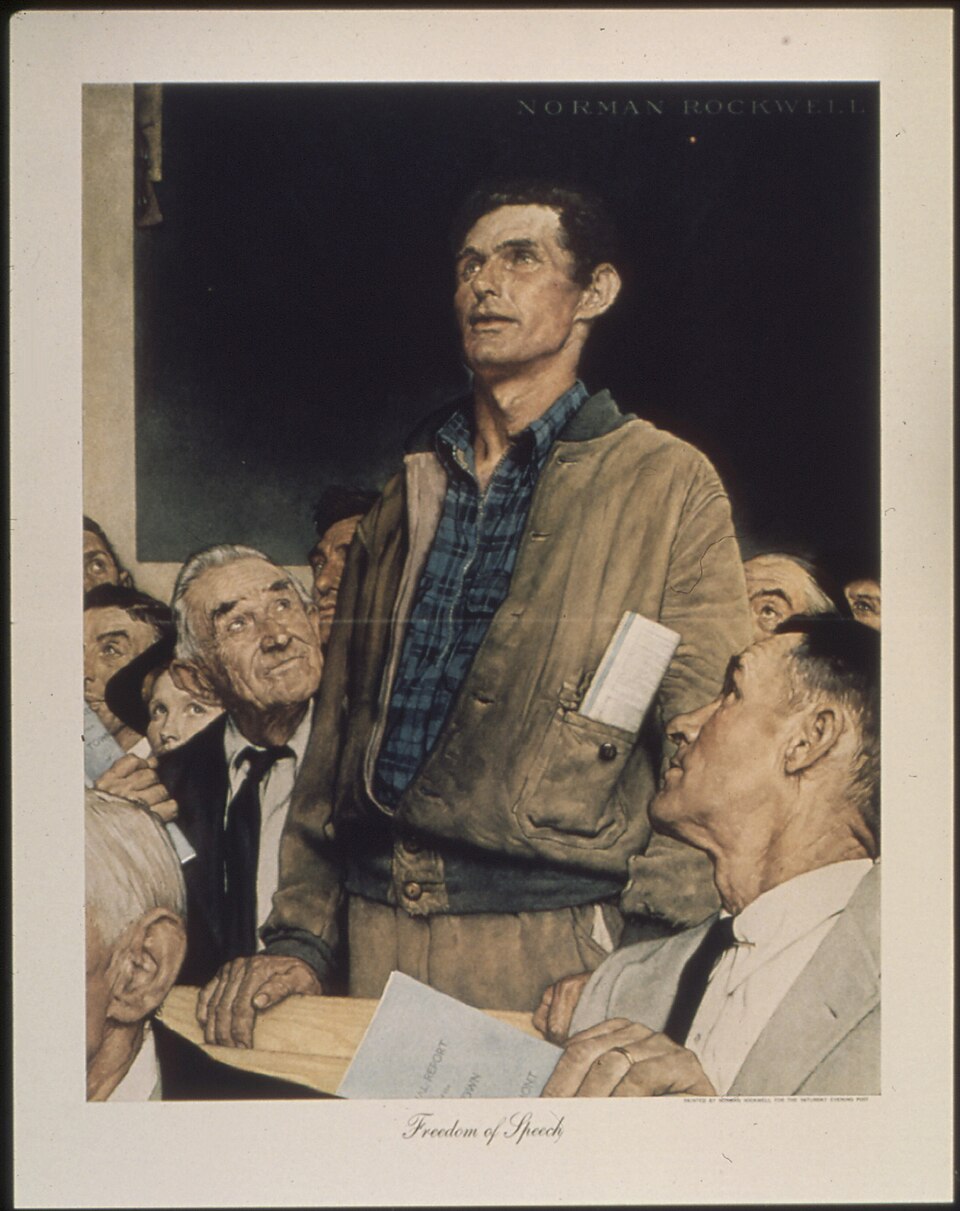
In January 1941, President Franklin D. Roosevelt delivered a State of the Union address to the 77th United States Congress, naming four freedoms he believed every person deserved: freedom of speech, freedom of worship, freedom from want, and freedom from fear. Of these, only speech and worship were explicitly guaranteed in the U.S. Constitution. The speech would eventually echo through the Atlantic Charter and the founding charter of the United Nations, but it also lodged itself in the imagination of a magazine illustrator in Vermont named Norman Rockwell.
Rockwell decided to translate Roosevelt's four abstractions into paintings ordinary Americans could recognize in their own lives. He found his inspiration not in Washington but in Arlington, Vermont, at a 1942 town meeting. The town's selectmen had announced plans to build a new school after the old one burned down, and one man, Jim Edgerton, was the lone dissenter. Edgerton actually supported rebuilding but worried about the tax burden, since his family farm had been ravaged by disease. As a matter of protocol, he was given the floor to speak his mind. That small act of democratic courtesy struck Rockwell as the perfect image for 'freedom of speech,' and it inspired him to use his Vermont neighbors as models for the entire Four Freedoms series.
The painting shows a blue-collar man standing among seated neighbors dressed in white shirts, ties, and jackets. He wears a plaid shirt and suede jacket, his hands dirty, his complexion darker than those around him. One attendee holds a document identifying the meeting's subject as a discussion of the town's annual report. Critics have noted the contrast: the speaker, younger and more roughly dressed than the others, is nonetheless granted full attention and respect. Writer Bruce Cole observed that Edgerton is shown 'standing tall, his mouth open, his shining eyes transfixed,' his face resembling Abraham Lincoln's. Robert Scholes compared the rapt audience to a scene from a Frank Capra film, the speaker recalling a Gary Cooper or Jimmy Stewart character.
The man who actually posed for the painting was not Edgerton himself but Carl Hess, a Rockwell neighbor and the son of a German immigrant who ran a gas station in Arlington. Hess was suggested by Rockwell's assistant, Gene Pelham, who said Hess 'had a noble head.' Hess posed eight separate times for the work. Other Arlington residents filled out the rest of the composition: Carl's father Henry appears with only his left ear visible; Jim Martin, who appeared in all four paintings, occupies the lower right corner; Harry Brown shows only the top of his head and an eye; Robert Benedict Sr. and Rose Hoyt sit to the left. Rockwell even placed his own eye along the painting's left edge. The suede jacket worn by Hess actually belonged to Pelham.
Getting the composition right took Rockwell two months and four complete restarts. Twice he nearly finished the painting only to feel something was missing, and he eventually confessed to the Post's art director, Jim Yates, that he had to start over after overworking an early attempt. An early draft placed Hess surrounded by people seated squarely around him; Hess himself felt this looked more natural, but Rockwell disagreed, saying it 'was too diverse, it went every which way and didn't settle anywhere or say anything.' In the final version, Rockwell chose an upward angle from bench level, isolating the speaker as the clear subject rather than diffusing attention across the crowd.
More from Art

The Painting With No Foreground
A single robed figure stares out at an empty grey sea — and the emptiness itself became a scandal. When it was unveiled in Berlin in 1810, no one knew quite what to do with it.

The Painter Who Chased the Light
For a few purple minutes each evening, an American exile knelt in an English garden and raced the dying sun to paint two little girls lighting lanterns. It took him two years to finish.

When a President Became a God
Look straight up inside the U.S. Capitol dome and you will find George Washington enthroned among the clouds, surrounded by goddesses — the founding father transformed into myth.

Marble Brought Back to Life
A corpse asleep, a wing barely brushing her skin — and marble somehow learns to breathe. This is the moment Antonio Canova dared to carve.

The World Turned Upside Down
Look closely at a sixteenth-century Flemish village and you'll find a man biting a pillar, another carrying daylight in a basket, and a wife slipping a blue cloak over her husband's shoulders. Every gesture is a joke — if you know the language.

The Girl in the Glass Case
She stood two-thirds life size, dressed in a real tutu and human hair — and the critics who saw her in 1881 recoiled as if she were something obscene.