The Marble Fury of Michelangelo's Moses
A seated giant of stone glares out from a Roman church, his hand frozen mid-motion in his beard — and for centuries, viewers have wondered what he is about to do.
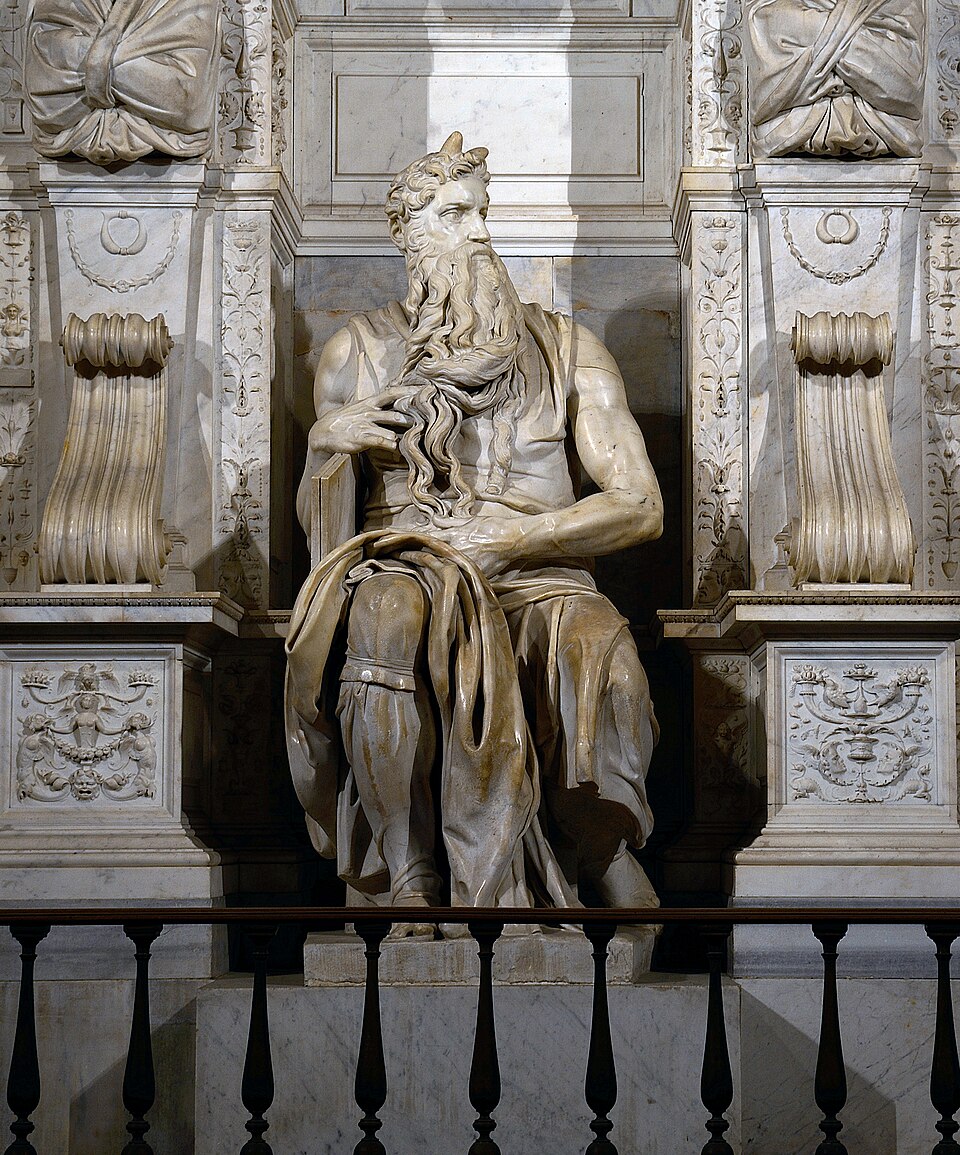
In 1505, Pope Julius II summoned Michelangelo to Rome with an audacious commission: design a tomb worthy of a pope who saw himself as a modern Caesar. The original plan was staggering in scope, calling for more than forty statues arranged across multiple tiers, a monument meant to overwhelm anyone who entered its presence. Among the planned figures was Moses, intended to sit high on a tier nearly 3.74 meters up, facing a statue of St. Paul across the structure.
History intervened before the vision could be realized. Julius II died in 1513, and the grand design shrank over decades of negotiation, funding troubles, and shifting priorities. It would not be until 1545 — forty years after the commission began — that the tomb was finally completed, a much reduced version of Michelangelo's original ambition. In this final arrangement, Moses no longer sat high above the viewer but was placed at the center of the bottom tier, flanked by figures of Leah and Rachel, close enough now to meet the gaze of anyone standing before him.
The statue captures a precise and combustible moment from the biblical Book of Exodus. Moses has climbed Mount Sinai to receive the Ten Commandments from God, remaining there forty days and forty nights. When he descends carrying the tablets, he finds his people worshipping a golden calf they built in his absence. Michelangelo's Moses seizes this instant — not the outburst of rage itself, but the fragile second just before or just after it, when fury is present but not yet unleashed.
Giorgio Vasari, writing in his Life of Michelangelo, marveled at the technical achievement: a marble figure five braccia tall, seated gravely, one arm resting on the tablets while the other hand grips a long, flowing beard rendered with such softness that the chisel seemed to move like a brush. Vasari claimed the statue's face carried such divine radiance that it seemed to need a veil, and he noted that Rome's Jewish population reportedly visited the sculpture weekly, treating it less as art than as something sacred.
The horns on Moses' head are among the sculpture's most debated details. They stem from a translation choice in the Vulgate, the Latin Bible used in Michelangelo's era, which rendered a description in Exodus 34 in a way that gave Moses horns rather than rays of light. Some scholars see in this iconographic choice an antisemitic undertone; others regard it simply as an inherited convention from a translation error, faithfully reproduced by an artist working within the visual language of his time.
More from Art

The Painting With No Foreground
A single robed figure stares out at an empty grey sea — and the emptiness itself became a scandal. When it was unveiled in Berlin in 1810, no one knew quite what to do with it.

The Painter Who Chased the Light
For a few purple minutes each evening, an American exile knelt in an English garden and raced the dying sun to paint two little girls lighting lanterns. It took him two years to finish.

When a President Became a God
Look straight up inside the U.S. Capitol dome and you will find George Washington enthroned among the clouds, surrounded by goddesses — the founding father transformed into myth.

Marble Brought Back to Life
A corpse asleep, a wing barely brushing her skin — and marble somehow learns to breathe. This is the moment Antonio Canova dared to carve.

The World Turned Upside Down
Look closely at a sixteenth-century Flemish village and you'll find a man biting a pillar, another carrying daylight in a basket, and a wife slipping a blue cloak over her husband's shoulders. Every gesture is a joke — if you know the language.

The Girl in the Glass Case
She stood two-thirds life size, dressed in a real tutu and human hair — and the critics who saw her in 1881 recoiled as if she were something obscene.