The Marble That Breathes
A block of stone that looks soaked through with water. For two and a half centuries, visitors have refused to believe it isn't a real cloth turned to marble by magic.
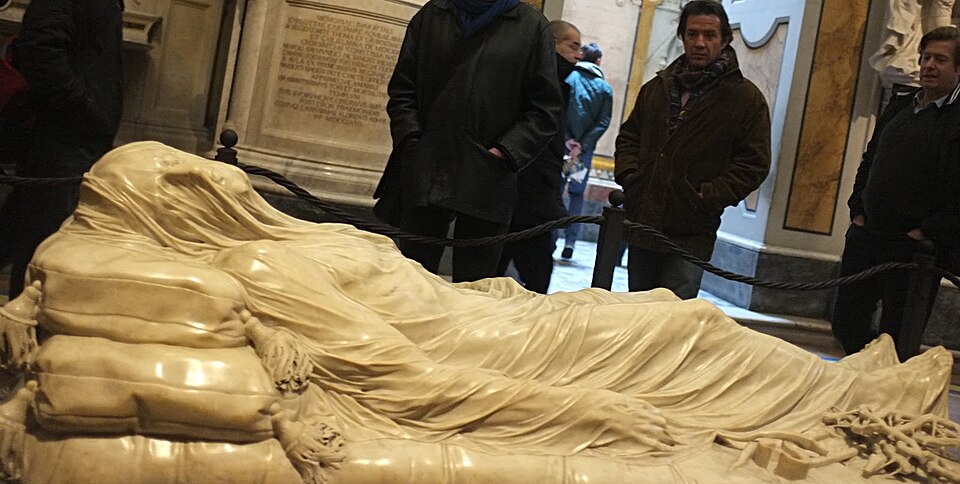
In 1753, in the small Cappella Sansevero in Naples, a wealthy nobleman named Raimondo di Sangro unveiled the centerpiece of a chapel he had spent years rebuilding: a life-sized marble effigy of the dead Christ, lying beneath a shroud so thin and so wet-looking that it seemed to cling to every contour of the body underneath.
The project had not begun with the man who finished it. Di Sangro originally commissioned the sculptor Antonio Corradini to create the piece, and Corradini produced a small terracotta model — a bozzetto — now preserved in the Museo Nazionale di San Martino. But Corradini died shortly afterward, leaving the commission unfinished and the block of marble untouched.
The task then fell to a young Neapolitan sculptor named Giuseppe Sanmartino. His instructions were exact and demanding: carve 'a marble statue sculpted with the greatest realism, representing Our Lord Jesus Christ in death, covered by a transparent shroud carved from the same block of stone as the statue.' There would be no separate pieces, no assembly — the veil and the body beneath it had to emerge from a single mass of white marble.
Sanmartino adapted Corradini's earlier model but pushed it into something far more haunting. He carved Christ lying on a couch, the veil draped over him so precisely that it reveals rather than conceals — the sunken cheeks, the strained tendons, the marks of suffering endured on the cross all visible through the stone 'cloth.' At Christ's feet, Sanmartino added the instruments of the Passion: pliers, shackles, and the crown of thorns, each rendered in the same unforgiving marble.
When the statue was placed at the center of the chapel's nave, where it remains today, it was met with astonishment. Viewers struggled to reconcile what they saw with what they knew to be true — that this was solid stone, not wet fabric. The illusion was so complete that rumors began to spread: surely the prince, a known scholar of alchemy fascinated by the secrets of the cosmos, had draped a real veil over a real body and then transmuted the cloth into marble through some hidden alchemical process.
More from Art

The Painting With No Foreground
A single robed figure stares out at an empty grey sea — and the emptiness itself became a scandal. When it was unveiled in Berlin in 1810, no one knew quite what to do with it.

The Painter Who Chased the Light
For a few purple minutes each evening, an American exile knelt in an English garden and raced the dying sun to paint two little girls lighting lanterns. It took him two years to finish.

When a President Became a God
Look straight up inside the U.S. Capitol dome and you will find George Washington enthroned among the clouds, surrounded by goddesses — the founding father transformed into myth.

Marble Brought Back to Life
A corpse asleep, a wing barely brushing her skin — and marble somehow learns to breathe. This is the moment Antonio Canova dared to carve.

The World Turned Upside Down
Look closely at a sixteenth-century Flemish village and you'll find a man biting a pillar, another carrying daylight in a basket, and a wife slipping a blue cloak over her husband's shoulders. Every gesture is a joke — if you know the language.

The Girl in the Glass Case
She stood two-thirds life size, dressed in a real tutu and human hair — and the critics who saw her in 1881 recoiled as if she were something obscene.