The Mirror That Signed a Marriage
A merchant, his wife, a dog, and a single burning candle — hidden in a convex mirror is a signature that turned a portrait into a legal witness.
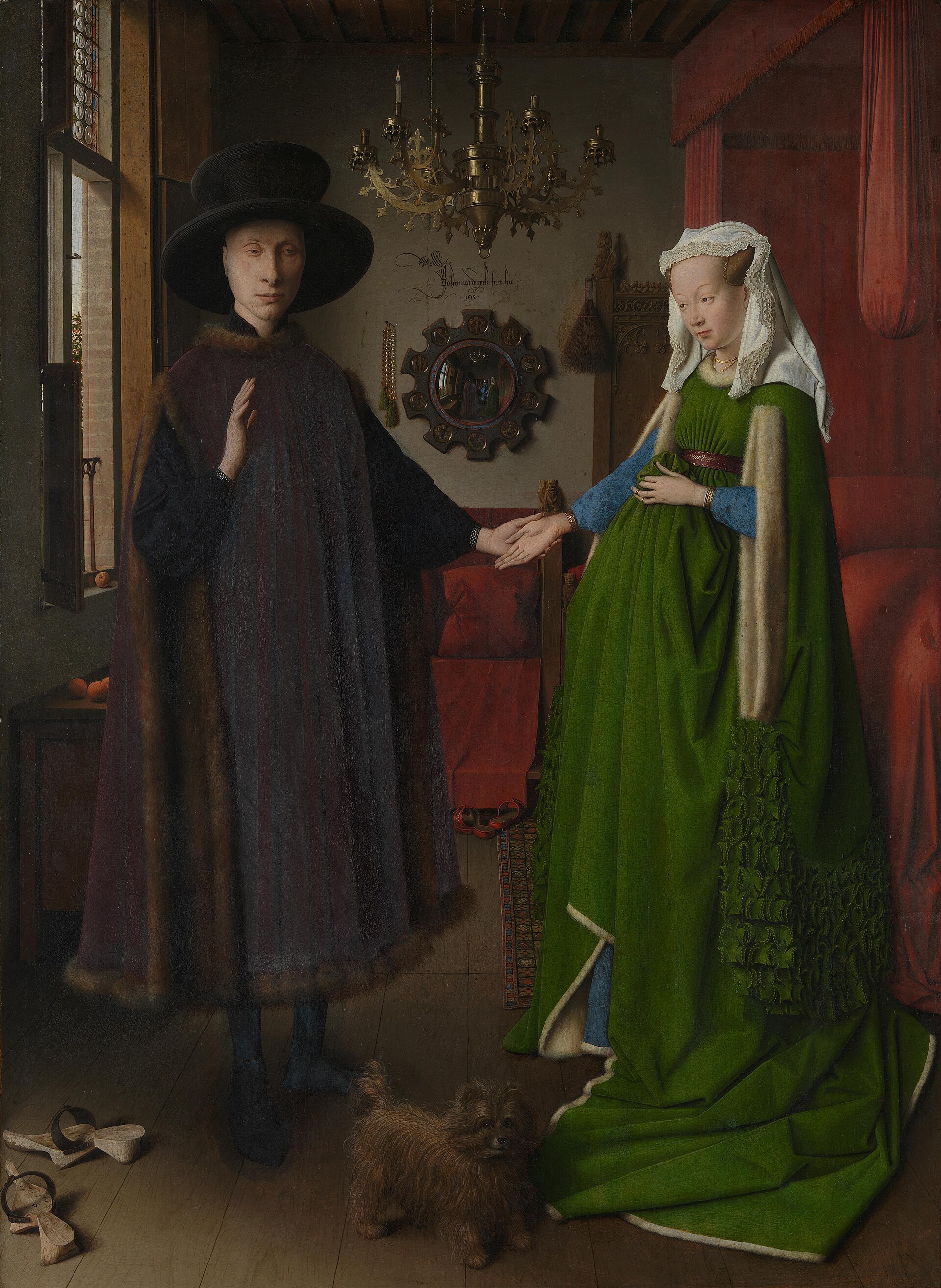
In 1434, in the Flemish city of Bruges, the painter Jan van Eyck completed a small oak panel that would puzzle and delight viewers for nearly six centuries. It shows an Italian merchant, believed to be Giovanni di Nicolao Arnolfini, standing hand in hand with his wife in an upstairs room of their home. Nothing about the scene seems staged for drama — and yet every inch of it has been picked apart by historians ever since.
Van Eyck painted in oils rather than tempera, a rare choice at the time, and it gave him extraordinary control. By layering thin, translucent glazes and blending colors wet-in-wet, he achieved a glow and precision that made fabric, fur, and brass look almost touchable. It's been suggested he even used a magnifying glass to render the tiny individual highlights on the beads hanging beside the mirror.
The couple's clothing announces their wealth without shouting it. Despite the scene being set in early summer — signaled by cherries ripening on the tree outside the window — both wear heavy fur-trimmed robes, his a tabard likely lined with sable, hers a houppelande trimmed in ermine or miniver. Their only visible jewelry is a plain gold necklace and their rings, a restraint some scholars link to the more modest style favored by Duke Philip the Good of Burgundy, whom merchants of Arnolfini's class might have wished to emulate.
The room itself is staged with signs of prosperity: an oversized brass chandelier that would likely have had a pulley-and-chain mechanism above it for lowering to manage the candles, a small oriental rug by the bed, stained-glass roundels in the window, and oranges imported at considerable expense — fruit long associated with love and marriage. A dog stands at the couple's feet, facing the viewer, widely read as a symbol of fidelity, and perhaps a literal gift from husband to wife.
But the true marvel sits at the exact center of the composition: a convex mirror, framed by ten tiny painted medallions depicting scenes from Christ's Passion. Van Eyck painted this mirror larger than any that could actually have been manufactured at the time — a deliberate departure from realism. Peer closely into its curved surface and you see the couple from behind, and beyond them, two more figures standing in the doorway. One, dressed in red, is thought to be van Eyck himself.
More from Art

The Painting With No Foreground
A single robed figure stares out at an empty grey sea — and the emptiness itself became a scandal. When it was unveiled in Berlin in 1810, no one knew quite what to do with it.

The Painter Who Chased the Light
For a few purple minutes each evening, an American exile knelt in an English garden and raced the dying sun to paint two little girls lighting lanterns. It took him two years to finish.

When a President Became a God
Look straight up inside the U.S. Capitol dome and you will find George Washington enthroned among the clouds, surrounded by goddesses — the founding father transformed into myth.

Marble Brought Back to Life
A corpse asleep, a wing barely brushing her skin — and marble somehow learns to breathe. This is the moment Antonio Canova dared to carve.

The World Turned Upside Down
Look closely at a sixteenth-century Flemish village and you'll find a man biting a pillar, another carrying daylight in a basket, and a wife slipping a blue cloak over her husband's shoulders. Every gesture is a joke — if you know the language.

The Girl in the Glass Case
She stood two-thirds life size, dressed in a real tutu and human hair — and the critics who saw her in 1881 recoiled as if she were something obscene.