The Ninth Wave: Aivazovsky's Light of Hope
Seven survivors cling to a broken mast in a raging sea, waiting for one more wave that could either drown them or save them.
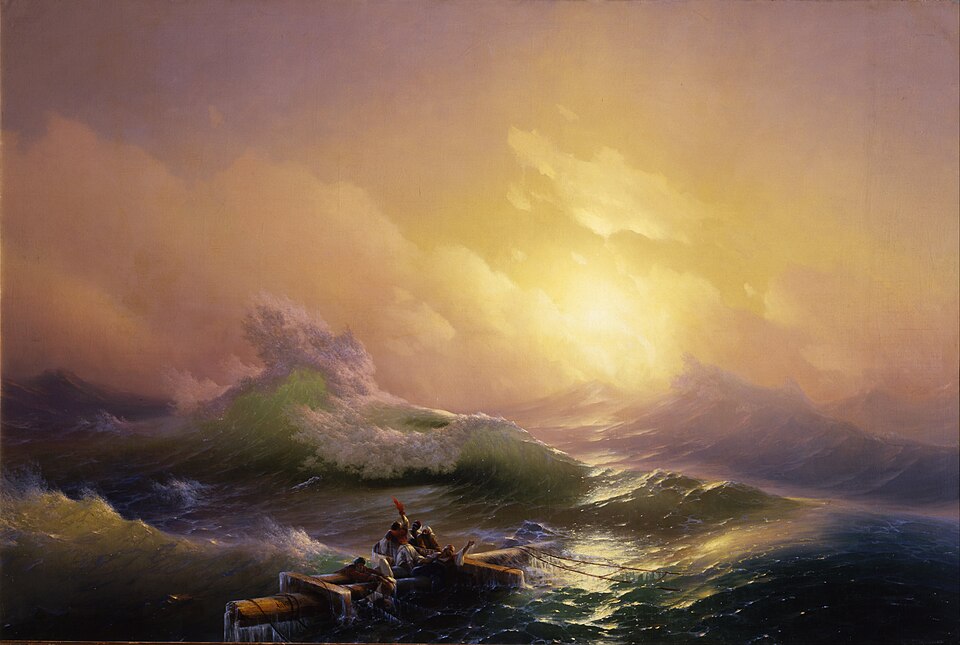
Dawn breaks over a wrecked ship, and seven people cling to the remains of its mast, tossed by a sea still churning from the night's storm. This is the scene Ivan Aivazovsky painted in 1850, a work he titled The Ninth Wave — Devyatiy val in his native Russian — which would become the single most famous image of his long career.
Aivazovsky himself was no stranger to the sea. Born in 1817 in Feodosia, Crimea, to an Armenian father, he grew up along the Black Sea coast and devoted his life to painting its moods: calm, violent, luminous, and terrifying. Few painters before or since have rendered water with such obsessive attention, and The Ninth Wave stands as the culmination of that lifelong study.
The title comes from an old sailing expression. Sailors believed that after a succession of eight incrementally larger waves, a ninth wave would arrive of extraordinary, even deadly size. Folklore held that a sailor who managed to survive this single, most dangerous wave might then receive divine mercy — that God's help would come to those who endured it.
In the painting, the debris the survivors grasp is shaped like a cross, a detail widely read as a Christian metaphor for salvation amid earthly suffering. Six people huddle on the broken mast, while a seventh swims alone toward it, struggling against the swell. One of the men on the mast waves a red turban, seemingly urging the lone swimmer onward — a small gesture of encouragement amid chaos.
The sailors' clothing reflects the Orientalist tastes fashionable in Romantic-era art, giving the figures a Muslim-style dress that situates the scene somewhere exotic and elemental rather than tied to a specific ship or nation. It is less a historical record than a meditation on human endurance against nature's indifferent power.
More from Art

The Painting With No Foreground
A single robed figure stares out at an empty grey sea — and the emptiness itself became a scandal. When it was unveiled in Berlin in 1810, no one knew quite what to do with it.

The Painter Who Chased the Light
For a few purple minutes each evening, an American exile knelt in an English garden and raced the dying sun to paint two little girls lighting lanterns. It took him two years to finish.

When a President Became a God
Look straight up inside the U.S. Capitol dome and you will find George Washington enthroned among the clouds, surrounded by goddesses — the founding father transformed into myth.

Marble Brought Back to Life
A corpse asleep, a wing barely brushing her skin — and marble somehow learns to breathe. This is the moment Antonio Canova dared to carve.

The World Turned Upside Down
Look closely at a sixteenth-century Flemish village and you'll find a man biting a pillar, another carrying daylight in a basket, and a wife slipping a blue cloak over her husband's shoulders. Every gesture is a joke — if you know the language.

The Girl in the Glass Case
She stood two-thirds life size, dressed in a real tutu and human hair — and the critics who saw her in 1881 recoiled as if she were something obscene.