The Nude Woman of Titian's Studio
She stares straight at you, unbothered by her own nakedness — and for nearly five centuries, viewers have argued about who she was, and why she seems so unashamed.
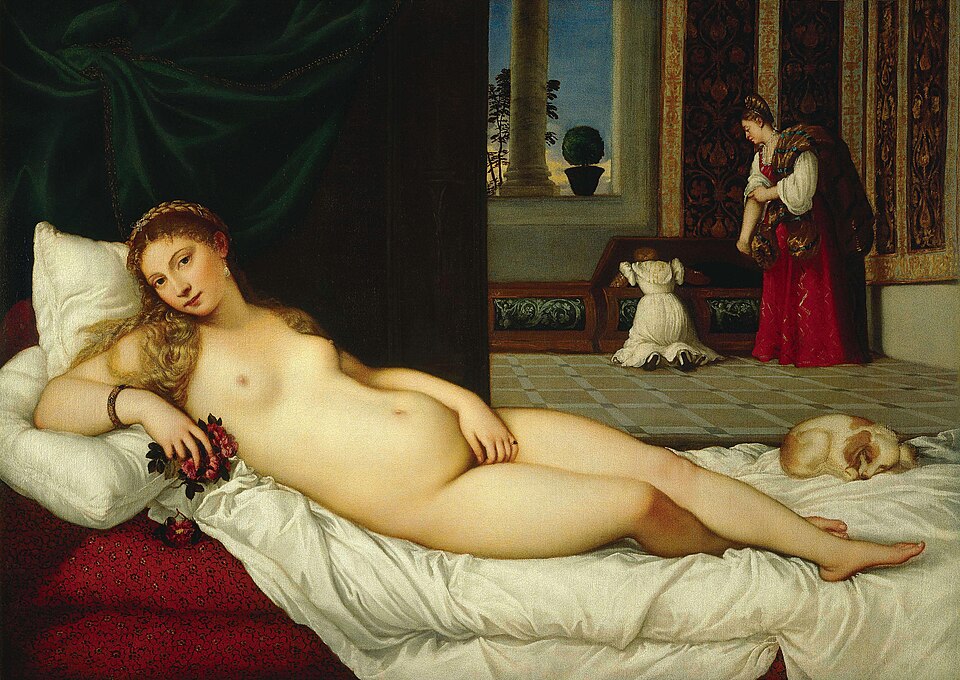
In January 1538, a 24-year-old man named Guidobaldo II della Rovere arrived at Titian's studio in Venice to sit for a portrait. While there, he saw something else: a reclining nude woman that had been sitting in the studio, unsold, for years. He referred to it simply as 'the nude woman.' Letters from him and his mother show he was extremely keen to buy it, worried Titian might sell it to someone else, and he eventually did buy it, though only some months later. When his father died that same year, Guidobaldo inherited the Duchy of Urbino, and the painting took on the name we know today — though it was mostly kept in Pesaro, not Urbino itself.
The work itself had begun far earlier, around 1532 or 1534, and was perhaps completed as early as 1534 — meaning it sat finished, or nearly so, in Titian's studio for several years before Guidobaldo ever saw it. Titian had been doing work for Ippolito de' Medici, a young cardinal more interested in soldiering and diplomacy than priesthood. On 20 October 1532, Ippolito spent a night in Venice with Angela del Moro, known as Angela Zaffetta, one of the city's leading courtesans and an occasional dinner companion of Titian and his friend the writer Aretino. It seems likely Titian was asked — or decided on his own — to paint a nude portrait of her to accompany Ippolito's commissioned likeness.
By December 1534, Titian wrote to Ippolito's chamberlain in Rome, saying he'd been working on a painting of a woman for the cardinal. But Ippolito died in August 1535 without ever seeing it. The canvas remained in Titian's studio for years until Guidobaldo walked in and claimed it in 1538.
The pose itself borrows from an earlier work, the Dresden Venus, made around 1510–11 and traditionally credited to Giorgione, with its landscape finished by Titian. But where that earlier nude gazes away, distant and dreamlike, Titian's woman meets the viewer's eyes directly. She holds a posy of roses in one hand; her other hand rests over her genitals in a gesture some scholars have read as far more than modesty. Behind her, a small dog sleeps at the foot of the bed — traditionally a symbol of fidelity — while in the background two maids rummage through a cassone, the kind of chest used to store a bride's trousseau.
That detail has fueled one major theory: that the painting isn't a courtesan's portrait at all, but a marriage picture. Some scholars, including Rona Goffen, have argued the woman's gesture alludes to Renaissance beliefs that female arousal — even self-stimulation — helped ensure conception, making the image a kind of erotic wedding blessing tied to Guidobaldo's 1534 marriage to ten-year-old Giulia Varano, or its later consummation. Others have pushed further, with Józef Grabski proposing the painting is an allegory of marital love between poet Vittoria Colonna and her dead husband, pointing to a column in the window that echoes the Colonna family crest.
More from Art

The Painting With No Foreground
A single robed figure stares out at an empty grey sea — and the emptiness itself became a scandal. When it was unveiled in Berlin in 1810, no one knew quite what to do with it.

The Painter Who Chased the Light
For a few purple minutes each evening, an American exile knelt in an English garden and raced the dying sun to paint two little girls lighting lanterns. It took him two years to finish.

When a President Became a God
Look straight up inside the U.S. Capitol dome and you will find George Washington enthroned among the clouds, surrounded by goddesses — the founding father transformed into myth.

Marble Brought Back to Life
A corpse asleep, a wing barely brushing her skin — and marble somehow learns to breathe. This is the moment Antonio Canova dared to carve.

The World Turned Upside Down
Look closely at a sixteenth-century Flemish village and you'll find a man biting a pillar, another carrying daylight in a basket, and a wife slipping a blue cloak over her husband's shoulders. Every gesture is a joke — if you know the language.

The Girl in the Glass Case
She stood two-thirds life size, dressed in a real tutu and human hair — and the critics who saw her in 1881 recoiled as if she were something obscene.