The Ocean That Gave Up Immortality
When a slighted sage's curse stripped the gods of their power, heaven and hell struck an uneasy bargain — to churn an entire ocean of milk for the secret of eternal life.
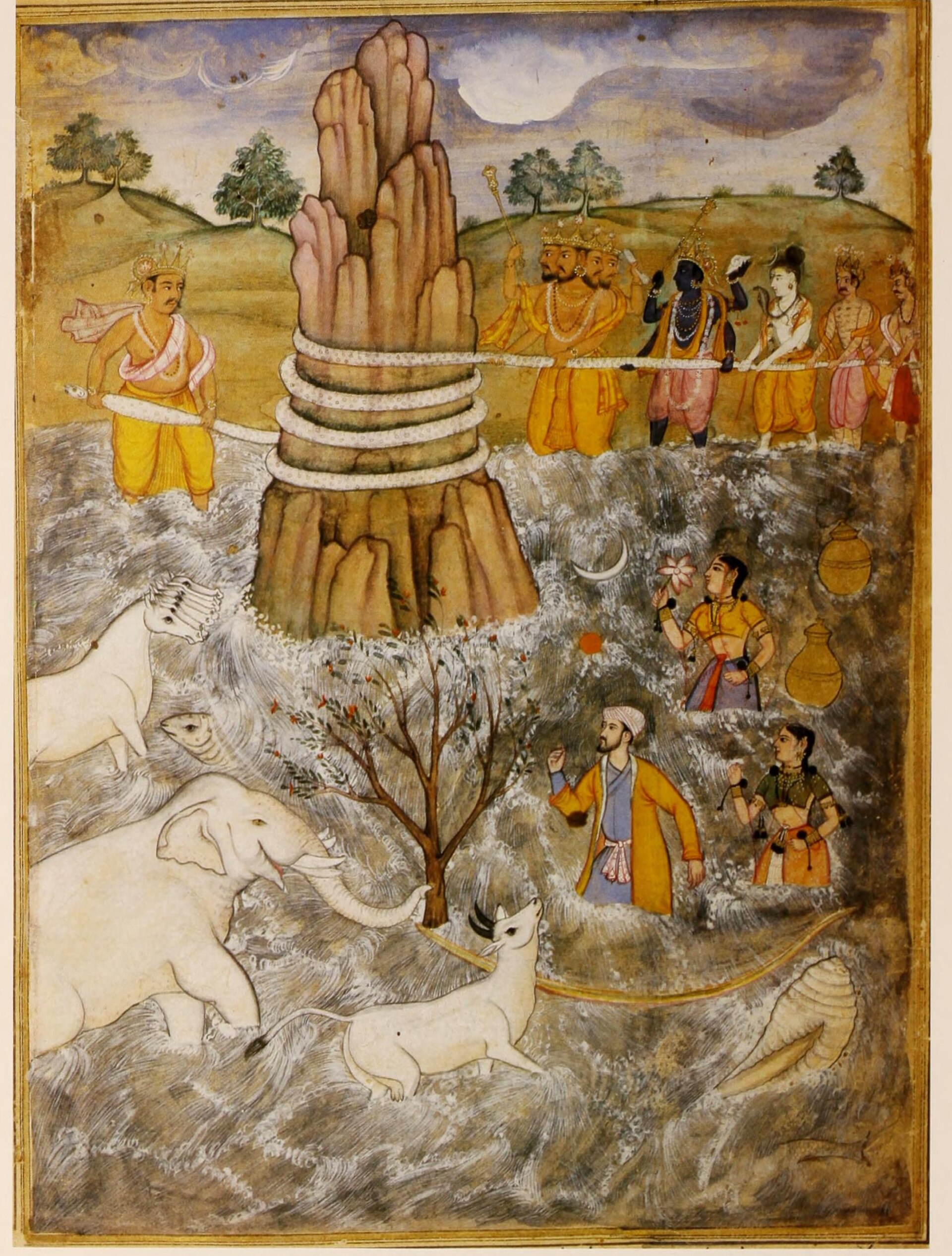
It began, as so many upheavals do, with an insult too small to seem dangerous. Indra, King of Svarga, riding his elephant Airavata, met the sage Durvasa, who pressed upon him a fragrant garland from an apsara. Indra placed it on his elephant's trunk in a show of humility, but the scent drew bees, and the irritated Airavata flung the sacred garland to the ground. Durvasa, seeing his offering treated as refuse, was enraged: the garland was a dwelling place of Sri, the goddess of fortune. She vanished into the ocean, and Durvasa cursed Indra and all the devas to lose their strength, their energy, and their luck.
Stripped of their power, the devas fell before the asuras, whose king Bali seized control of the three worlds. Desperate, the devas turned to Vishnu, who counseled diplomacy rather than war. His plan was audacious: an alliance between gods and demons to churn the entire Ocean of Milk together and share whatever nectar of immortality emerged. Privately, Vishnu assured the devas he would see to it that the amrita ended up in their hands alone.
The churning demanded titanic tools. Mount Mandara was uprooted to serve as the churning rod, and Vasuki, the serpent who lived coiled around Shiva's neck, agreed to become the churning rope in exchange for a promised share of the spoils. Simply transporting the mountain proved lethal — devas and asuras died from the strain and the fall — until Vishnu, mounted on Garuda, revived the fallen and carried Mandara himself to the ocean's center.
Even then, the mountain sank under its own weight into the depths. Vishnu solved this by taking the form of Kurma, a great turtle, and bearing Mandara on his shell. Vasuki coiled around the mountain, and Vishnu arranged the teams: devas at the serpent's head, asuras at the tail. The asuras balked at the tail as an ill omen, so the devas conceded the position, and the churning began, rotating the mountain and stirring the primordial sea.
The first thing to surface was not treasure but catastrophe: halahala, a poison so virulent it threatened to unmake all creation, pouring from Vasuki's mouth as the churning intensified. Both devas and asuras were sickened by the fumes. It was Shiva who stepped forward and swallowed the poison to save the three worlds, an act that turned his throat permanently blue and earned him the name Neelakantha, the blue-throated one.
More from Mythology

The Doctor Who Sang a Nation Into Being
A country doctor rode into the forests of Karelia armed with nothing but a notebook — and rode out with the soul of a nation.

The Boat That Carried the Sun
Every sunset, the ancient Egyptians believed, the sun climbed into a boat and sailed straight into the realm of the dead — only to fight a monstrous serpent before dawn could return.

The Wild Man of the Snows
At 21,000 feet, a colonel found tracks in the snow that he blamed on a wolf — but his guides knew better, and gave the world a name that would echo for a century.

The Knight Who Went Mad for Love: Orlando Furioso
A hero so devoted to duty he was Charlemagne's greatest paladin loses his mind—not to a sword wound, but to heartbreak. To cure him, a friend must ride a flying horse to the Moon.

The Book That Turned the World Into Myth
A poet condemned to exile spent his final years in Rome finishing a poem that would outlive empires—a poem about nothing standing still, not gods, not lovers, not even the shape of a man.

Paradise Lost: Milton's Rebel Angel
A blind poet, dictating verses in the dark, dared to explain the ways of God to men — and in doing so, made Hell's ruler unforgettable.