The Painting That Fought Back
A twenty-year-old woman picked up a brush and turned an Old Testament assassination into the most physically brutal image the Baroque had ever seen.
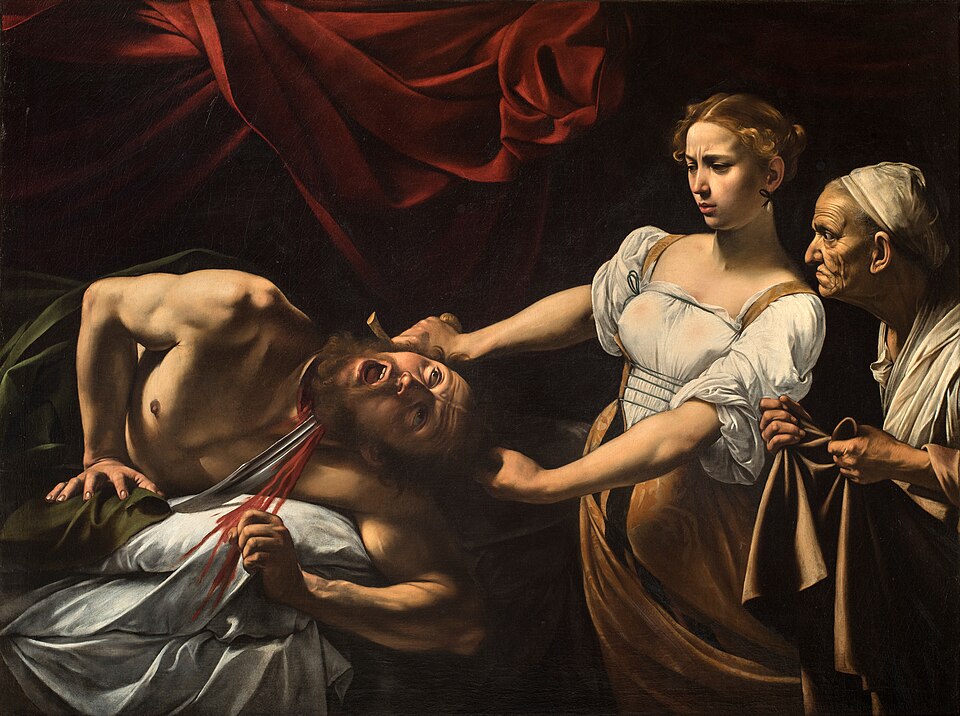
In a studio somewhere in Rome, Artemisia Gentileschi was around twenty years old when she painted what would become one of the defining images of the Baroque era: Judith Slaying Holofernes, completed in 1612–13. The canvas depicts a single violent instant from the deuterocanonical Book of Judith — the moment when the Israelite heroine Judith, aided by her maidservant Abra, beheads the sleeping Assyrian general Holofernes, who had fallen into a drunken stupor.
Gentileschi was no novice by this point. She had already painted Susanna and the Elders and a Madonna and Child, works that revealed her growing command of bodies in motion and faces caught in emotion. But Judith Slaying Holofernes pushed further. Judith occupies the right side of the canvas, actively restraining Holofernes as she performs the beheading, while Abra pins him down from behind. X-rays later revealed that Gentileschi reworked the composition multiple times — adjusting the position of Judith's arms and the fall of the drapery — before settling on the final, taut arrangement.
The painting is built on ferocious chiaroscuro: pools of darkness swallow the background while harsh light falls on the straining bodies, the twisted sheets, the struggle itself. Nothing is softened. The lighting does not merely illuminate the scene — it insists on the physical effort of killing a man, the resistance of muscle and bone against blade.
The subject itself was well-worn territory in Renaissance and Baroque art, but earlier artists had rarely approached it this way. Lucas Cranach the Elder painted Judith holding Holofernes' severed head with composed restraint, emphasizing her chastity and virtue rather than violence. Donatello's sculpture of Judith standing over her victim functioned as a moral warning against tyranny and pride, tied to Florence's Medici politics. Even Caravaggio, whose Judith Beheading Holofernes is considered a major influence on later Baroque interpretations including Gentileschi's, kept a degree of psychological distance in his staging.
Gentileschi did not. Art historian Mary Garrard has argued that her composition emphasizes Judith's active, physical role in the killing far more than any male predecessor dared. Where Caravaggio built dramatic tension through naturalism and stark light, Gentileschi intensified the bodily engagement — Judith is not a distant executioner but a woman gripping, cutting, straining, with Abra's hands as complicit as her own.
More from Art

The Painting With No Foreground
A single robed figure stares out at an empty grey sea — and the emptiness itself became a scandal. When it was unveiled in Berlin in 1810, no one knew quite what to do with it.

The Painter Who Chased the Light
For a few purple minutes each evening, an American exile knelt in an English garden and raced the dying sun to paint two little girls lighting lanterns. It took him two years to finish.

When a President Became a God
Look straight up inside the U.S. Capitol dome and you will find George Washington enthroned among the clouds, surrounded by goddesses — the founding father transformed into myth.

Marble Brought Back to Life
A corpse asleep, a wing barely brushing her skin — and marble somehow learns to breathe. This is the moment Antonio Canova dared to carve.

The World Turned Upside Down
Look closely at a sixteenth-century Flemish village and you'll find a man biting a pillar, another carrying daylight in a basket, and a wife slipping a blue cloak over her husband's shoulders. Every gesture is a joke — if you know the language.

The Girl in the Glass Case
She stood two-thirds life size, dressed in a real tutu and human hair — and the critics who saw her in 1881 recoiled as if she were something obscene.