The Painting That Hid in a Dining Room
For two hundred years, one of Caravaggio's greatest paintings was lost to history — hanging, unrecognized, above the dinner plates of Dublin priests.
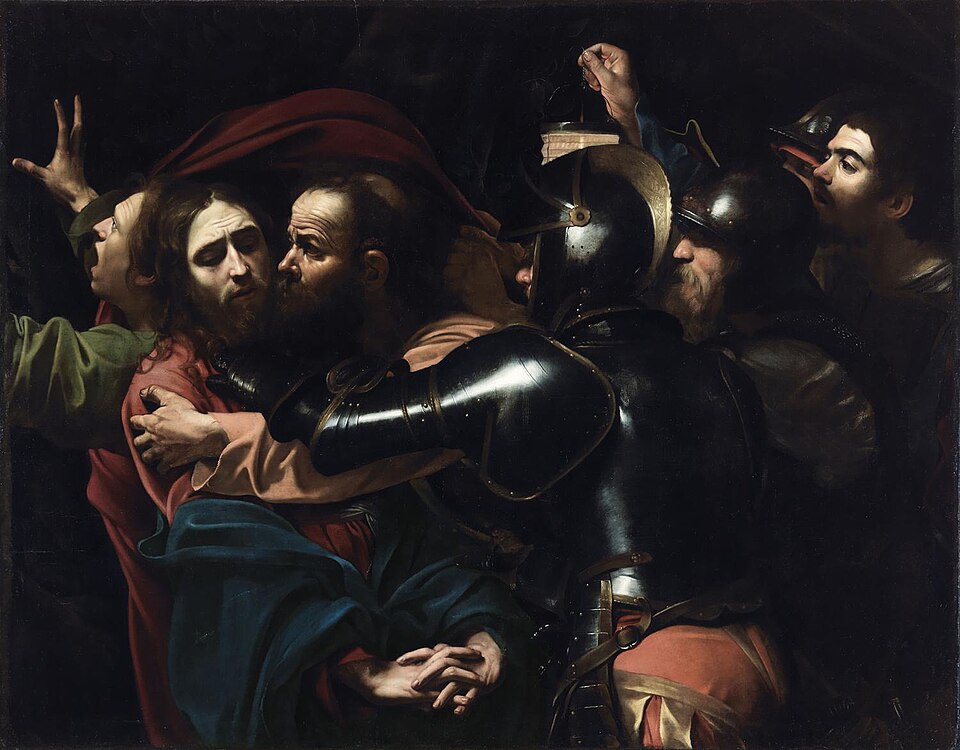
In the darkness of a garden, a kiss becomes a betrayal. Judas leans in, his lips meeting the cheek of Jesus, and in that instant a soldier's gauntleted arm reaches across the canvas to seize his prey. To the left, John flees in terror, his cloak snatched back by a soldier's grip, his mouth open in a silent cry. At the far right, a man holds up a lantern to illuminate the scene — believed to be a self-portrait of Caravaggio, presumably representing Saint Peter, who would first betray Jesus by denying him, and then go on to bring the light of Christ to the world.
Caravaggio painted The Taking of Christ in 1602, commissioned by the Roman nobleman Ciriaco Mattei. Seven figures crowd the composition: John, Jesus, Judas, three soldiers, and the lantern-bearer. The scene is bathed in the artist's signature theatrical darkness, lit by an unseen source from the upper left and by the lantern's warmer glow. Scholars have long puzzled over two details — the way the heads of Jesus and John seem to melt together in the shadowed upper corner, and the startling prominence of a soldier's polished metal shoulder armor, gleaming at the very center of the canvas.
Franco Mormando has suggested that this polished pauldron functions as a kind of mirror, inviting viewers to see their own reflection — and their own complicity in betrayal — staring back at them. Susan Gubar has written that Caravaggio's self-portrait as the lantern-bearer underscores humankind's shared guilt with Judas. One scholar has even argued that the painting suggests a sinner living 1,500 years after the resurrection may understand Christ better than his own frightened friend does. The composition's central trio — Christ, Judas, and the soldier's outstretched arm — echoes a 1509 woodcut by Albrecht Dürer.
By the late eighteenth century, the painting had vanished from the historical record. In 1786, an observer named Giuseppe Vasi misattributed it to Gerard van Honthorst, a Dutch follower of Caravaggio, and this error was repeated in a Mattei family inventory in 1793. In 1802, the Mattei family sold the piece — still believed to be a Honthorst — to William Hamilton Nisbet, in whose Scottish home it hung until 1921.
The painting's journey then took an unexpected turn. Later in the 1920s, still unrecognized as a Caravaggio, it was purchased by Marie Lea-Wilson, an Irish paediatrician. Her husband, Captain Percival Lea-Wilson, a District Inspector in the Royal Irish Constabulary, had been shot by the Irish Republican Army in Gorey, County Wexford, on 15 June 1920. In gratitude for the support she received from the Jesuit Fathers afterward, she donated the painting to them in the 1930s. It hung, unremarked, in the Jesuit dining room on Leeson Street in Dublin for roughly sixty years.
More from Art

The Painting With No Foreground
A single robed figure stares out at an empty grey sea — and the emptiness itself became a scandal. When it was unveiled in Berlin in 1810, no one knew quite what to do with it.

The Painter Who Chased the Light
For a few purple minutes each evening, an American exile knelt in an English garden and raced the dying sun to paint two little girls lighting lanterns. It took him two years to finish.

When a President Became a God
Look straight up inside the U.S. Capitol dome and you will find George Washington enthroned among the clouds, surrounded by goddesses — the founding father transformed into myth.

Marble Brought Back to Life
A corpse asleep, a wing barely brushing her skin — and marble somehow learns to breathe. This is the moment Antonio Canova dared to carve.

The World Turned Upside Down
Look closely at a sixteenth-century Flemish village and you'll find a man biting a pillar, another carrying daylight in a basket, and a wife slipping a blue cloak over her husband's shoulders. Every gesture is a joke — if you know the language.

The Girl in the Glass Case
She stood two-thirds life size, dressed in a real tutu and human hair — and the critics who saw her in 1881 recoiled as if she were something obscene.