The Painting That Refused to Leave
Two slashes scar her cheek, and for six centuries the icon has been called the reason horses stopped and armies faltered. This is the story of Poland's Black Madonna.
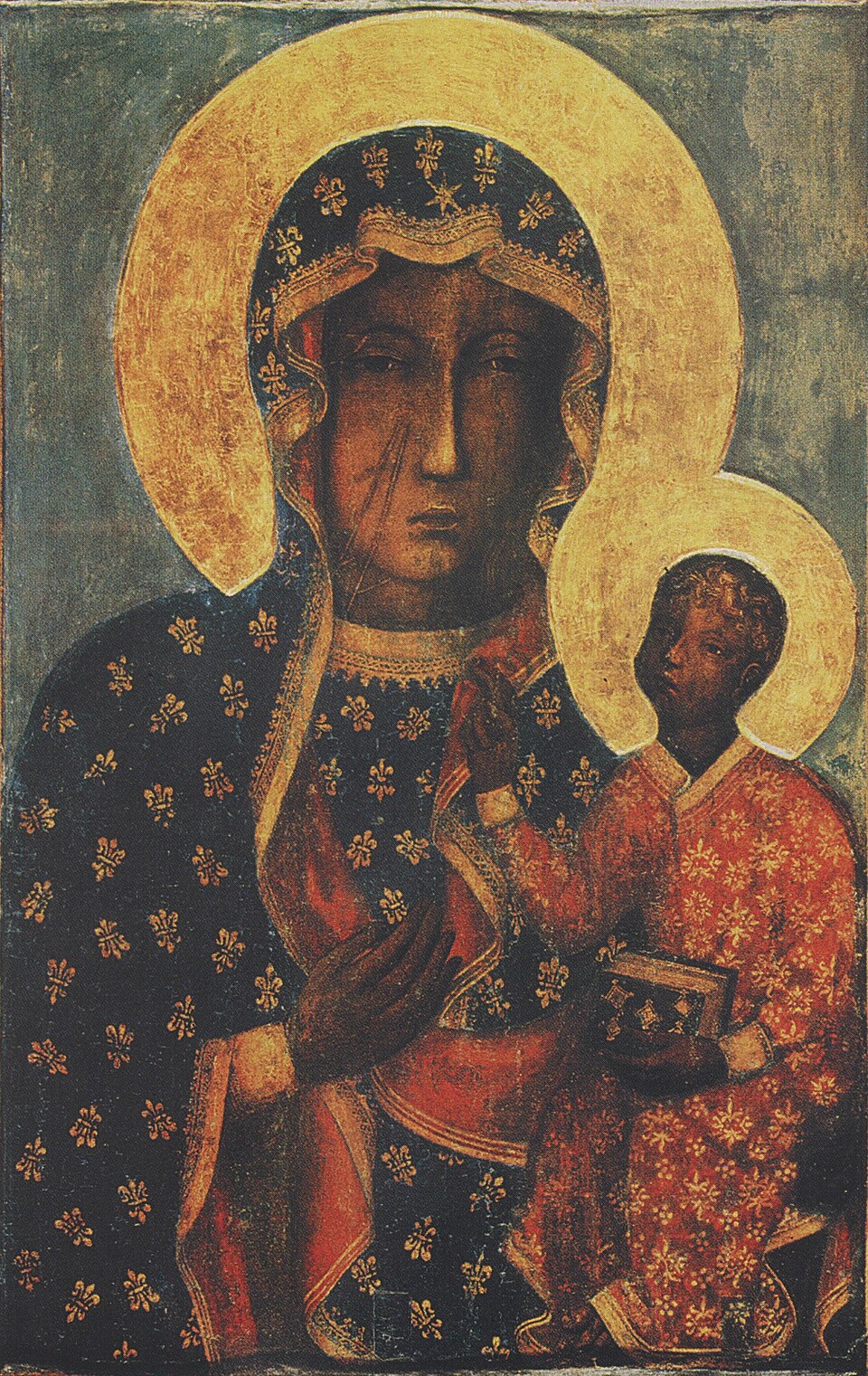
Legend begins the story long before Poland does. According to the Lucan tradition, Luke the Evangelist painted the image on a cedar tabletop taken from the house of the Holy Family. The same legend says Helena discovered the painting in Jerusalem in 326 and carried it to Constantinople, presenting it to her son, Constantine the Great. Art historians tell a more grounded version: the original was a Byzantine icon created sometime in the sixth to ninth century, its true authorship lost to time.
However it began, the painting's documented history starts with its arrival in Europe's borderlands. The oldest documents from Jasna Góra trace the icon's journey from Constantinople through Belz, where Ukrainian sources say it had been brought with great ceremony by King Lev I of Galicia. It later came into the hands of Władysław Opolczyk, Duke of Opole, an adviser to Louis of Anjou, King of Poland and Hungary, who is said to have taken it from the Castle of Belz once the town became part of the Polish kingdom.
A famous story tells that in late August 1384, Władysław was passing through Częstochowa with the icon when his horses simply refused to move any farther. That night, he was advised in a dream to leave the image at Jasna Góra. He did. Art historians agree that it was indeed Władysław who brought the painting to the monastery in the 14th century, whatever the truth of the dream.
The hilltop church itself had passed, in August 1382, to the Paulites, a hermitic order from Hungary. This detail matters: the golden fleur-de-lis painted on the Virgin's blue veil echo the heraldic emblem of the French royal house, and historians believe the icon had spent time in Hungary during the reigns of the Anjou kings Charles I or Louis the Great, who likely had their family's lily added to the image. It is possible, then, that the Pauline monks themselves carried the icon to Jasna Góra from their founding monastery in Hungary.
The painting nearly did not survive the century. In 1430, robbers severely damaged it, breaking the wooden panel and slashing the image itself. Medieval restorers, unfamiliar with the original encaustic technique, found their new paint simply sloughed off, according to the chronicler Risinius. Their solution was drastic: they erased what remained of the original and repainted the entire surface on the same panel, softening the Orthodox features and giving Mary a more aquiline nose. One scholar, Zygmunt Holcer, has even proposed that the restorers modeled her face on Queen Jadwiga of Anjou, who had died in 1399 and whose canonization was then under preliminary consideration — making the fleur-de-lis a deliberate dynastic symbol.
More from Art

The Painting With No Foreground
A single robed figure stares out at an empty grey sea — and the emptiness itself became a scandal. When it was unveiled in Berlin in 1810, no one knew quite what to do with it.

The Painter Who Chased the Light
For a few purple minutes each evening, an American exile knelt in an English garden and raced the dying sun to paint two little girls lighting lanterns. It took him two years to finish.

When a President Became a God
Look straight up inside the U.S. Capitol dome and you will find George Washington enthroned among the clouds, surrounded by goddesses — the founding father transformed into myth.

Marble Brought Back to Life
A corpse asleep, a wing barely brushing her skin — and marble somehow learns to breathe. This is the moment Antonio Canova dared to carve.

The World Turned Upside Down
Look closely at a sixteenth-century Flemish village and you'll find a man biting a pillar, another carrying daylight in a basket, and a wife slipping a blue cloak over her husband's shoulders. Every gesture is a joke — if you know the language.

The Girl in the Glass Case
She stood two-thirds life size, dressed in a real tutu and human hair — and the critics who saw her in 1881 recoiled as if she were something obscene.