The Painting That Vanished Twice
A country road, two anonymous laborers, and a canvas so radical it may have been destroyed by war before anyone could agree on what happened to it.
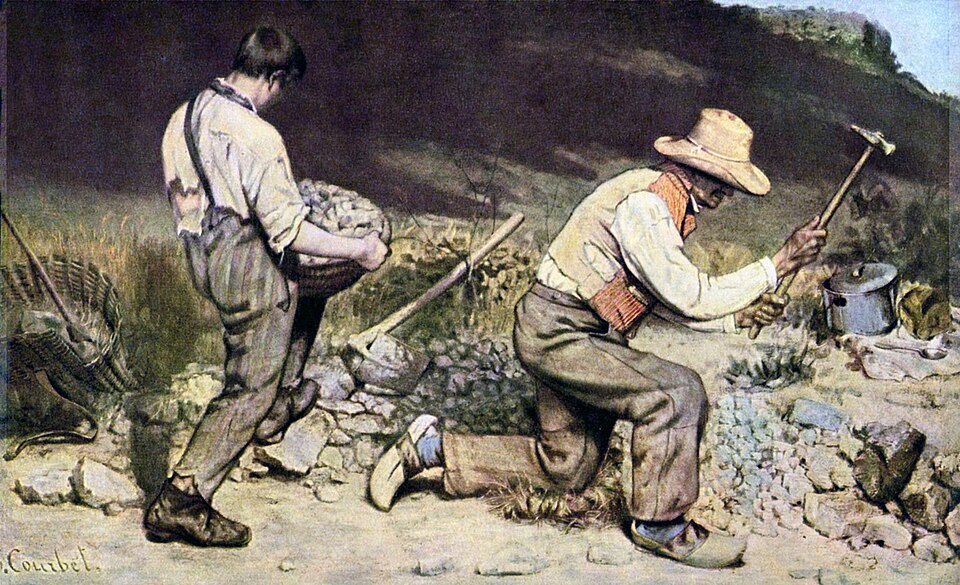
In November 1849, Gustave Courbet was riding in his carriage toward the Château of Saint-Denis, intent on painting a landscape, when he stopped near Maisières to watch two men breaking stones along the road. He later wrote to his friends Francis and Marie Wey that he had rarely encountered so complete an expression of poverty, and that the sight gave him an idea for a painting on the spot. He arranged to meet the men in his studio the next morning, and from that meeting came The Stone Breakers.
Courbet was already committed to what he called 'my way of seeing' — a devotion to painting only what existed before him. He insisted he could not paint an angel because he had never seen one. This conviction shaped The Stone Breakers into something startling for its time: not a scene of myth or history, but two ordinary road workers, an old man and a young man, shown breaking rocks in tattered clothes and worn wooden clogs.
Courbet described the figures himself: an old man of seventy, bent over his work, sledgehammer raised, skin parched by the sun, his head shaded by a straw hat, his coarse trousers entirely patched, his cracked sabots revealing bare heels through socks once blue. Beside him stood a young man with swarthy skin. Neither man's face was shown — a choice that made them stand not as individuals but as representatives of laboring peasants everywhere.
When the painting was exhibited at the Paris Salon of 1850–1851, it provoked sharp division. Critics objected to its subject matter, deeming manual laborers unworthy of serious art, and complained about Courbet's thick application of paint and the picture's dim lighting. The press even mocked the painting, exaggerating the size of the wooden clogs worn by one of the men into caricature. Yet the social theorist Pierre-Joseph Proudhon saw something else entirely: he praised the work as a masterpiece of its genre, reading it as a successful socialist painting that exposed the injustice of peasant life.
The unease critics felt may have been deliberate. The long-handled hammers and rocks in the men's hands could be read as tools of labor or as implements verging on weapons. Courbet's refusal to individualize the workers' faces reinforced the sense that this was not a portrait but a statement about class and toil. By 1915, the painting had come to be regarded as a genuinely important work in the history of art.
More from Art

The Painting With No Foreground
A single robed figure stares out at an empty grey sea — and the emptiness itself became a scandal. When it was unveiled in Berlin in 1810, no one knew quite what to do with it.

The Painter Who Chased the Light
For a few purple minutes each evening, an American exile knelt in an English garden and raced the dying sun to paint two little girls lighting lanterns. It took him two years to finish.

When a President Became a God
Look straight up inside the U.S. Capitol dome and you will find George Washington enthroned among the clouds, surrounded by goddesses — the founding father transformed into myth.

Marble Brought Back to Life
A corpse asleep, a wing barely brushing her skin — and marble somehow learns to breathe. This is the moment Antonio Canova dared to carve.

The World Turned Upside Down
Look closely at a sixteenth-century Flemish village and you'll find a man biting a pillar, another carrying daylight in a basket, and a wife slipping a blue cloak over her husband's shoulders. Every gesture is a joke — if you know the language.

The Girl in the Glass Case
She stood two-thirds life size, dressed in a real tutu and human hair — and the critics who saw her in 1881 recoiled as if she were something obscene.