The Painting That Whispered a Prayer
At the top of a staircase, in near-darkness, an angel stoops toward a girl — and monks passing by were commanded, in painted Latin letters, never to walk past without a prayer.
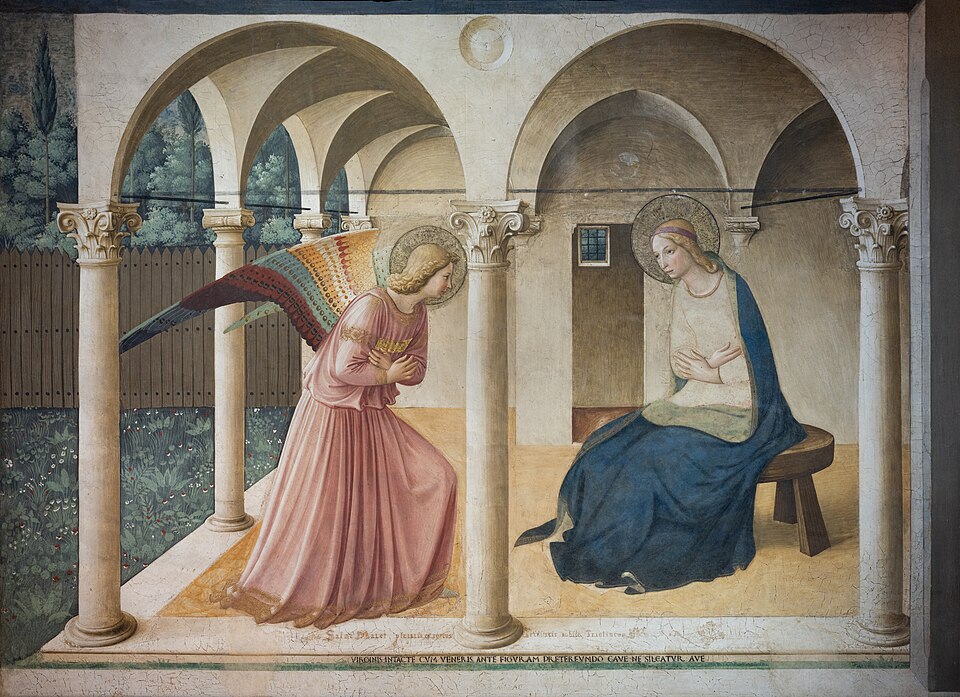
Sometime around 1440, in the Convent of San Marco in Florence, a Dominican friar named Fra Angelico climbed to the top of a stairway leading to the dormitories and began to paint. Cosimo de' Medici had rebuilt the convent and commissioned Angelico to cover its walls with frescoes — roughly fifty in all, spread across the altarpiece, the friars' cells, the cloister, the chapter house, and the corridors. Of everything he made there, one image would come to define his legacy: the Annunciation on the north corridor wall.
It was not his first attempt at the subject, nor his last; his Annunciations are scattered in museums from Florence to the Prado. But Fra Angelico is credited with inventing a wholly new way of composing the scene. Gothic tradition placed Gabriel and Mary indoors, Mary enthroned, the figures flat and static, floating without spatial logic, their lines never resolving into a vanishing point. Angelico broke this. He set the encounter outdoors, in a cloister, and gave it a sense of real, breathable space — a hinge between the Gothic world and the Renaissance.
The fresco sits at the top of the stairs on the first floor, on the north side of the dormitories — one of only three Angelico placed in the open corridor rather than inside a private cell. The staircase itself has been altered many times, including changes to its windows that shifted how much light reaches the painting. This mattered enormously, because the fresco was meant to be seen in near-darkness. Angelico painted an invisible light source into the scene itself, so that friars viewing it by candle or dusk would need no further illumination. Modern lighting, installed from multiple angles, has made the experience unrecognizable to what the friars once knew.
Placement was deliberate. By setting the Annunciation where every friar climbing to the dormitories would pass it, Angelico pulled the sacred scene into the rhythm of daily monastic life. Lighter, brighter paintings of the era were made for decoration; darker ones were made for reflection and prayer. This one belonged to the second category.
Inside the cells, Angelico worked with restraint — images meant purely for contemplation, meditation, and reflection on poverty. Gold leaf and azurite, expensive luxury materials, were reserved for Cosimo de' Medici's private cell and for frescoes in the public corridors. Even so, the north dormitory Annunciation remained relatively subdued, fitting its place within a convent built on humility.
More from Art

The Painting With No Foreground
A single robed figure stares out at an empty grey sea — and the emptiness itself became a scandal. When it was unveiled in Berlin in 1810, no one knew quite what to do with it.

The Painter Who Chased the Light
For a few purple minutes each evening, an American exile knelt in an English garden and raced the dying sun to paint two little girls lighting lanterns. It took him two years to finish.

When a President Became a God
Look straight up inside the U.S. Capitol dome and you will find George Washington enthroned among the clouds, surrounded by goddesses — the founding father transformed into myth.

Marble Brought Back to Life
A corpse asleep, a wing barely brushing her skin — and marble somehow learns to breathe. This is the moment Antonio Canova dared to carve.

The World Turned Upside Down
Look closely at a sixteenth-century Flemish village and you'll find a man biting a pillar, another carrying daylight in a basket, and a wife slipping a blue cloak over her husband's shoulders. Every gesture is a joke — if you know the language.

The Girl in the Glass Case
She stood two-thirds life size, dressed in a real tutu and human hair — and the critics who saw her in 1881 recoiled as if she were something obscene.