The Poem That Swallowed a World
Ten times longer than the Iliad and Odyssey combined, it claims to hold every truth ever needed — and somehow still keeps growing.
Long before anyone wrote it down, the Mahābhārata lived in the mouths of charioteer bards, men called sutas who served kings as advisors, genealogists, and storytellers. They sang of a war between cousins, the Kauravas and the Pāṇḍavas, descendants of a common ancestor named Bharata, and the tale grew in the telling the way rivers grow from tributaries, gathering myths, philosophy, and digression as it moved through centuries.
The epic frames itself as a story within a story. It is first recited at Takshashila by the sage Vaisampayana, a disciple of the legendary author Vyasa, to King Janamejaya, great-grandson of the Pāṇḍava prince Arjuna. Later still, a professional storyteller named Ugrashrava Sauti retells it to sages gathered in the Naimisha Forest for a twelve-year sacrifice. Nested tellings within tellings — the structure itself insists that this story has always been passed hand to hand, voice to voice.
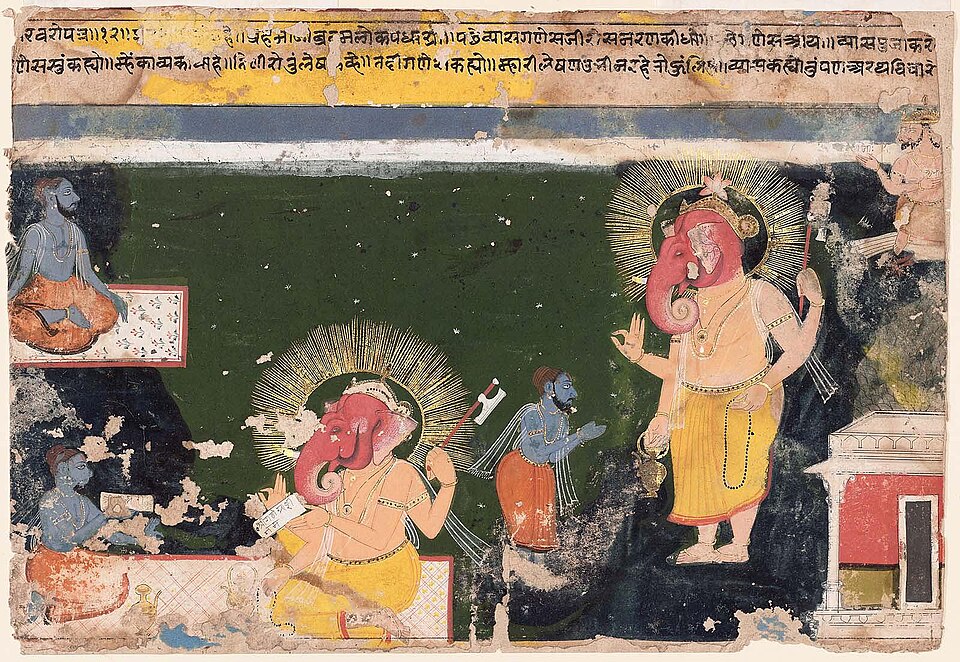
Tradition credits authorship to the sage Vyāsa, who appears as a character within his own epic and who, according to the text's opening section, dictated it to the elephant-headed god Ganesha — a detail modern scholars regard as a later addition, absent from the critical edition. Vyasa called his work an itihasa, a history, and wove into it the Guru-shishya tradition tracing the great teachers of Vedic times back through their students.
Scholars believe the core of the story reaches back to a time not far from the 8th or 9th century BCE, after the earliest Vedic period but before India's first empires arose. The bulk of the text was likely compiled between the 3rd century BCE and the 3rd century CE, with its oldest surviving fragments no older than roughly 400 BCE, and it probably reached the form we know by the early Gupta period, around the 4th century CE. The Mahābhārata itself distinguishes an inner core of 24,000 verses — the 'Bharata proper' — from the vast secondary material layered around it, and tradition speaks of at least three redactions: an 8,800-verse Jaya attributed to Vyasa, a 24,000-verse Bharata recited by Vaisampayana, and finally the full Mahābhārata of over 100,000 verses recited by Sauti.{}
That final number is staggering on its own terms. The longest version runs past 100,000 shlokas, more than 200,000 individual lines, plus long stretches of prose — roughly 1.8 million words, about ten times the combined length of the Iliad and the Odyssey, some four times the length of the Rāmāyaṇa. Only the Epic of Manas outlasts it. Within Indian tradition it is sometimes honored as a fifth Veda.
More from Mythology

The Doctor Who Sang a Nation Into Being
A country doctor rode into the forests of Karelia armed with nothing but a notebook — and rode out with the soul of a nation.

The Boat That Carried the Sun
Every sunset, the ancient Egyptians believed, the sun climbed into a boat and sailed straight into the realm of the dead — only to fight a monstrous serpent before dawn could return.

The Wild Man of the Snows
At 21,000 feet, a colonel found tracks in the snow that he blamed on a wolf — but his guides knew better, and gave the world a name that would echo for a century.

The Knight Who Went Mad for Love: Orlando Furioso
A hero so devoted to duty he was Charlemagne's greatest paladin loses his mind—not to a sword wound, but to heartbreak. To cure him, a friend must ride a flying horse to the Moon.

The Book That Turned the World Into Myth
A poet condemned to exile spent his final years in Rome finishing a poem that would outlive empires—a poem about nothing standing still, not gods, not lovers, not even the shape of a man.

Paradise Lost: Milton's Rebel Angel
A blind poet, dictating verses in the dark, dared to explain the ways of God to men — and in doing so, made Hell's ruler unforgettable.