The Potato Eaters: Van Gogh's Dark Beginning
Five figures huddle under a single oil lamp, hands that dug the earth now lifting its harvest to their mouths — and a young painter stakes his reputation on their coarseness.
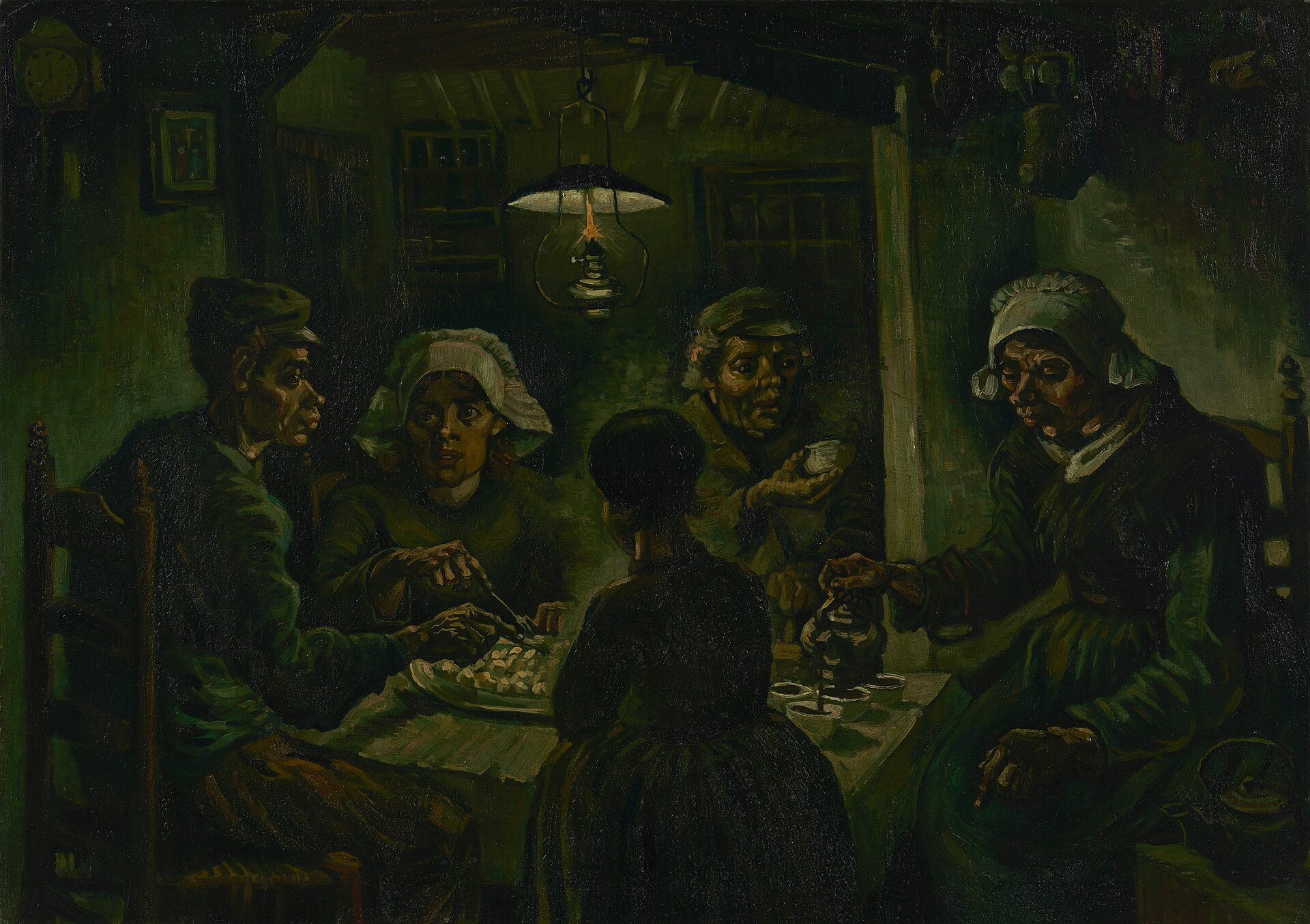
In the spring of 1885, in the rural Dutch town of Nuenen, Vincent van Gogh sat with his parents and began work on a painting that would come to define his early career. He had spent March and early April sketching studies, sending them to his brother Theo in Paris — who was unimpressed. Undeterred, Van Gogh pressed on, working on the canvas from 13 April until the beginning of May 1885, later returning to make small brushwork adjustments.
The finished painting, The Potato Eaters, shows five peasants gathered around a table under a small hanging lamp: two men, two women, and a girl, sharing potatoes and coffee. Van Gogh was explicit about his intent. He wanted viewers to understand that these people, eating potatoes by lamplight, had tilled the earth themselves with the very hands now reaching into the dish — that the meal represented honest, manual labour.
He rejected any temptation toward prettification. Anyone wanting 'insipidly pretty peasants' could look elsewhere, he said; he believed painting them in their coarseness produced better, truer results than conventional sweetness. To Van Gogh, a peasant girl in a dusty, patched blue skirt was more beautiful than a lady in silk, because the patches carried the genuine marks of weather, wind, and sun.
He carried this philosophy into his description of what a peasant painting should smell like: bacon, smoke, the steam of potatoes — not perfume. This was the aesthetic guiding every rough hand, every furrowed face in the composition. Before painting it, Van Gogh had already made a lithograph of the same scene, completed from memory in a single day, sent to his brother and referenced in letters to friends.
His roots for this style lay not in Impressionism, a movement he admitted he didn't fully understand at the time, but in the Hague School artists like Anton Mauve and Jozef Israëls, whose peasant-family table scenes he admired. Israëls had painted a similar subject, A Peasant Family at the Table, which Van Gogh may have seen before beginning his own work.
More from Art

The Painting With No Foreground
A single robed figure stares out at an empty grey sea — and the emptiness itself became a scandal. When it was unveiled in Berlin in 1810, no one knew quite what to do with it.

The Painter Who Chased the Light
For a few purple minutes each evening, an American exile knelt in an English garden and raced the dying sun to paint two little girls lighting lanterns. It took him two years to finish.

When a President Became a God
Look straight up inside the U.S. Capitol dome and you will find George Washington enthroned among the clouds, surrounded by goddesses — the founding father transformed into myth.

Marble Brought Back to Life
A corpse asleep, a wing barely brushing her skin — and marble somehow learns to breathe. This is the moment Antonio Canova dared to carve.

The World Turned Upside Down
Look closely at a sixteenth-century Flemish village and you'll find a man biting a pillar, another carrying daylight in a basket, and a wife slipping a blue cloak over her husband's shoulders. Every gesture is a joke — if you know the language.

The Girl in the Glass Case
She stood two-thirds life size, dressed in a real tutu and human hair — and the critics who saw her in 1881 recoiled as if she were something obscene.