The Raft of Human Ruin
Fifteen men, a splintered raft, and thirteen days of horror at sea — one painting turned a national scandal into art history's most damning indictment.
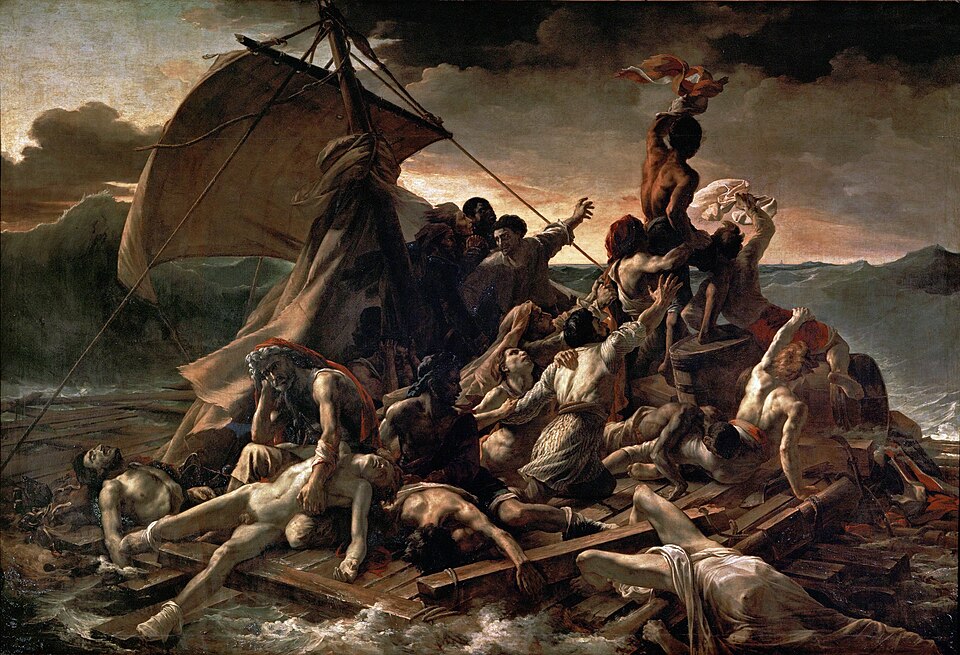
In June 1816, the French frigate Méduse set sail from Rochefort bound for Senegal, carrying the newly appointed colonial governor and hundreds of passengers under the command of Viscount Hugues Duroy de Chaumareys — a royalist émigré who had barely sailed in twenty years. His appointment was a matter of political favor, not merit, and it would prove catastrophic. Pushing ahead of its escort ships to make good time, the Méduse drifted 160 kilometers off course and, on 2 July, ran aground on a sandbank off the coast of what is now Mauritania.
The ship carried roughly 400 people but lifeboats for only 250. The rest — at least 146 men and one woman, including half a garrison of marine infantry — were crowded onto a hastily built raft that sank partway under their weight once launched on 5 July. The boats towing the raft cut it loose after only a few miles, abandoning its occupants with a single sack of biscuit, six casks of wine, and two casks of water soon lost in the chaos.
What followed was, in the words of critic Jonathan Miles, a journey 'to the frontiers of human experience.' Starving, dehydrated, and crazed, the survivors mutinied, killed the weakest among them, and resorted to cannibalism. By the fourth day, dozens had already died or been thrown overboard. On 17 July, after thirteen days, the brig Argus stumbled upon the raft by pure chance — no organized rescue had been mounted. Only fifteen people remained alive.
The wreck became a national scandal, its blame falling squarely on Chaumareys's incompetence and the political cronyism of the newly restored Bourbon monarchy. Two survivors, Henri Savigny and Alexandre Corréard, published an account of their ordeal — and it was this story that captured the imagination of Théodore Géricault, a young painter fascinated by the wreck.
Géricault approached the subject with the rigor of an investigator. He interviewed Savigny and Corréard directly, built a detailed scale model of the raft, and — determined to render suffering and death with total accuracy — sketched corpses in the morgue of the Beaujon Hospital, even bringing severed limbs into his studio to study their decay. Friends served as models: painter Eugène Delacroix posed for the prone, arm-flung figure in the foreground, while Savigny and Corréard themselves appear in the shadows near the raft's mast. He completed the work in 1818-1819, at the age of 27.
More from Art

The Painting With No Foreground
A single robed figure stares out at an empty grey sea — and the emptiness itself became a scandal. When it was unveiled in Berlin in 1810, no one knew quite what to do with it.

The Painter Who Chased the Light
For a few purple minutes each evening, an American exile knelt in an English garden and raced the dying sun to paint two little girls lighting lanterns. It took him two years to finish.

When a President Became a God
Look straight up inside the U.S. Capitol dome and you will find George Washington enthroned among the clouds, surrounded by goddesses — the founding father transformed into myth.

Marble Brought Back to Life
A corpse asleep, a wing barely brushing her skin — and marble somehow learns to breathe. This is the moment Antonio Canova dared to carve.

The World Turned Upside Down
Look closely at a sixteenth-century Flemish village and you'll find a man biting a pillar, another carrying daylight in a basket, and a wife slipping a blue cloak over her husband's shoulders. Every gesture is a joke — if you know the language.

The Girl in the Glass Case
She stood two-thirds life size, dressed in a real tutu and human hair — and the critics who saw her in 1881 recoiled as if she were something obscene.