The Room Where Everyone Who Ever Thought Met
Two men stand at the vanishing point of a painted archway, one pointing to the sky, the other to the earth — and around them, nearly every philosopher who ever lived seems to have wandered in from history to argue.
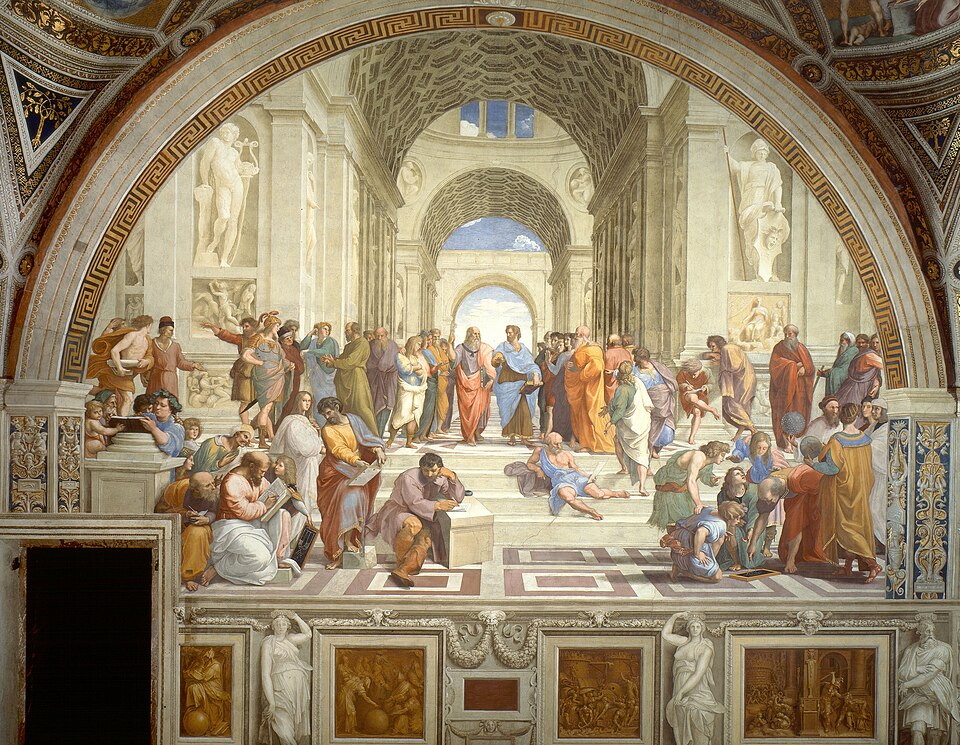
In 1509, a young painter from Urbino named Raphael arrived in Rome carrying a commission from Pope Julius II: decorate a set of rooms in the Apostolic Palace now known as the Stanze di Raffaello. One chamber, the Stanza della Segnatura, was to be his masterwork. Between 1509 and 1511, Raphael filled its walls with four frescoes representing philosophy, poetry, theology, and justice. The philosophy fresco would become the most famous of them all — later known simply as The School of Athens.
At its center walk two figures beneath a coffered Roman arch: Plato and Aristotle. Plato, gray-bearded and modeled on Leonardo da Vinci, holds his dialogue Timaeus and gestures toward the heavens. Aristotle, beside him, carries his Ethics and gestures down toward the earth. The gesture is often read as a summary of their philosophies — Plato's world of eternal forms above, Aristotle's world of physical causes below — though how deliberately Raphael intended this remains uncertain, since he left no written explanation of the work.
Surrounding the two philosophers is a crowd of more than twenty figures, ancient and Renaissance faces blended together. Socrates, recognizable from classical busts, is thought to be conversing with a cluster of listeners. Pythagoras sits in the foreground writing in a book. Euclid, bent over a slate demonstrating geometry, is believed to bear the likeness of the architect Bramante. Ptolemy stands nearby holding a globe, and beside him, gazing straight out at the viewer, is a young man in a dark cap — Raphael's own self-portrait.
Not every identity is certain. A brooding figure resting his head on a marble block, alone and separate from the crowd, is generally identified as Heraclitus, and is believed to have been modeled on Michelangelo, whose Sistine Chapel ceiling Raphael reportedly glimpsed while it was still underway nearby. Other figures have been proposed as Averroes, Zoroaster, Diogenes sprawled on the steps, and even Alexander the Great. One enigmatic figure in a white robe on the left, the only person in the whole composition looking directly at the viewer, has never been conclusively identified — proposed as either the ancient philosopher Hypatia or Francesco Maria I della Rovere, the pope's nephew.
What unites this improbable gathering — spanning centuries, cities, and schools of thought that often contradicted each other — is not a real historical event but an idea: that ancient Greek philosophy, seeking 'knowledge of causes,' could be reborn under one roof, in one continuous perspective space that seems to extend into the viewer's own room. Raphael achieved this illusion using precise perspective projection, a technique he had absorbed from Leonardo da Vinci, whose pursuits in geometry, optics, and anatomy shaped the intellectual atmosphere Raphael was painting into being.
More from Art

The Painting With No Foreground
A single robed figure stares out at an empty grey sea — and the emptiness itself became a scandal. When it was unveiled in Berlin in 1810, no one knew quite what to do with it.

The Painter Who Chased the Light
For a few purple minutes each evening, an American exile knelt in an English garden and raced the dying sun to paint two little girls lighting lanterns. It took him two years to finish.

When a President Became a God
Look straight up inside the U.S. Capitol dome and you will find George Washington enthroned among the clouds, surrounded by goddesses — the founding father transformed into myth.

Marble Brought Back to Life
A corpse asleep, a wing barely brushing her skin — and marble somehow learns to breathe. This is the moment Antonio Canova dared to carve.

The World Turned Upside Down
Look closely at a sixteenth-century Flemish village and you'll find a man biting a pillar, another carrying daylight in a basket, and a wife slipping a blue cloak over her husband's shoulders. Every gesture is a joke — if you know the language.

The Girl in the Glass Case
She stood two-thirds life size, dressed in a real tutu and human hair — and the critics who saw her in 1881 recoiled as if she were something obscene.