The Room Where the King Watched Himself Being Watched
A painter stares out of his own canvas, brush raised, and somewhere behind him a mirror holds the faces of a king and queen who may or may not really be standing there.
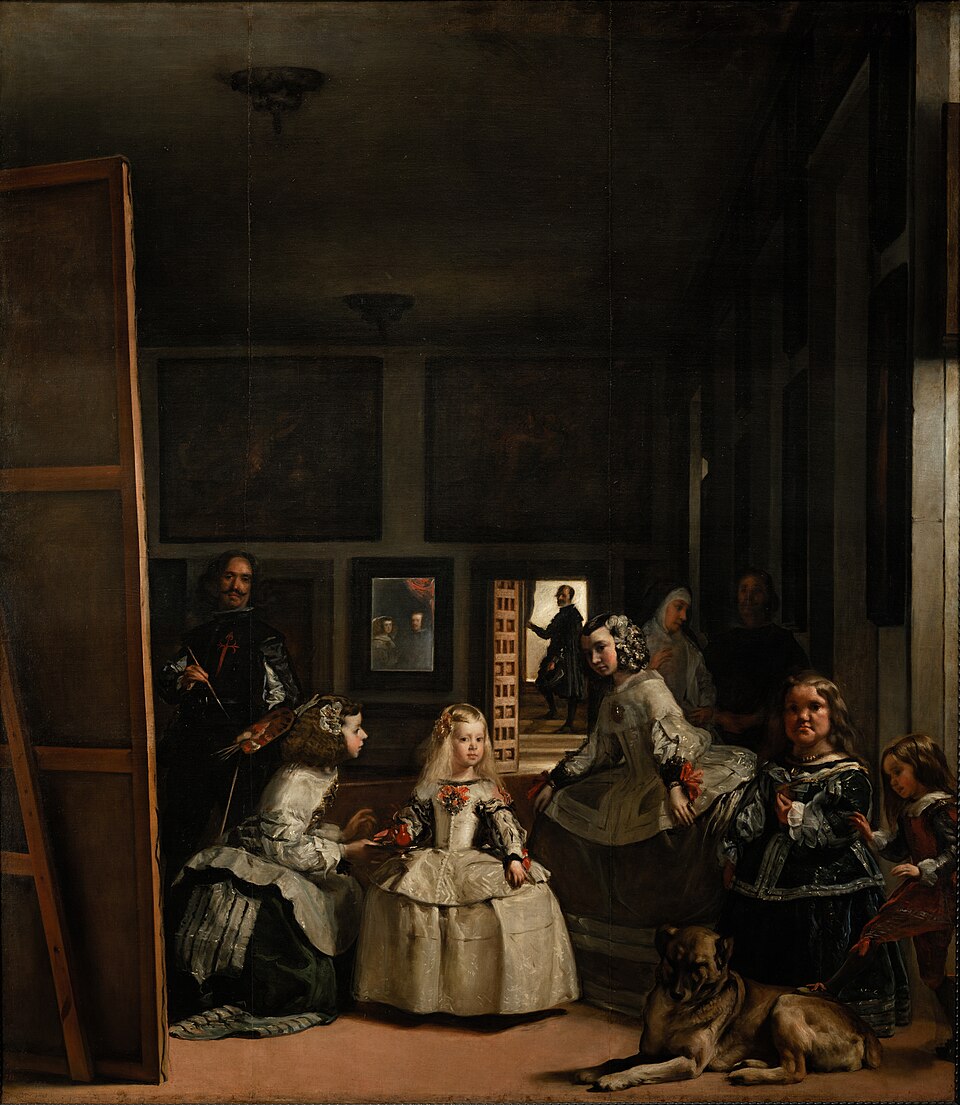
In 1656, in a room of Madrid's Royal Alcázar once belonging to a dead prince, Diego Velázquez set up his easel and painted something that had no obvious precedent: a picture of the act of painting itself. Las Meninas — 'The Ladies-in-waiting' — shows eleven figures caught in a single suspended moment, as if the canvas were a snapshot rather than a composition. At its center stands five-year-old Infanta Margaret Theresa, the only child of King Philip IV and his second wife, Mariana of Austria, at the time the work was made.
Around the infanta cluster her entourage: two meninas, Doña Isabel de Velasco and Doña María Agustina Sarmiento de Sotomayor, one offering her a drink from a red cup, the other caught mid-curtsy; a chaperone; two dwarfs; a dog; and, near the doorway, José Nieto Velázquez, thought to be a relative of the painter, frozen on a staircase in a pose that leaves it unclear whether he is arriving or leaving. Just behind the group, Velázquez has painted himself at a large canvas, looking outward past the picture plane to wherever a viewer might stand.
The painting's most debated detail is small: a mirror on the back wall reflecting the upper bodies of Philip IV and Mariana. Scholars have long argued about what exactly that mirror shows — the king and queen standing where the viewer stands, posing for their own portrait, or merely a reflection of the very canvas Velázquez is shown working on. The ambiguity is deliberate enough that it has never been resolved.
Velázquez did not come to this commanding position easily. In seventeenth-century Spain, painting was considered a craft, not a liberal art, and painters held little social status. Velázquez spent decades climbing the ranks of Philip IV's court, becoming, in February 1651, palace chamberlain — a post of real prestige that also ate into his time for painting. He doubled as curator of the king's growing art collection, sourcing, attributing and hanging works that would later form the core of the Prado's holdings, including paintings by Titian, Raphael and Rubens.
Philip IV's household had been marked by loss: his first wife, Elizabeth of France, died in 1644, and their son and heir, Balthasar Charles, died just two years later. His 1649 marriage to Mariana of Austria produced Margaret Theresa, and later two more children, one of whom, Charles, would eventually inherit the throne. Philip gave Velázquez the run of the late prince's old main room as a studio, kept his own chair there, and reportedly liked to sit and watch the painter work — a closeness unusual for a king so bound by court etiquette.
More from Art

The Painting With No Foreground
A single robed figure stares out at an empty grey sea — and the emptiness itself became a scandal. When it was unveiled in Berlin in 1810, no one knew quite what to do with it.

The Painter Who Chased the Light
For a few purple minutes each evening, an American exile knelt in an English garden and raced the dying sun to paint two little girls lighting lanterns. It took him two years to finish.

When a President Became a God
Look straight up inside the U.S. Capitol dome and you will find George Washington enthroned among the clouds, surrounded by goddesses — the founding father transformed into myth.

Marble Brought Back to Life
A corpse asleep, a wing barely brushing her skin — and marble somehow learns to breathe. This is the moment Antonio Canova dared to carve.

The World Turned Upside Down
Look closely at a sixteenth-century Flemish village and you'll find a man biting a pillar, another carrying daylight in a basket, and a wife slipping a blue cloak over her husband's shoulders. Every gesture is a joke — if you know the language.

The Girl in the Glass Case
She stood two-thirds life size, dressed in a real tutu and human hair — and the critics who saw her in 1881 recoiled as if she were something obscene.